Monday
10 August, 2026
News Flash
News Flash
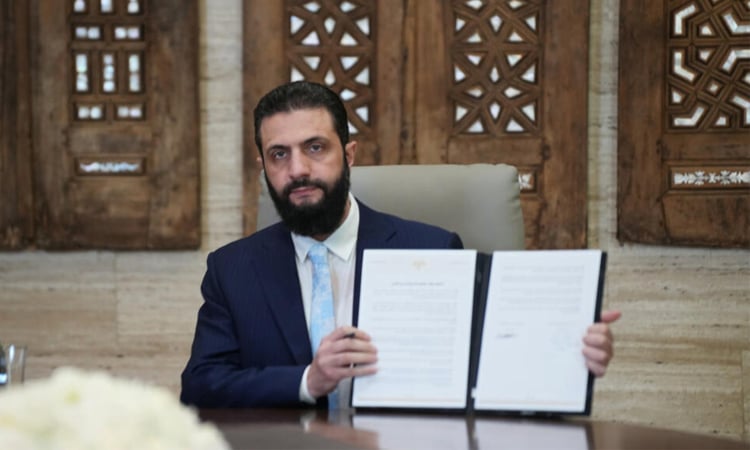
DAMASCUS, Jan 19, 2026 (BSS/AFP) - Syrian President Ahmed al-Sharaa on Sunday announced a deal with the chief of Kurdish-led forces that includes a ceasefire, after government troops advanced across Kurdish-held areas of the country's north and east.
Syrian Kurdish leader Mazloum Abdi said he agreed to the deal to avoid a broader war.
He made the decision after deadly clashes in the Syrian city of Raqa Sunday between Kurdish-led forces and local fighters loyal to Damascus, and fighting this month between the Kurds and government forces.
The agreement will also see the Kurdish administration and forces integrate into the state after months of stalled negotiations on the issue.
But it marks a blow for the minority, which has long held ambitions of preserving the de facto autonomy they had exercised over areas they held for over a decade.
Sharaa announced the agreement to reporters on Sunday.
He said had had been scheduled to meet Abdi, who heads the Kurdish-led Syrian Democratic Forces (SDF), but that it had been postponed until Monday due to poor weather.
"In order to calm the situation, we decided to sign the agreement," Sharaa said.
Abdi said in a statement broadcast by Kurdish television channel Ronahi that "in order for this war not to turn into civil war... we accepted to withdraw from the Deir Ezzor and Raqa regions to Hasakeh".
He said he would explain the deal's details to Syria's Kurds after returning from Damascus.
- 'Pivotal' -
Government forces this weekend captured the strategic city of Tabqa in the Raqa region as well as the Euphrates Dam. They also advanced into parts of Deir Ezzor province, including the Al-Omar oil field, the country's largest, having earlier made advances in Aleppo province.
Syrian state media reported celebrations in some areas after the deal's announcement, including in Raqa city where state media had earlier said SDF gunfire had killed two civilians.
The Syrian Observatory for Human Rights monitor had reported fighting between the SDF and "local Arab tribal fighters" in the city.
Sharaa on Sunday met US envoy Tom Barrack, who called the deal with the Kurds a "pivotal inflection point".
The envoy, whose country has long supported the Kurdish forces but also backs Syria's new Islamist authorities, had met Abdi in Erbil on Saturday.
The Syrian presidency published the text of the 14-point agreement, which includes integrating the SDF and Kurdish security forces into the state and the immediate handover of Kurdish-run Deir Ezzor and Raqa provinces.
It will also see Damascus take responsibility for Islamic State group prisoners and their families held in Kurdish-run jails and camps.
Alexander McKeever, researcher and author of the This Week in Northern Syria newsletter, said the deal "falls significantly short of what the SDF had established over the years in the northeast, as well as the decentralised scenario it had been pushing for in negotiations".
Sharaa had on Friday issued a decree granting the Kurds official recognition, but the Kurds said the announcement fell short of their expectations.
Earlier Sunday, an AFP correspondent on Raqa's outskirts reported hearing gunfire and said government forces had brought reinforcements and were combing parts of the city.
The SDF suddenly withdrew "from all areas under its control in the eastern Deir Ezzor countryside, including the Al-Omar and Tanak oil fields", Observatory chief Rami Abdel Rahman told AFP.
He said the movements in Deir Ezzor and Raqa provinces came as "fighters from local tribes, including Arab fighters who are part of the SDF, advanced in coordination with government troops".
Deir Ezzor province said all public institutions were closed Sunday and urged people to stay home.
- 'Opening door wide' -
The government push captured Arab-majority areas that came under Kurdish control during the fight against IS.
Damascus also said it retook the Safyan and Al-Tharwa oil fields in Raqa province.
Energy Minister Mohammad al-Bashir said the return of the area's resources to state control "means opening the door wide for reconstruction, revitalising agriculture, energy and trade".
The army also announced its control of the Euphrates Dam near Tabqa, a key water and energy facility that includes one of Syria's largest hydroelectric power stations.
An AFP correspondent had seen armoured vehicles and tanks around Tabqa, with security personnel patrolling the streets.
Shops were closed, but some residents milled outside their homes, lighting fires to keep warm.
Resident Ahmad Hussein told AFP: "We have suffered a lot, and I hope that the situation will improve with the arrival of the Syrian army."
Near the dam, an AFP photographer saw residents destroying a statue honouring a woman who fought with Kurdish forces and who was killed by IS during the battle for Raqa city.