Wednesday
05 August, 2026
News Flash
News Flash
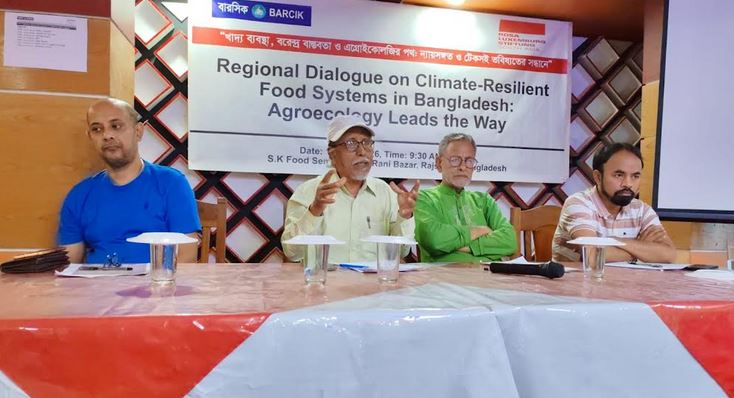
RAJSHAHI, May 11, 2026 (BSS)- Social think-tank’s at a participatory discussion here today unanimously said there is no alternative to formulating a national policy to promote agro-ecological practices regionally and to protect life and the environment.
They came up with the observation while addressing a regional dialogue titled “Regional Dialogue on Climate-Resilient Food Systems in Bangladesh: Agro-ecology Leads the Way” held at S.K. Food Seminar Hall with the aim of building a climate-resilient food system in Bangladesh.
The dialogue was organized by the development research organization BARCIK, with support from Rosa Luxemburg Stiftung South Asia. Farmers, researchers, development workers, civil society representatives, and professionals from various sectors participated in the event.
The discussion highlighted the water crisis in the Barind region, the impacts of climate change, chemical dependency in agriculture, conservation of indigenous seeds, the role of women farmers, and the importance of an agro-ecology-based food system.
Speakers said that to address the climate crisis, it is urgent to build a food system based on local knowledge, biodiversity, low-cost agriculture, and farmer control.
Agroecology is not just a farming method, but an effective path to establishing environmental and social justice.
At the start of the dialogue, BARCIK Director Silvanus Lamin delivered the welcome address, and Shaheda Purno moderated the session.
BARCIK Policy and Research Officer Amroni Binte Azad gave a PowerPoint presentation on field experiences regarding agro-ecological crises and prospects.
Following this, participants discussed what needs to be done for agro-ecology and a climate-resilient food system in the Barind region.
The dialogue called for coordinated initiatives to build a climate-resilient, farmer-friendly, and sustainable food system.
Mahbub Siddiqui, President of Green Coalition District and river environment researcher, said: “The Barind region is one of the richest regions. Instead of water-dependent rice cultivation here, the cultivation of Rabi crops must be increased.”
He added, “To maintain agro-ecology, the environment here cannot be destroyed.”
Renuka Begum, a woman farmer from Karigar Para in Paba Upazila, said: “There is a lot of talk about women in agriculture, but women are neither valued nor given dignity in agriculture.” She demanded a separate allocation for women in agricultural policy.
Atikur Rahman, President of Barind Youth Forum, said: “To spread knowledge and experience related to agroecology, these topics must be included in our textbooks.”
He added: “A nation cannot progress without safe food and environmental protection.”
Also speaking at the dialogue were Green Coalition Convener Jamal Qaderi, Associate Professor of Anthropology at Rajshahi University Abhijit Roy, Barind Farmers’ Seed Bank President Zaidur Rahman, and other distinguished individuals.
In the concluding remarks, BARCIK Barind Region Coordinator Shahidul Islam shared his experience with agro-ecology.
He said that if laws are to be made, they must prioritize farmers’ opinions and regional contexts.