Wednesday
05 August, 2026
News Flash
News Flash
KISHOREGANJ, May 2, 2026 (BSS) - Water levels in most rivers across Kishoreganj have increased over the past 24 hours due to continuous rainfall and upstream flow, raising concerns among farmers in the district’s haor areas.
According to the Water Development Board (WDB), the Dhanu-Baulai River at Itna point recorded a rise to 3.06 meters, up by 5 centimeters from the previous day. The Meghna River at Chhatraghat rose by 10 centimeters to 2.73 meters, while the Kalni River at Ashtagram increased by 15 centimeters, reaching 2.45 meters.
However, a slight decrease was observed at the Meghna River’s Bhairab Bazar point, where the water level dropped by 7 centimeters to 1.80 meters.
Despite the upward trend, officials confirmed that river water is still flowing below danger levels, ranging between 109 and 400 centimeters under the risk threshold. Nonetheless, authorities warned that continued rainfall and upstream flooding could trigger further rises, posing additional risks to agriculture.
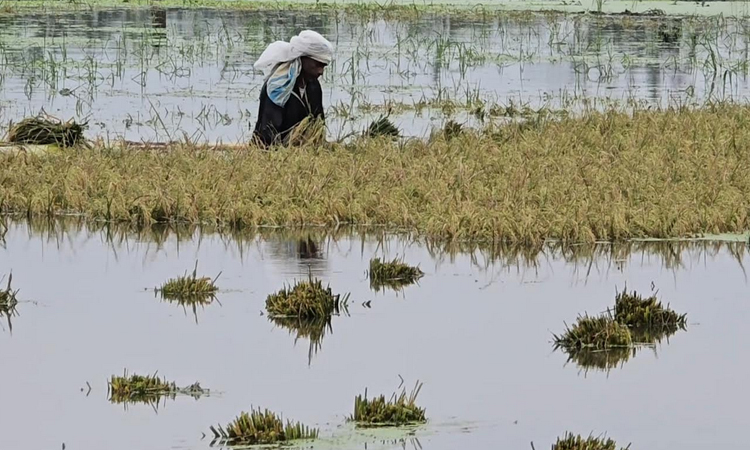
The rising water has already caused significant damage to Boro paddy in haor regions. Approximately 7,000 hectares of farmland have been submerged, leaving farmers worried about salvaging their crops.
Local farmers reported growing uncertainty as persistent rainfall hampers efforts to harvest and dry paddy. “If we cannot dry the harvested crops, they will rot,” one farmer said, highlighting the challenges caused by ongoing wet weather.
Kishoreganj WDB Executive Engineer Md. Sajjad Hossain said that the situation is being monitored around the clock. He added that both local authorities and farmers have been advised to remain vigilant and take necessary precautions. Earlier, farmers were urged to harvest ripe paddy quickly to minimize losses.
Meanwhile, Dr. Sadiqur Rahman, Deputy Director of the District Department of Aricultural Extension, said that as of Thursday afternoon, 6,768 hectares of land had already been affected by flooding. The worst-hit areas include Itna and Ashtagram upazilas.
Officials said that if rainfall subsides, the likelihood of further large-scale damage may decrease, offering some hope to farmers in the region.