Wednesday
05 August, 2026
News Flash
News Flash
RAJSHAHI, March 18, 2026 (BSS)- As the Holy Eid-ul-Fitr approaches, shopping
has picked up pace in the divisional city of Rajshahi.
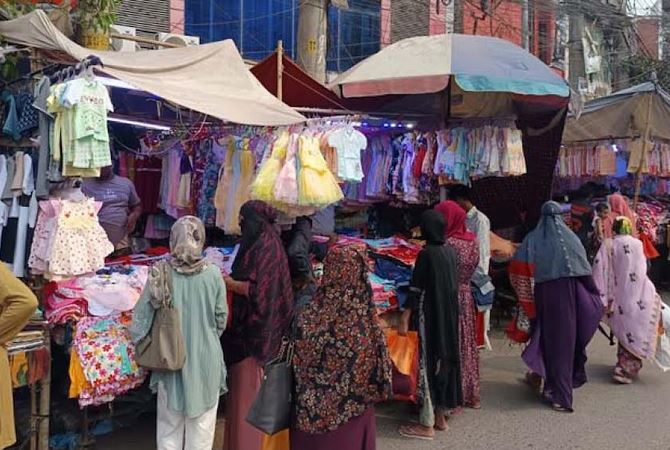
However, compared to large shopping malls or branded showrooms, a bigger
crowd is now seen at the city's sidewalk stalls.
These roadside temporary shops have become the main destination for middle-
and low-income people, allowing them to match their preferences with their
limited budgets.
Thousands of shoppers are returning home with satisfied smiles after buying
clothes of their choice at affordable prices.
Visits to different areas such as Saheb Bazar Zero Point, Gankapara, roads in
front of RDA Market, Sonadighi intersection and Kumarpada reveal overwhelming
crowds of buyers.
Shopping continues from morning until late at night. From children's frocks,
jeans, and T-shirts to adults' punjabis and three-piece outfits-everything is
available here.
Although sidewalks were once considered markets only for the lower class, the
scenario has changed somewhat this year.
Even salaried individuals and middle-class families are now seen bargaining
at these stalls. Vendors call out to attract customers while buyers negotiate
prices before purchasing.
In front of Jamal Supermarket, Shamsuzzohar is selling shirts from a van,
announcing through a hand microphone: "Fixed price at Taka 300 per shirt."
Customers gather around the van, selecting shirts of their choice.
Sohel Ahmed, a sales representative at a company, said while shopping at
Saheb Bazar that the rising prices of goods have made it difficult to shop at
large stores and malls.
"Good-quality clothes are available on the sidewalks at affordable prices, so
I'm buying for my family from here," he said.
Day laborer Solaiman Ali said, "I'm looking for pants for my 10-year-old
child. I visited several markets before this. Big stores are asking for Taka
1,000 for pants and are not reducing the price. On the sidewalks, I can get
the same for taka 300-400. For poor people like us, sidewalks are our only
hope."
However, there are also complaints about these sidewalk products. Some buyers
say that colors fade after washing or the fabric quality is not good, and in
some cases the stitching is poor.
Still, due to the low prices, many people take the risk and buy these
clothes. Bargaining also plays an important role while some shops have fixed
prices, most allow negotiation. Buyers often compare prices at several stalls
before making a decision.
Vendors are also happy to see the surge in customers.
Russell Ali, a sidewalk seller at Zero Point, said, "There are many more
customers this year, especially from evening until late at night. People from
all income groups are coming here, so sales are good."
Although the increased crowds have caused some traffic congestion in Saheb
Bazar and nearby areas, police patrols have been intensified.
Traffic police and Rajshahi Metropolitan Police are maintaining strict
vigilance to ensure smooth shopping for the public.
On the other hand, these roadside stalls occupying sidewalks have created
some inconvenience for pedestrians, as many walkways have become narrow.
Nevertheless, the festive spirit of Eid is evident among both buyers and
sellers.
Traders say that the Eid season is the most important time of the year for
them, with many waiting all year for this period. A significant portion of
their annual income comes from just a few weeks of business before Eid.
Despite limited means, everyone wants to bring smiles to their families by
buying new clothes for Eid.
As a result, sidewalk markets have become vibrant hubs of Eid shopping.
Despite the complaints, these markets remain the primary reliance for low-
income people.