Wednesday
05 August, 2026
News Flash
News Flash
RAJSHAHI, March 15, 2026 (BSS)- Speakers at a meeting here today unanimously
mentioned that interfaith dialogue coupled with religious learning is very
important for ensuring religious harmony besides preventing all sorts of
communal violence everywhere in the society.
Concerted efforts of religious leaders from all faiths and frequent
interfaith dialogue can also be the best ways of ensuring peace and
tranquility everywhere in the society.
Interfaith dialogues and intensified efforts are very important to combat
terrorism and extremism coupled with freeing the society from all sorts of
social crimes.
Religious think tanks and leaders from all faiths and development activists
came up with the observations while addressing an interfaith dialogue with
religious leaders and citizens in the city today (Sunday).
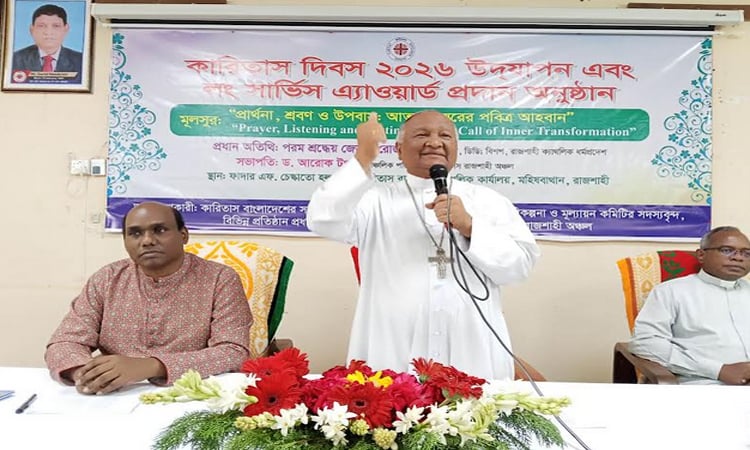
Regional office of Caritas Bangladesh organized the meeting at its conference
hall to mark the celebration of Caritas Day 2026 and provide long-service
awards.
"Prayer, Listening and Fasting: A Holy Call of Inner Transformation" was the
main theme of the event where 37 Caritas members were awarded as recognition
for their devotion to works.
Hafez Mawlana Rafiqul Islam from Hazi Jamir Uddin Safina Mohila College,
Subrata Kumar Sarker from Ramkrishna Mission Ashram and Reverend Father
Fabian from Catholic Dharma Prodesh addressed the dialogue as panel
discussants on behalf of their respective faiths.
Bishop Jevers Rosario addressed the meeting as the chief guest while Caritas
Regional Director Dr Arook Toppo was in the chair.
Editor of 'Daily Sonar Desh' Akbraul Hassan Millat, entrepreneur Abul Hasna
Poly and development activist Everest Hembrom also spoke.
Bishop Jevers Rosario illustrated the aspects of maintaining communal and
religious harmony, putting forward a set of recommendations on the issue
saying dialogue should be held in such a way, that participants are able to
learn from others' religious experiences, and good practices.
He said deepening communion and alignment is the aim of prayer as to
establish a direct, personal, and uninterrupted relationship with the God,
allowing the soul to be refreshed and filled with the Holy Spirit.
Besides, cultivating spiritual sensitivity is the aim of "listening" as it is
a deliberate act of silence and attention that sharpens one's ability to hear
God's guidance and direction, reducing the tendency to confuse personal
desires with God's will.
Apart from this, subduing the flesh and empowering the spirit is the aim of
fasting as it works to break the power of carnal desires (flesh) and
acknowledge complete dependence on God.
Stirring spiritual hunger acts to replace physical cravings with a deeper
craving for God's presence, word, and righteousness.
As a whole, the revelation of true spiritual condition allows the Holy Spirit
to expose sin and shortcomings, leading to sincere repentance, brokenness,
and inner renewal.
The religious think tanks said the main theme of the holy call of inner
transformation is to move from superficial religious activity to a dynamic,
inward change that radiates outward as Christlike character.
In his remarks, Dr Arook Toppo underlined the need for organising and
promoting extensive interfaith dialogues with a stronger approach at
community levels to create a strong public opinion in favour of peaceful
religious practices.
He called for concerted efforts of religious leaders from all faiths to
ensure harmony and tranquility everywhere in the society.