Wednesday
05 August, 2026
News Flash
News Flash
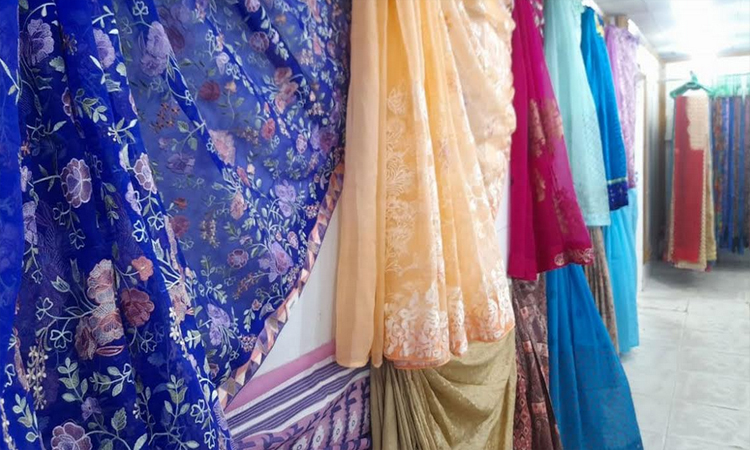
RAJSHAHI, March 6, 2026 (BSS) - Silk is no longer as popular in Rajshahi as it once was. It is now difficult to find the diverse designs and varieties of silk products that were available in the past.
The number of silk factories has also declined. However, the few silk showrooms that remain are already seeing a growing crowd ahead of Eid. Traders hope that sales will increase further during the remaining days of Ramadan.
Rajshahi silk does not necessarily mean products made from thread obtained from cocoons produced by mulberry trees in Rajshahi. In fact, for about a decade and a half, most silk garments available in the Rajshahi market have been made using imported thread.
The thread mainly comes from China. Although the raw material is imported, the skilled craftsmanship of Rajshahi's artisans continues to attract many buyers. As a result, silk enthusiasts are visiting the showrooms in Rajshahi every day.
Artisans have been busy for quite some time producing garments according to customers' preferences.
Meanwhile, Eid shopping has already picked up at the silk showrooms in the BSCIC area of the city. Buying and selling continues from morning until late at night. Because Rajshahi silk has a strong reputation across the country, buyers are also coming from outside the region.
However, traders say they are missing out on expected customers due to increased online sales and frequent power outages. They believe customer turnout may increase further after the 20th day of Ramadan.
Traditional Rajshahi silk items available in the showrooms include sarees, panjabis, sherwanis, three-piece suits, shirts, hijabs, ornas and scarves. Customers can browse various designs and varieties in a calm shopping environment.
Nahida Akhter, who visited Sapura Silk in Rajshahi to buy a saree, said she always prefers silk clothing.
"I have always liked silk, and my interest grows even more during Eid. Some new designs have arrived this time. First I will buy clothes for the children and then choose a saree for myself," she said.
Another customer, Nawrin Ara, said she is planning to buy a silk saree for Eid and is satisfied with the options available.
"The prices of everything have increased, so I came to the market assuming the price of clothes would also be a bit higher," she said.
Selim Reza, manager of Rajshahi Silk Fashion, said they have made full preparations for the Eid season and expect better business this year.
"Some customers are now coming in the evening, but after the 20th of Ramadan we may see a larger crowd," he said, adding that sales so far are similar to previous years.
Various types of sarees such as Balaka, Mokka, Katan and Chip Katan are being sold at prices ranging from Tk 1,000 to Tk 30,000. Panjabis are priced between Tk 1,000 and Tk 7,000, sherwanis between Tk 8,000 and Tk 25,000, and three-piece suits between Tk 1,000 and Tk 10,000.
In addition, silk three-piece suits, hijabs, ornas, scarves and sarees made from muslin, matka, tussar katan, balaka katan, satin silk and ND print fabrics are also available in the showrooms.
Yusuf Ahmed, marketing manager of the company, said online sales have increased significantly in recent years.
"People can now purchase clothing from home, which has reduced the number of customers visiting physically. However, we expect the number of shoppers to rise as Eid draws nearer," he said.
Saidur Rahman, manager of Sapura Silk, said business usually improves during Eid compared to other times of the year.
"This year we are seeing more customers than usual. Buyers are coming not only from Rajshahi but also from Khulna, Jessore, Kushtia, Ishwardi, Pabna, Natore, Bogura, Rangpur, Dinajpur, Naogaon and Chapainawabganj," he said, adding that many customers travel from areas with train connections to Rajshahi.
He said sales continue from 9:00 am until about 11:30 pm every day, with short breaks for iftar and prayers.
At Sapura Silk, sarees such as muslin silk, ND silk, balaka silk, soft silk and raw silk are priced between Tk 2,000 and Tk 12,000. Panjabis sell for Tk 3,700 to Tk 8,500, while three-piece suits range from Tk 2,500 to Tk 10,000.