Sunday
13 September, 2026
News Flash
News Flash
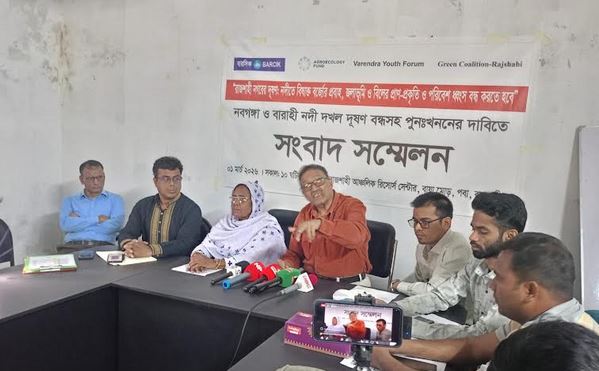
RAJSHAHI, March 1, 2026 (BSS) - Experts at a press conference here today urged immediate protection of existing rivers and wetlands, describing them as lifelines for public health, agriculture, and food security.
They warned that uncontrolled and unplanned management of solid and liquid waste in Rajshahi city has led to severe pollution, encroachment, and environmental degradation of adjacent rivers, wetlands, and water bodies.
The conference was organized by the Bangladesh Resource Centre for Indigenous Knowledge (BARCIK) at its regional resource centre at Baya under Paba Upazila, with support from the Agroecology Fund, Varendra Youth Forum, and Green Coalition.
BARCIK regional coordinator Shahidul Islam presented an observational policy brief, while Mahbub Siddiqui spoke on urban rivers and environmental issues.
Varendra Youth Forum President Atikur Rahman and Paba Upazila Green Coalition President Rahima Khatun also addressed the gathering.
Shahidul Islam highlighted how toxic waste from Rajshahi city is creating a crisis for the Nabaganga, Barahi, and Barnai rivers, along with connected canals and wetlands, affecting safe food production, livelihoods, and human life.
Policy recommendations on solid and liquid waste management were also presented at the press conference.
Mahbub Siddiqui expressed concern that without immediate coordinated action, the crisis could develop into a long-term environmental, agricultural, and public health disaster for Rajshahi, while the greater Barendra region may face serious ecological collapse.
Field observations show enormous quantities of liquid waste are discharged daily through city drains and canals, and plastic and non-biodegradable toxic substances are aggravating the crisis, he added.
Rivers and canals originating from the Padma River-including the Swarmangala, Barahi, and Nabaganga rivers-have gradually been destroyed. Urban engineering interventions have converted many into drains, leaving younger generations unaware of their existence.
Experts stressed that these rivers and wetlands underpin the region's agriculture, biodiversity, food security, and human life, warning of far-reaching environmental and public health consequences if current practices continue.
The organizers demanded immediate installation and operation of a modern Sewage Treatment Plant (STP); treatment of all liquid waste before discharge; mandatory Effluent Treatment Plants (ETP) for industries, hospitals, and commercial establishments; strict monitoring and legal action against polluters; closure of direct drain connections to rivers and wetlands; and formation of an independent investigation committee.