Friday
15 May, 2026
News Flash
News Flash
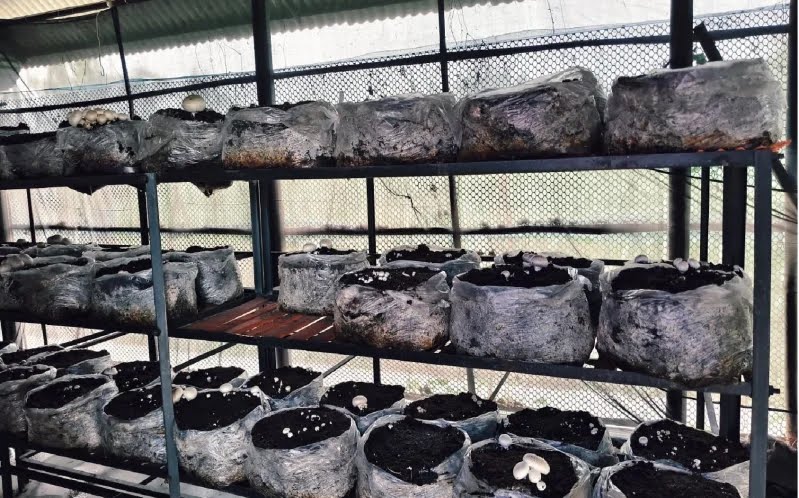
DINAJPUR, Feb 18, 2026 (BSS) - Birganj upazila of the district has achieved a
significant milestone in agricultural innovation with the successful
cultivation of button mushrooms using indigenous technology.
The breakthrough was made through a joint initiative of the Protina Research
Foundation and Bahari Agrotech. For the first time in the country, button
mushrooms have been successfully produced from locally prepared seeds in a
natural cool environment, marking a major step toward reducing import
dependence.
The development was announced by Masuda Islam, chairman of Protina Research
Foundation, at a press conference held on Wednesday afternoon at his farm in
Dakshin Nijpara village under Birganj upazila.
Speaking at the event, Masuda Islam said the foundation undertook laboratory-
based initiatives to develop button mushroom seeds (spawn) using domestic
technology.
"We first focused on preparing quality mushroom seeds in our own laboratory.
Later, we achieved success in small-scale button mushroom cultivation through
compost-based methods," she added.
She also described the various challenges and obstacles faced during
different stages of research and production, emphasizing that the success
came after overcoming significant technical and environmental hurdles.
Professor Dr AK Obaidul Haque of the Food Technology and Nutrition Department
at Maulana Bhashani Science and Technology University highlighted the
nutritional importance of mushrooms during the press conference.
He stated that every 100 grams of raw mushrooms contains approximately 2.75
grams of protein, 2.5 grams of carbohydrates (sugar), 0.5 grams of fat and
significant amounts of vitamin B-complex and essential minerals.
According to him, regular consumption of mushrooms supports body growth,
strengthens immunity, and helps in disease prevention. Mushrooms play
effective roles as anti-diabetic, anti-cancer, anti-hypertensive, and anti-
inflammatory foods, he added.
Engineer Md. Habibur Rahman, partner of Bahari Agrotech, said that Bangladesh
imports button mushrooms and mushroom seeds annually from countries including
India and Thailand, spending more than Taka 100 crore.
He expressed optimism that domestic production using local raw materials
could meet national demand and create opportunities for export to
international markets.
Several researchers and partners, including Engineer Md. Fahim Rahman, Md.
Salauddin, Md. Mim Islam, Md. Jim Islam, and Akhter Kabir Kanon, were present
at the conference.
The success in Birganj is being viewed as a promising development for
Bangladesh's agricultural sector, potentially opening new avenues for
sustainable farming, nutritional security, and export earnings.