Tuesday
04 August, 2026
News Flash
News Flash
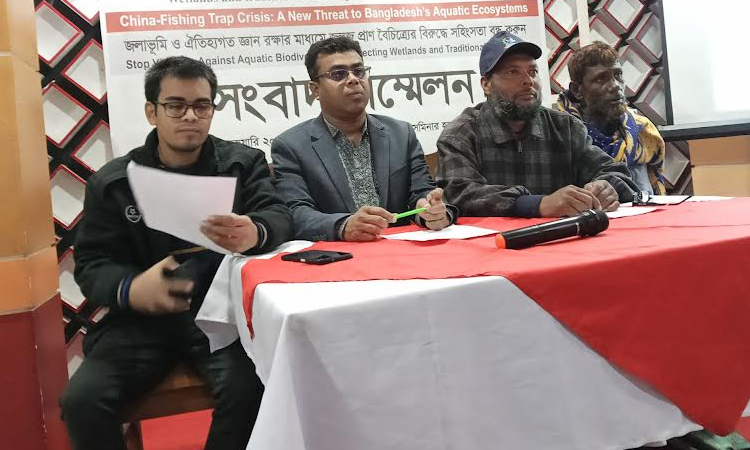
RAJSHAHI, Feb 2, 2026 (BSS) - Social watchdogs and local fishermen today urged strong measures to curb the use of China fishing traps, warning that these traps are threatening fish populations and the livelihoods of traditional fishing communities in the region.
Speaking at a press conference held at SK Food World Restaurant to mark World Wetlands Day 2026, participants stressed the urgent need to protect aquatic resources, particularly native fish species, from further degradation.
The press conference was jointly organized by BARCIK, Green Coalition, Varendra Youth Forum (VYF), and the Agroecology Fund.
The theme of this year's observance is "Wetlands and Traditional Knowledge: Celebrating Cultural Heritage", highlighting the vital role of indigenous knowledge in managing and conserving wetland ecosystems.
Shahidul Islam, Regional Coordinator of the Bangladesh Resource Centre for Indigenous Knowledge (BARCIK), presented a concept paper noting that the ultra-fine mesh of China Duari nets captures fish of all sizes, fish eggs, fry, and plankton, disrupting the breeding cycle of native species such as rui, katla, shing, and magur.
He also presented two research papers: "China Fishing Trap and Honey-Trap Crisis: A New Threat to Bangladesh's Aquatic Ecosystems" and "The China-Origin Fishing Trap and Honey-Trap Crisis in Bangladesh: A Political Ecology of Technological Dependency, Inland Fisheries Collapse and Governance Failure."
Shahidul Islam warned that improper use of these nets blocks natural water flow, causing siltation and oxygen depletion (eutrophication) in wetlands. This not only suffocates aquatic life but also destroys habitats of native flora and fauna.
Atiqur Rahman, President of Varendra Youth Forum (VYF), and Abu Sama, General Secretary of Naohata Fishermen Cooperative Society, also spoke at the event.
Abu Sama presented a six-point demand, highlighting that the commercial use of highly efficient China nets has marginalized traditional fishing communities in Rajshahi.
He said declining fish populations have left traditional fishers, who use sustainable methods, with little or no catch.
He also warned that the synthetic nylon fiber used in these nets is non-biodegradable, contributing to severe plastic pollution in rivers and wetlands. Abandoned nets, he added, pose risks to aquatic animals through entanglement.
Atiqur Rahman noted that while China Duari nets are not explicitly banned, their ultra-fine mesh violates the minimum mesh size requirements set under the Bangladesh Fish Conservation and Protection Act, making them effectively illegal.