Tuesday
04 August, 2026
News Flash
News Flash
By S M Zahid Hossain
KHULNA, Jan 25, 2025 (BSS) - Handicrafts produced by persons with disabilities in different parts of southwestern Bangladesh are being exported abroad, marking a remarkable transformation from dependence to economic contribution.
Tofi Khatun, 30, a woman with disabilities from Shimulia village under Shimulia Union of Jashore district, is one of such examples.
She lost the use of one leg due to complications after receiving a polio vaccine at the age of one. After enduring years of hardship and social negligency, she is now contributing to the economy through her handmade products, which are being exported overseas.
Similarly, Rika Karmakar from Chandpai area of Mongla in Bagerhat district and Shahanara Begum from Karpasdanga area of Damurhuda upazila in Chuadanga district have received the prestigious Joyita Padak in the category of “New Initiative in Life after Overcoming Oppression.”
Like Tof Khatun and Rika Karmokar, a total of 1,775 elderly and persons with disabilities from three upazilas of Chuadanga, Jashore and Bagerhat districts are now actively contributing to society in various ways.
Having developed skills and self-reliance, they no longer depend on others when dealing with government or non-government offices. Many of them now independently process old-age allowances, disability allowances, widow allowances and other necessary works.
A decade ago, these elderly and disabled people were unfamiliar with union, upazila and district-level government offices. Today, they are welcomed at union parishads, seated beside UpazilaNirbahi Officers (UNOs), and even invited to speak at programmes organised by district administrations. They can visit social welfare offices and complete both their own tasks and those of others without difficulty.
Behind this socio-economic transformation is the sustained effort of the non-government organisation Caritas Bangladesh.
Over the past two days, visits to these areas revealed that Caritas Bangladesh, through itsSDDP project( Promotion of Comprehensive Social Inclusion of Vulnerable Groups), has been working in three unions of the Khulna region with the elderly and persons with disabilities.
The project aims to improve the health and education by enhancing the skills, capacities and human resources of elderly and disabled people, while strengthening their ability to claim rights and ensuring their full participation and accessibility in society.
Snigdha Mou Ghosh, Regional Monitor of Social Welfare for Vulnerable Community (SWVC) of Caritas Bangladesh, Khulna region, said the organisation has been working with elderly and persons with disabilities since 2005.
Initially, the activities were charity-based, including income-generating support, medical assistance, financial grants, assistive devices, and emergency support during the COVID-19 pandemic.
“Later we realised that Caritas would not always be there. So we focused on skill development and sustainable livelihoods,” she said, adding that since 2016 the SDDP project has been working in Karpasdanga Union of Damurhuda upazila, Shimulia Union of Jhikargacha upazila, and Chandpai Union of Mongla upazila.
Through the project, elderly and disabled people have been directly linked to government safety-net programmes and trained on how to apply for services and interact with various offices. “Now many of them are even more skilled than us,” she added.
Alvino Nath, Regional Director of Caritas Bangladesh, Khulna region, said development of the elderly and disabled population is not only a humanitarian duty but also a commitment to social justice.
“By centering our plans on their voices, rights and potential, we can build a dignified and sustainable society,” he said.
He noted that the project has shifted from charity-based to rights-based activities. Currently, 24 clubs have been formed in 24 wards across three unions, along with three women’s disability forums. One of these forums has already been registered with the government.
According to project data, Karpasdanga Union has 656 beneficiaries, including 425 elderly and 231 persons with disabilities. Shimulia Union has 521 beneficiaries, while Chandpai Union has 598.
About 80 percent of beneficiaries are already receiving government services such as old-age allowances, disability allowances, citizen cards and loan facilities, with the rest in process.
Beneficiaries have received various skill-development trainings, including tailoring, poultry rearing and computer training, enabling them to become self-reliant. Advocacy, lobbying and networking training have also raised awareness about their rights.
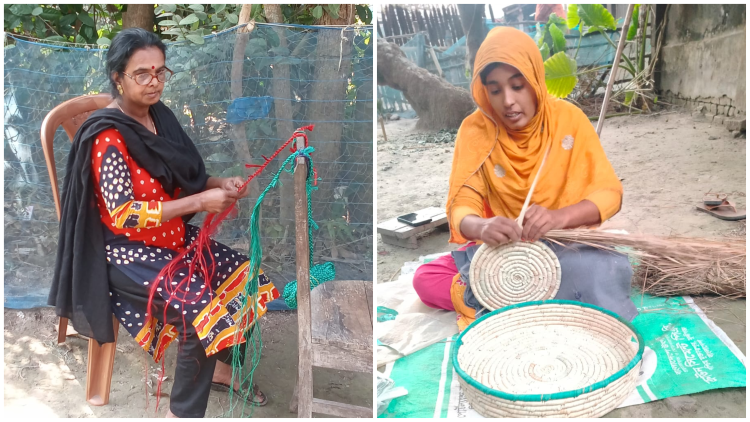
Tofi Khatun said she once felt like a burden on her family, but with Caritas’ support she now weaves baskets of various designs using dried date palm leaves and straw.
“I make a good profit selling each product for Tk 60, and these items are exported abroad,” she said, adding that many people with disabilities in her village are now involved in the same work.
Rika Karmakar said she now weaves jute table mats of different designs, selling them for Tk 60 to Tk 100, she received the Upazila-level Joyita Award in 2025.
Shahanara Begum, who received the award in 2023, now runs a tailoring training centre for underprivileged youth after overcoming poverty and disability.
Many other beneficiaries are now earning livelihoods through fish fry collection, grocery shops, salons, agriculture, tailoring, cosmetics businesses and village medical services.
Though their life stories are marked by hardship, these elderly and disabled individuals are no longer seen as burdens.
They are now respected members of the society, capable of assisting others with social welfare services and living with dignity and confidence.