Sunday
30 August, 2026
News Flash
News Flash
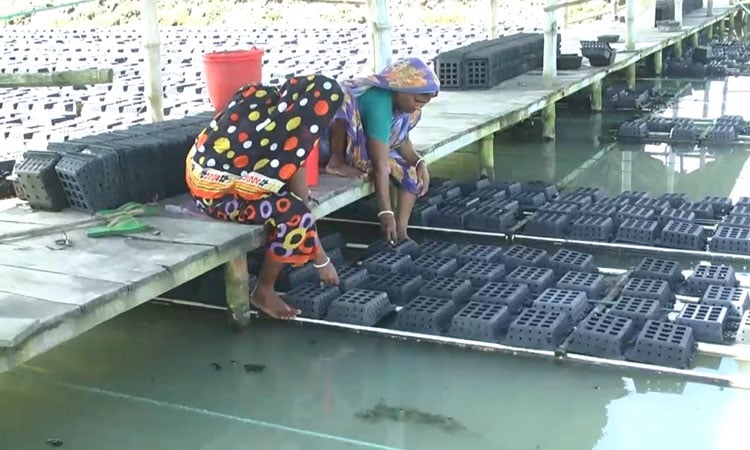
SATKHIRA, Jan 5, 2026 (BSS) - Crab farming has emerged as a life-changing livelihood for women in the coastal Shyamnagar upazila of the district, offering safety, steady income and newfound dignity to families once dependent on risky fishing in the Sundarbans.
At dawn in Burigoalini union, women begin their work at soft shell crab farms—cutting small tilapia fish to feed crabs kept in plastic boxes floating in fish enclosures, checking rows of boxes, placing feed into each container and separating freshly molted crabs for sale.
This routine has replaced years of hazardous river fishing, where men and women alike risked encounters with crocodiles and tigers.
Following the devastation of cyclones Sidr and Aila, soft shell crab farms have multiplied across the coastal belt alongside traditional fish farms.
These ventures have created widespread employment, particularly for women, enabling families to improve their living standards and ensure better education for their children.
Crab farm worker Anima Mondal said she and her husband both work at a crab farm and are educating their two children. “We have even bought five kathas of land,” she said, adding that earning her own income has restored her confidence and earned her respect in the community.
Another worker, Shardini Mondal, said wages are paid by the hour around Taka 30, allowing workers to earn between Taka 300 and Taka 400 per day depending on hours worked.
“The more time we give, the more we earn. It helps us live decently with our families,” she said.
Tumpa Mondal recalled the dangers of earlier livelihoods. “Before Sidr and Aila, we fought crocodiles and tigers while fishing in the Sundarbans. Now our lives have changed,” she said, noting that both men and women now earn safely at crab farms and send their children to good schools.
Explaining the process, worker Sudesh Mandal said hard shell crabs are placed in individual boxes and, after 10–15 days, molt into soft shell crabs.
“Grade A crabs sell for Taka 1,000 to Taka 1,400, Grade B for Taka 700 to Taka 800, and Grade C for Taka 400 to Taka 500,” he said, adding that companies collect, package and export the crabs abroad.
Abdullah Al Qayyum, owner of Burigoalini BD Soft Crab Agro Farm, said the industry has helped neglected coastal populations—especially women—become self-reliant. “Employment has expanded, poverty has reduced, and farms with around 10,000 crab boxes can earn Taka 8–10 lakh annually,” he said.
District Fisheries Officer GM Selim said crab production in Satkhira now stands at about 3,500 metric tons annually, with the district producing 100 percent of the country’s soft shell crabs. Around 750 metric tons are exported each year, contributing to foreign exchange earnings.
However, he noted challenges in seed collection due to seasonal restrictions imposed by the forest department. “Establishing government and private hatcheries would ease this problem and create more livelihood opportunities,” he said, adding that pilot initiatives are already underway.
Officials and farmers said, the soft shell crab industry could further transform the coastal economy—placing women at the forefront of sustainable growth in Satkhira.