Monday
17 August, 2026
News Flash
News Flash
DHAKA, Aug 17, 2026 (BSS) - Commerce, Industries, Textiles and Jute Minister
Khandakar Abdul Muktadir today said coordinated efforts by industry, academia
and the government are essential for the development of Bangladesh's textile
and jute sectors.
"There are opportunities to further improve Bangladesh's textile education,
research and technological capabilities through collaboration with
international educational institutions such as China's Zhejiang Sci-Tech
University," he said.
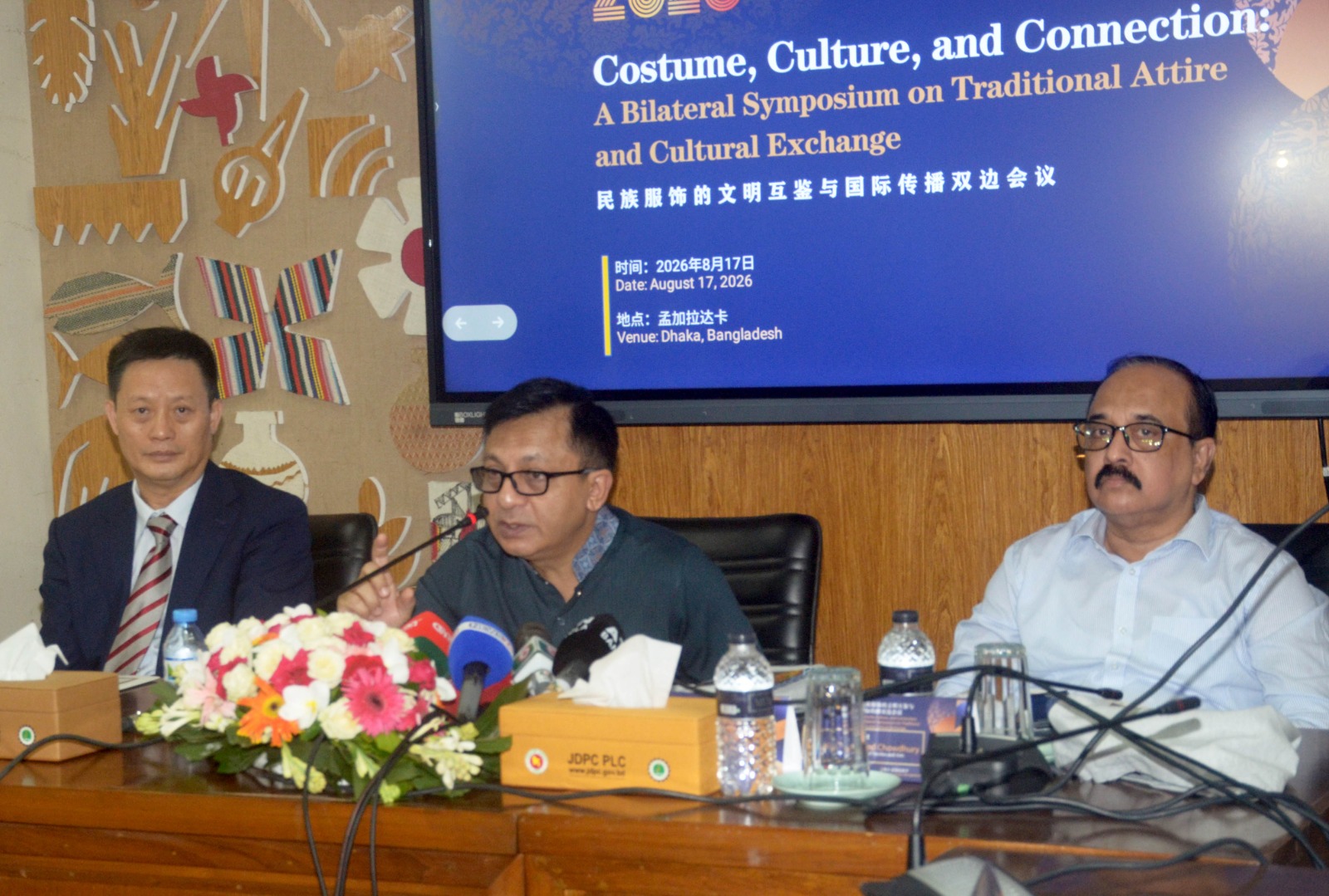
The minister made the remarks while addressing a symposium organised by
Zhejiang Sci-Tech University at the Jute Diversification Promotion Centre
(JDPC) in the capital today as the chief guest.
Khandakar Abdul Muktadir said the world economy is rapidly moving towards
technology-driven systems, and students, teachers and industry stakeholders
need to be connected with artificial intelligence, modern technologies and
digital management.
"The government is taking necessary initiatives to help Bangladesh keep pace
with global technological changes," he said.
The minister stressed the need to modernise the country's textile institutes
and vocational education system in line with the requirements of the modern
world.
"To this end, initiatives will be taken to review the curricula of
Bangladesh's textile institutes and align them with China's modern textile
education system," he continued.
He also said opportunities would be created for skills development through
training by experienced Chinese teachers and experts, as well as by sending
Bangladeshi faculty members to China for advanced training.
The commerce minister said Bangladesh's readymade garment sector currently
earns around US$38-39 billion from exports. However, he noted that there is a
significant scope to earn more foreign currency from the same volume of
exports by producing high-value and value-added textile products.
"Bangladesh's textile sector needs to move towards man-made fibres and value-
added products," he said.
Muktadir said the textile sector had played an important role in the economic
development of industrialised countries. Although many countries moved from
textiles to other sectors as their economies transformed, Bangladesh still
has considerable scope to further develop the textile industry.
"China's experience and technology can be utilised to accelerate this
transformation in Bangladesh," he said.
On the jute sector, Khandakar Abdul Muktadir said jute is an important
product deeply connected with Bangladesh's heritage and emotion.
He stressed the need to raise jute productivity, develop new products and
produce high-value jute goods to take the sector to a new level.
"Joint research initiatives with China can create opportunities to increase
jute productivity, introduce new technologies and develop value-added
products," he added.
The minister said the potential of the jute sector could increase manifold if
raw jute is transformed into blended fibre, fabrics and other high-value
products instead of being exported or used primarily in raw form.
He also said higher jute productivity would benefit farmers and encourage
them to cultivate more jute.
The bilateral symposium titled "Costume, Culture, and Connection: A Bilateral
Symposium on Traditional Attire and Cultural Exchange" was organised by
Zhejiang Sci-Tech University at JDPC in Dhaka.
The secretary of the Ministry of Textiles and Jute, Director General of the
Department of Textiles, representatives of Zhejiang Sci-Tech University and
the Chinese Academy of Social Sciences, Vice-Chancellor of BGMEA University
of Fashion and Technology, academics, researchers and entrepreneurs from the
textile and apparel industries attended the event.