Friday
04 September, 2026
News Flash
News Flash
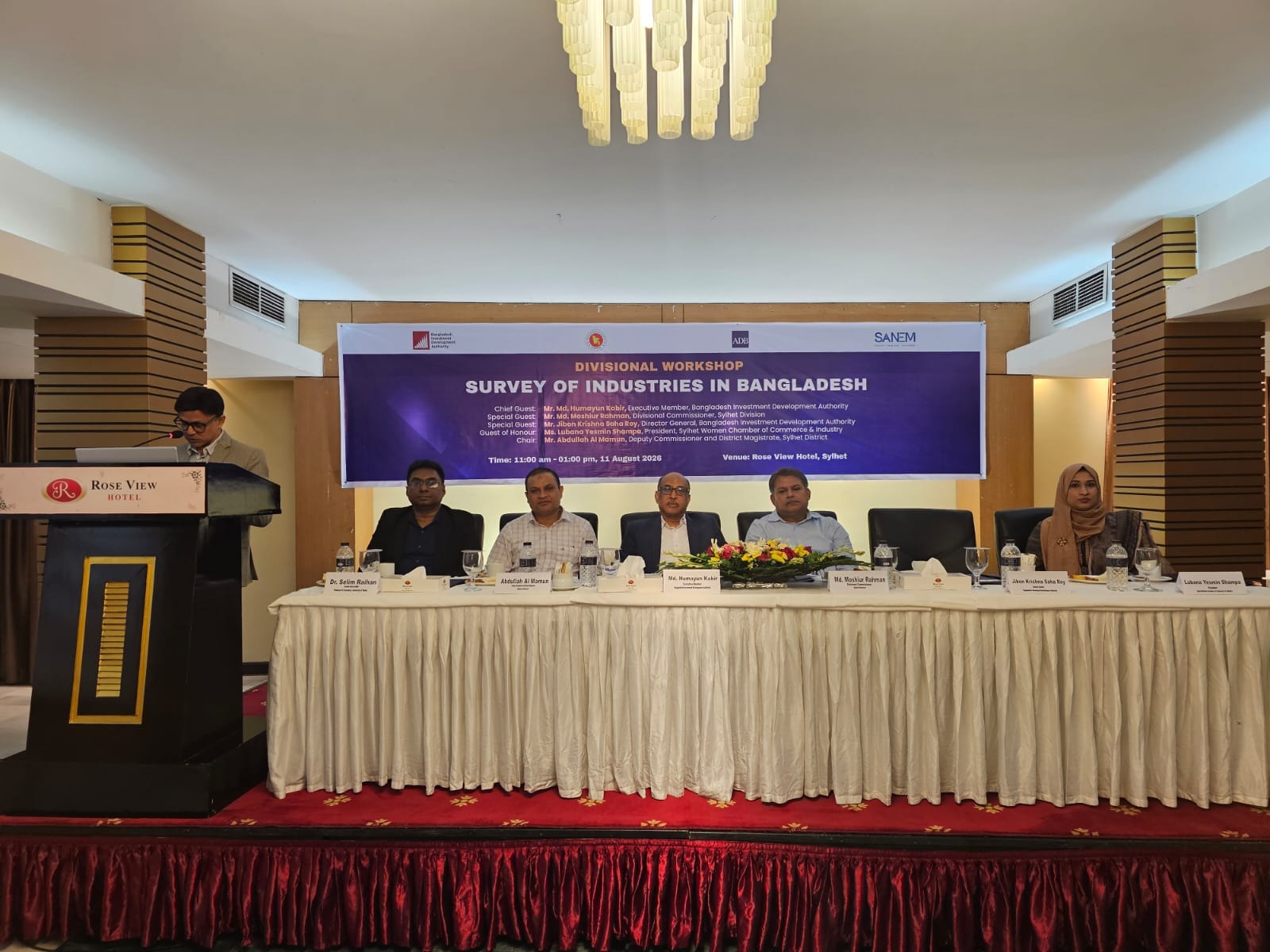
DHAKA, Aug 12, 2026 (BSS) - The Bangladesh Investment Development Authority
(BIDA), in partnership with the Asian Development Bank (ADB) and the South
Asian Network on Economic Modelling (SANEM), has sought active cooperation
from stakeholders in Sylhet to build a comprehensive database of industries
and identify new investment opportunities in the region.
The call came at a divisional workshop on the Survey of Industries in
Bangladesh, held at Rose View Hotel in Sylhet on Tuesday, aimed at collecting
and verifying field-level information on industries, investment challenges
and potential sectors, said a press release here today.
The survey, led by BIDA with ADB funding and technical support from SANEM,
seeks to identify problems faced by investors, develop a reliable industrial
database and help formulate effective policies for promoting investment and
balanced regional industrialisation.
Addressing the workshop, ADB Bangladesh Public Sector Economist Tasnim Alam
stressed the importance of increased investment as Bangladesh prepares to
graduate from the Least Developed Country (LDC) category.
He said Bangladesh needs a clear transition roadmap anchored by higher
investment and greater private-sector participation, while regional economic
opportunities should be identified and utilised. He cited Sylhet's tourism
sector as an area with significant growth potential.
SANEM Executive Director and Dhaka University Professor of Economics Dr Selim
Raihan said the survey would help identify the problems confronting investors
and provide a reliable database to support both investors and policymakers.
SANEM Programme Director Zubayer Hossen said industries are currently heavily
concentrated in Dhaka and Chattogram.
The survey will verify the industrial distribution through a full census of
foreign-owned and joint-venture firms and a representative survey of domestic
enterprises, covering ownership, sector, operations and location.
BIDA Director General Jibon Krishna Saha Roy said the survey is crucial to
addressing the country's longstanding shortage of a reliable national
industrial database.
He stressed the need for proactive planning ahead of LDC graduation,
strengthening BIDA's One Stop Service (OSS), ensuring balanced distribution
of investment and expanding export potential.
BIDA Executive Member Md Humayun Kabir said the authority has faced data
discrepancies, inadequate post-registration follow-up and limited information
on the actual number of active industries.
He said BIDA is interested in working with Sylhet's SMEs and exploring high-
potential sectors, including agro-processing based on local production. The
survey database, he added, would support policymaking, deregulation and
coordination among chambers and other stakeholders.
Sylhet Divisional Commissioner Md Moshiur Rahman said the survey would
provide a comprehensive picture of the region's industrial landscape and help
identify numerous raw-material-based industries that remain largely
unrecognised.
President of Sylhet Women Chamber of Commerce and Industry Lubana Yesmin
Shampa highlighted the shortage of export-oriented entrepreneurs,
particularly women, and called for stronger integration of agriculture with
tourism. She said the lack of reliable regional data was hindering the
establishment of new industries.
Sylhet Deputy Commissioner and District Magistrate Abdullah Al Mamun, who
chaired the workshop, said investors often face bureaucratic complications
and a serious shortage of reliable information.
He assured the survey team of the district administration's full cooperation
in collecting data.
Participants at the workshop identified low-interest financing, poor port
connectivity, shortage of skilled manpower, unreliable electricity supply,
taxation and VAT-related difficulties as major obstacles to industrial
development in Sylhet.
They also called for greater sector-specific investment and suggested
expanding the fisheries sector and exploring solar energy as potential areas
of future industrial development.
The workshop brought together government officials, private-sector
representatives, investors, chamber leaders and other stakeholders from
across the Sylhet division.