News Flash

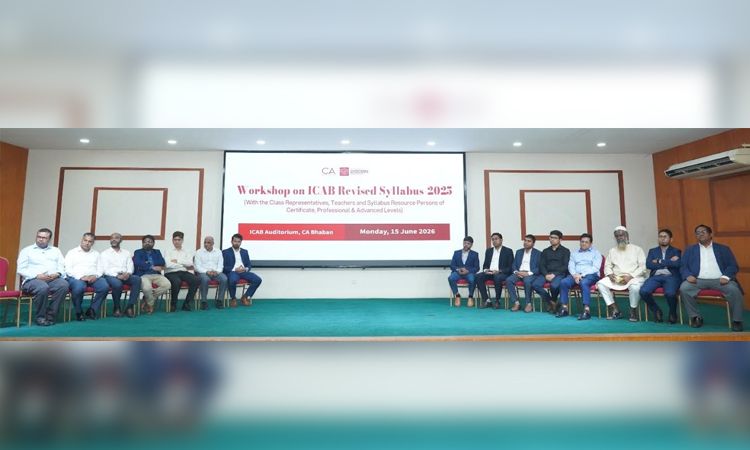
DHAKA, June 17, 2026 (BSS) - The Institute of Chartered Accountants of Bangladesh (ICAB) has organized a workshop on its Revised Syllabus-2025 aimed
at preparing a new generation of chartered accountants equipped to meet the demands of a rapidly evolving global business environment.
The workshop, arranged by ICAB's Education, Student Affairs and Training Division (Curriculum Designing and Study Materials), was held at the ICAB
Auditorium in the city, said a press release here today.
It brought together class representatives, teachers, members of the Board of Studies, syllabus sub-committee members, councilors and syllabus resource
persons.
The event focused on the revised curriculum covering Certificate, Professional and Advanced levels, highlighting changes introduced since the
previous syllabus and discussing implementation strategies.
Participants also emphasized the need for continuous curriculum enhancement to develop future-ready chartered accountants.
Welcoming the participants, ICAB Acting Chief Executive Officer (CEO) Mostafa Kamal, FCA, said the institute remains committed to providing a globally
competitive professional education framework aligned with international standards, technological advancements and evolving business needs.
He noted that the revised syllabus reflects ICAB's vision of producing professionals capable of thriving in an increasingly dynamic and digital
economy.
Speaking on the occasion, ICAB Vice-President (Education and Training) and Chairman of the Board of Studies Md Rokonuzzaman, FCA, underscored the
importance of the Revised Syllabus-2025 in developing competent, ethical and innovative chartered accountants.
He said the new curriculum is designed to strengthen critical thinking, analytical skills, professional judgment and practical competencies essential
for success in today's changing business landscape.
He informed the workshop that the revised syllabus is scheduled to be implemented from the examination sessions due in November-December 2026.
He also revealed that another version of the syllabus, aligned with the "Next Generation ACA" model of the Institute of Chartered Accountants in England
and Wales (ICAEW), is under consideration and may be introduced between late 2027 and early 2028.
ICAB President N K A Mobin, FCA, highlighted the institute's ongoing efforts to modernize its education system and learning methodologies.
He described the revised syllabus as a strategic initiative to nurture chartered accountants capable of leading organizations, promoting sustainable
growth and contributing to the country's economic development.
A detailed presentation on the revised syllabus was delivered by Professor Dr. Ali Noor, Dean of the Faculty of Business Studies at Jagannath University
and Convener of the Syllabus Sub-Committee of the ICAB Board of Studies.
The presentation outlined key features of the curriculum, including outcome-based learning, enhanced professional skills development, updated technical
content, modern assessment methods and stronger alignment with international best practices.
The presentation was followed by an interactive discussion and feedback session where participants shared views and suggestions on various aspects of
the curriculum.
Questions raised during the session were addressed by syllabus resource persons and policymakers.
Concluding the workshop, Mohammad Redwanur Rahman, FCA, co-chairman of the Board of Studies, thanked participants for their contributions and reaffirmed
the board's commitment to the effective implementation of the revised syllabus.
The programme ended with a vote of thanks delivered by ICAB Director (Education and Examination) Masud Parvez, FCA.
The workshop reflected ICAB's commitment to strengthening chartered accountancy education in Bangladesh and developing highly skilled, ethical
and globally competitive professionals.
Through the Revised Syllabus-2025, the institute aims to equip aspiring chartered accountants with the knowledge, competencies and leadership
qualities needed to contribute meaningfully to the country's economic progress.