BSS
  13 Jun 2026, 19:04
Update : 13 Jun 2026, 19:11

Govt plans automatic licence approvals after 7 days to spur investment: Finance Minister

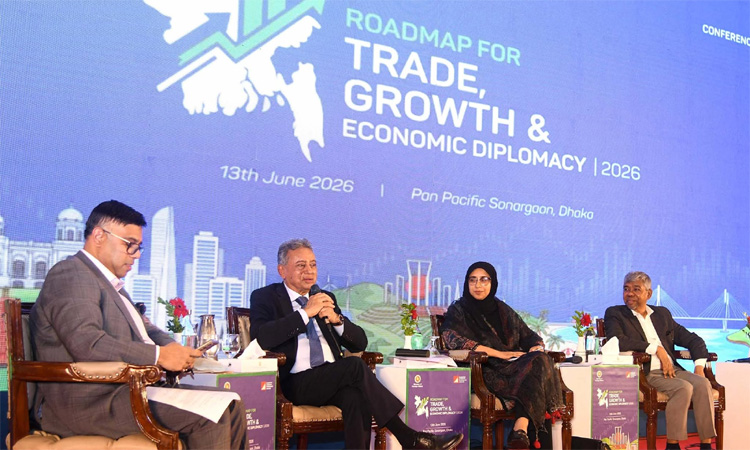
Finance Minister Amir Khosru Mahmud Chowdhury today addressed a conference held at a hotel in the capital. Photo: PID

DHAKA, June 13, 2026 (BSS) – Finance Minister Amir Khosru Mahmud Chowdhury today said that the government plans to introduce a system under which business licences and approvals will be granted automatically if authorities fail to respond within seven days.

The Finance Minister said this while addressing a conference titled “Roadmap for trade, growth and economic diplomacy,” held at a hotel in the capital today.

Khosru said the initiative aims to improve the investment climate and support economic growth, adding that businesses would no longer have to make appointment at multiple government offices for approvals.

The conference, jointly organized by the Ministry of Foreign Affairs and the Bangladesh Investment Development Authority (BIDA), brought together senior government leaders, heads of diplomatic missions, development partners, and representatives from the private sector to chart a forward-looking agenda for Bangladesh’s economic engagement.

He said under the proposed system, all applications will be submitted through a central focal point that will coordinate with relevant agencies. Authorities will have seven days to raise objections, seek additional information or flag compliance issues.
“If no response is received within that period, approval will be deemed granted automatically and the licence issued,” Khosru said.

He said the goal is to replace the current open-ended approval process with a predictable, time-bound system that provides investors with greater certainty. A task force will monitor implementation and ensure agencies comply with the deadline, he added.

The Finance Minister said the government will also launch a dedicated website where businesses and citizens can report delays, regulatory obstacles and failures by officials to follow rules. “Complaints will be reviewed directly by the taskforce,” he added. 
Khosru said deregulation is central to the government's efforts to create a more business-friendly environment.
He also highlighted the budget's focus on developing a “creative economy” by supporting artisans, designers, performers and cottage industry entrepreneurs through financing, skills development, branding support and access to digital marketplaces.

Responding to concerns from foreign investors about higher taxes on compliant businesses, Khosru said the government's priority was expanding the tax net rather than increasing the burden on existing taxpayers.

He added that reforms, including separating tax policy formulation from tax administration, are aimed at improving efficiency and making tax collection more predictable.
He called for a rethink of Bangladesh’s public finance architecture, citing rising borrowing costs and growing interest payments.

Khosru also called for greater reliance on the capital market for large investments and said state-owned enterprises should raise funds independently.

He also pledged financial-sector reforms and faster deregulation to improve the business environment.

BIDA Executive Chairman Chowdhury Ashik Mahmud Bin Harun said Bangladesh's biggest achievement over the past year was restoring democratic accountability through a free and fair election, which he said strengthened policy stability and investors’ confidence.
He outlined reforms to support an investment-led growth strategy aimed at creating more than 10 million jobs, including reducing factory permit approval times to 14 days, expanding digital services and streamlining regulatory procedures.

Acknowledging energy and logistics constraints, he said Bangladesh would accelerate solar power projects, diversify energy sources and fast-track LNG infrastructure development. He also announced plans to privatise or develop partnerships for around 20 underperforming state-owned enterprises.

"The biggest challenge is the execution," he said.

NBR Chairman Md Abdur Rahman Khan said Bangladesh must raise domestic revenue to support economic transformation but cautioned against tax policies that could undermine business growth and employment.

He said reforms are focused on lowering compliance costs, simplifying procedures and helping businesses expand. 

Rahman said exporters will receive broader bond facilities, while automation is being expanded across tax administration.

“More than 45 lakh taxpayers filed returns online last year, while over 12 lakh users obtained licences and permits through the National Single Window platform,” he said.

Among others, State Minister for Foreign Affairs Shama Obaed Islam, Prime Minister’s Foreign Affairs Adviser Humaiun Kobir, Adviser to the Prime Minister Dr Mahdi Amin, Jahrat Adib Chowdhury, MP, Foreign Secretary Asad Alam Siam, chairman and CEO of Policy Exchange Bangladesh, Dr M Masrur Reaz spoke in separate sessions.