Saturday
22 August, 2026
News Flash
News Flash
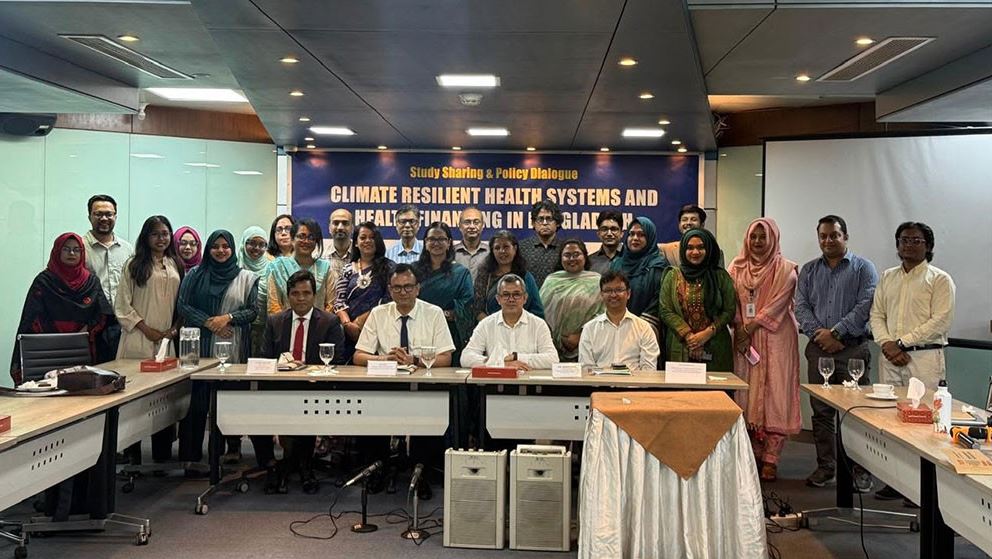
DHAKA, June 06, 2026 (BSS)- Ahead of the FY2026–27 national budget, policymakers, researchers and public health experts have called for urgent reforms to Bangladesh's climate-health financing system.
Speakers in a policy dialogue here today highlighted that climate-relevant allocation within the Health Services Division declined from 2.74 percent of its total budget in FY2021–22 to 1.97 percent in FY2025–26, despite increasing exposure to climate-related health threats across Bangladesh.
Health's share of the national climate budget also declined over the same period, from approximately 2.5 percent to 1.5 percent, they said.
Center for Participatory Research and Development (CPRD) in collaboration with HEKS/EPER and Shushilan arranged the dialogue titled “Climate Resilient Health System and Health Financing in Bangladesh” at BRAC Centre Inn, Dhaka today, said a press release.
The event featured findings from CPRD's two studies titled “Assessing the Impact of Climate Change on the Reproductive Health of Coastal Women and Adolescent Girls.” and “Climate Finance for Health in Bangladesh: Policy Ambition and Fiscal Reality”.
Shohanur Rahman and Md. Shahadat Hossain presented the first study that documents significant reproductive and maternal health challenges among women in the coastal area, driven by poverty, water scarcity, and climate-related vulnerabilities.
Ms. Sumaiya Binte Anwar, Program Manager of CPRD presented the second one that reveals a stark and consequential mismatch between what Bangladesh’s climate policies promise and what its budgets actually deliver.
The dialogue brought together senior government officials, public health experts, researchers, development partners, civil society representatives, academics, climate specialists, and media professionals.
Chief Executive of CPRD Md. Shamsuddoha said climate finance remains a hazy space. To attract global attention and financing, quantitative evidence is essential. However, in climate-health discussions, the focus often remains limited to ensuring safe drinking water. We need to broaden that focus to ensure access to quality water for all aspects of daily life.”
UN Wing Chief of ERD AKM Sohel emphasized that climate change has not yet been fully mainstreamed into development planning, resulting in fragmented initiatives.
He stressed that climate research should be expanded beyond coastal areas to include other vulnerable regions of the country. He further highlighted the need for stronger data generation and improved climate literacy, noting that significant gaps remain in both areas.
He also underscored the importance of creating a virtual platform to facilitate rapid access to information and collaboration opportunities.
Shah Abdul Saadi, Deputy Secretary of Economic Relations Division (ERD) emphasized that establishing a strong climate rationale is crucial for claiming and mobilizing international climate finance.
“As global public finance for adaptation has declined by US$ 2 billion in a single year; Bangladesh's climate budget tagging system needs clearer definitions and stronger sectoral ownership,” he said.
Director of Climate Change and Health Promotion Unit (CCHPU) Prof. Dr. Iqbal Kabir observed that health sector shares only five percent of global climate finance, demonstrating that climate-health remains neglected globally, not only in Bangladesh.
“The scarcity of relevant data is also limiting our ability to develop stronger funding proposals and formulate evidence-based, data-driven policies,” he said.
The dialogue concluded with a set of policy recommendations for the FY2026–27 National Budget.
The recommendations included stronger integration of Health National Adaptation Plan into national budgeting process, improved climate-budget tracking system, increased recurrent financing for preparedness and surveillance, and expanded access to domestic climate finance for health-led adaptation initiatives.