Wednesday
22 July, 2026
News Flash
News Flash
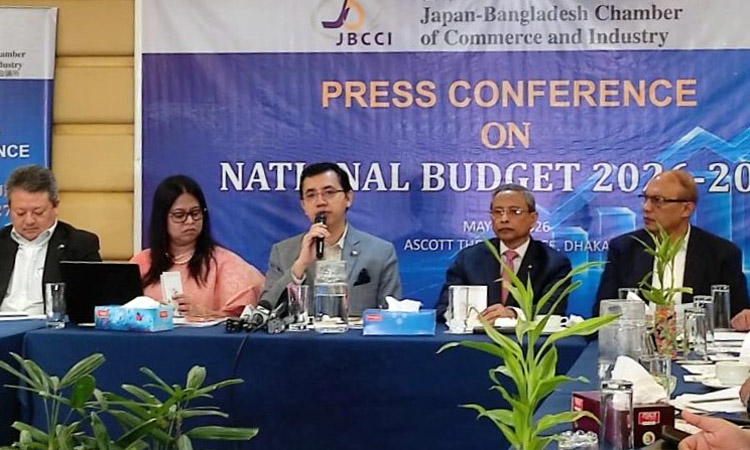
DHAKA, May 10, 2026 (BSS) – The Japan-Bangladesh Chamber of Commerce and Industry today unveiled a comprehensive set of recommendations aimed at including in the upcoming National Budget for Fiscal Year 2026–2027 (FY27), urging the government to prioritize investment, fiscal modernization and logistics reform to strengthen Bangladesh’s global competitiveness and attract greater Foreign Direct Investment (FDI).
At a press conference held at a city hotel in the capital, JBCCI leaders said the upcoming budget should move beyond a narrow focus on revenue collection and instead place stronger emphasis on industrial expansion, export competitiveness and long-term investment growth.
Maria Howlader, JBCCI Secretary General, said that the chamber proposed reducing the corporate tax rate from 25 percent to 20 percent in order to align Bangladesh with competing regional economies.
As an alternative, she suggested implementing a gradual one percentage point reduction annually over the next five years to balance fiscal requirements while signaling a more business-friendly investment climate.
She also recommended major reforms in the Value Added Tax (VAT) system, including reducing the standard VAT rate from 15 percent to 7.5 percent and introducing a unified structure to simplify compliance procedures for businesses.
She further called for the withdrawal of the minimum tax imposed on gross receipts for loss-making enterprises, arguing that such measures place additional pressure on struggling businesses and hinder sustainability.
In addition, she urged the government to lower customs duties on industrial raw materials, renewable energy equipment and manufacturing inputs to enhance export competitiveness and industrial productivity.
She also proposed introducing an automated and time-bound refund mechanism for VAT and income tax payments to reduce delays and release blocked working capital for businesses.
Highlighting strategic growth sectors, JBCCI also identified, agro-processing, textiles and automobiles as industries capable of transforming the country’s economic landscape.
Regarding the automobile sector, JBCCI Founding President Matiur Rahman noted that the domestic market is expected to surpass five lakh units annually by 2030.
He recommended gradually reducing the dominance of used vehicles in the market in order to encourage local automobile assembly and attract foreign investment in the sector.
In the textile industry, the chamber emphasized the need to shift toward high-end technical textiles and man-made fiber production to enable Bangladesh to move further up the global value chain.
It also underscored the significant potential of the agro-processing sector, noting that the global halal food market exceeds $2 trillion and remains largely underutilized by Bangladesh.
The chamber also stressed the importance of logistics and administrative reforms, observing that logistics costs in Bangladesh currently account for 12 to 15 percent of GDP, significantly higher than the 8 to 10 percent seen in competing economies. To address this gap, it called for greater automation at Chattogram Port to reduce vessel turnaround times and container dwell periods.
JBCCI further recommended repealing the “Bangladesh Flag Vessels (Protection) Act 2019” to improve maritime competitiveness and called for stronger coordination among the country’s 47 ministries to eliminate contradictory policies and reduce bureaucratic delays affecting trade and investment.
The chamber leaders also expressed support for the newly elected government under Tarique Rahman, praising what they described as an agenda of transformative reform. To ensure continuity in policy implementation and trade facilitation, they proposed establishing a quarterly dialogue mechanism between the government and business stakeholders.
Among others, JBCCI President Tareq Rafi Bhuiyan, JBCCI Vice President Md Anwar Shahid also spoke on the occasion.