Wednesday
22 July, 2026
News Flash
News Flash
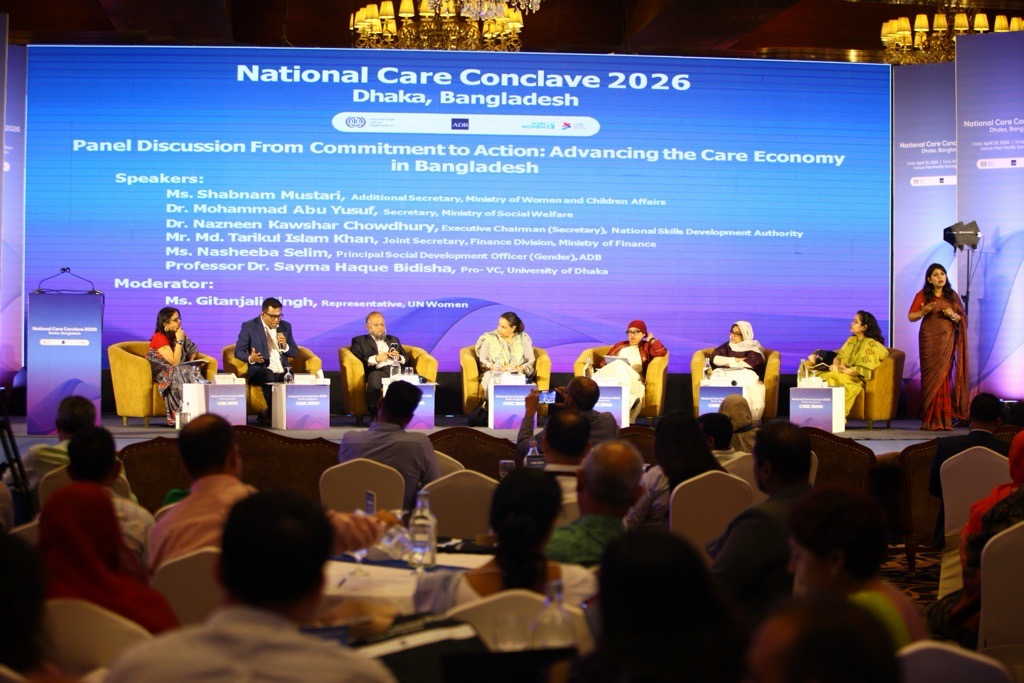
DHAKA, April 23, 2026 (BSS) - Bangladesh today convened the National Care Conclave 2026, bringing together government officials, development partners, policymakers, workers’ representatives, academics, and civil society leaders to build national consensus on strengthening the country’s care economy as a catalyst for economic prosperity, women’s employment, and social justice.
Organized jointly by the International Labour Organization (ILO), UN Women, and the Asian Development Bank (ADB) in coordination with the Ministry of Women and Children Affairs (MoWCA), Ministry of Labour and Employment (MoLE), and Ministry of Social Welfare (MoSW), the day-long conclave was held in the city, said a press release.
The conclave comes at a significant moment for Bangladesh as the country seeks to raise women’s labour market participation to 50 percent by 2030. While female labour market participation has risen to 42.6 percent, significant barriers remain, including unequal unpaid care workloads, underemployment, wage disparities, and the concentration of women in informal work.
Opening the event, Gitanjali Singh, Country Representative of UN Women Bangladesh, underscored the importance of investing in care systems that recognize, redistribute, and reward care work while creating opportunities for women and families.
Gitanjali Singh stated in her remarks: "The undervaluing and gendered division of care work (unpaid and paid) is one of the biggest drivers of gender inequality. Investing in care systems is a triple win for women, society, and the economy: as women’s time poverty reduces, more women enter and stay in the labour market, while investments in the care sector generate long-term dividends for human development, health, reduced poverty, and well-being of societies. "
Keynote presenters from ILO and ADB highlighted how investing in care systems drives economic prosperity. ILO estimates show that universal investment in childcare and long-term care could create over seven million decent care jobs in Bangladesh by 2035, significantly narrowing gender gaps in employment and earnings.
A ministerial dialogue on national policy commitments featured Abu Zafar Md. Zahid Hossain, MP, Honourable Minister, Ministry of Women and Children Affairs and Ministry of Social Welfare; and Ms. Farzana Sharmin, MP, Honourable State Minister, Ministry of Social Welfare.
“Empowering women is a macroeconomic necessity. By redefining care as a shared responsibility rather than a workload borne solely by women, we are unlocking the full potential of our workforce for national prosperity,” emphasized Minister Abu Zafar Md. Zahid Hossain during the session.
State Minister Farzana Sharmin added: “We must formally recognize the care economy as a cornerstone of development. Positioning care as a public priority ensures it becomes a dignified, professionalized sector that drives economic prosperity and empowers women across Bangladesh.”
“By transforming care from an invisible, private responsibility into a public policy priority, the government is unlocking a vital engine for economic prosperity and gender equality. We are committed to expanding quality and accessible childcare and long-term care services to address the evolving needs of society," Max Tunon, ILO Country Director in Bangladesh, summarized after the session.
A high-level panel discussion titled “From Commitment to Action: Advancing the Care Economy in Bangladesh” explored pathways for translating policy commitments into practical reforms. Speakers included senior secretaries from the relevant ministries, the National Skills Development Authority, Ministry of Finance, ADB, and academia.
The conclave also featured an interactive marketplace showcasing existing models of childcare, long-term care, and training services currently operating in Bangladesh. This was followed by three in-depth technical sessions that explored critical pathways for the care economy.
These sessions focused on professionalizing the care workforce to meet growing demand in domestic and global labour markets, utilizing care data to transition responsibility from households to the state, and integrating care entitlements—such as paid leave and breastfeeding breaks—into labour protections. Participants emphasized that these reforms are essential to ensuring social justice and the creation of decent care jobs that underpin economic prosperity.
In his closing remarks, Hoe Yun Jeong, ADB Country Director for Bangladesh, noted: “We stand ready to support this important agenda through strengthening policy and institutional frameworks, supporting pilot investments that can be scaled up, and integrating care more systematically across our sector operations. ADB remains committed to partnering with Bangladesh on this journey, in collaboration with other stakeholders.”
The conclave is expected to contribute to stronger national consensus on developing a comprehensive care policy framework that promotes quality services, decent work, gender equality, and inclusive economic participation.