Wednesday
22 July, 2026
News Flash
News Flash
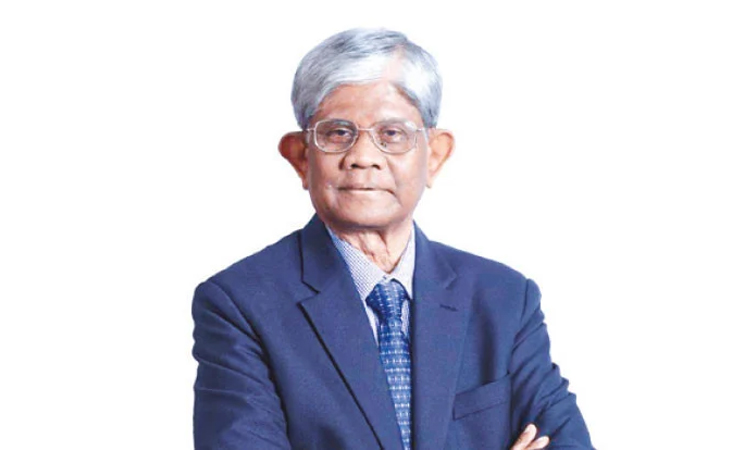
DHAKA, Feb 10, 2026 (BSS) - Finance Adviser Dr Salehuddin Ahmed today said that depositors’ interests have been prioritised in the banking sector while key corrective measures have been undertaken.
He also urged the stakeholders in the banking sector to adopt a balanced and constructive perspective.
“I request you to highlight issues positively as well. If there are mistakes, we will try to correct them—that is the most important thing,” he said.
The Finance Adviser was responding to the queries of reporters after chairing a meeting on the Advisers Council Committee on Government Purchase held at the Cabinet Division conference room at Bangladesh Secretariat today.
He said the government had taken difficult decisions to address irregularities and restore discipline in the financial system.
Referring to previous experiences, including his tenure as Governor of Bangladesh Bank during the last caretaker government (1/11 period), he said regulatory actions are not always pleasant but are sometimes necessary. “Many actions taken at that time were not comfortable or palatable, but they were required,” he said.
Dr Salehuddin Ahmed reiterated that protecting depositors remains the government’s foremost priority.
“Those who have deposits or fixed deposits in banks will receive their money. We have ensured that,” he said.
Evaluating the interim administration’s 18-month period in office, he said the government had stabilised the economy despite considerable inherited pressures.
“In last 18 months, we’ve tried to place Bangladesh in a stable position. Considering the country’s 54-year journey, the overall achievement is not poor,” he said.
He noted that Bangladesh has managed to sustain economic growth and support a population that has grown from 75 million at independence to around 180 million today.
“Bangladesh has often been described as a development test case. Despite ups and downs, it has emerged as a model in many respects,” he added.
Addressing broader concerns about economic management under previous administrations, the Finance Adviser said weaknesses in institutional transparency and accountability had contributed to systemic challenges.
“In many cases, institutions didn’t perform their mandated responsibilities. Some didn’t comply with existing laws, and discretionary powers were misused,” he said.
He maintained that during his tenure he refrained from exercising discretionary authority improperly.
“I’ve never used discretionary power in that way. When proposals came to issue new bank licences, I clearly said no,” he stated.
He said misallocation of credit and questionable lending decisions in the past led to significant distortions in the economy.
“Judgment errors were made in allocating funds to certain industries. In some cases, loan amounts far exceeded reasonable valuations,” he said, hinting at instances of inflated asset pricing.
He emphasised that neither he nor his colleagues personally benefited from such practices. “At least in my case, I have lived modestly. I have always lived in a flat. I have no personal gains from these matters,” he said.
On proposals to amend the Bangladesh Bank Order and alter the status of the governor, Dr Salehuddin Ahmed said structural reforms must go beyond symbolic changes.
“Simply upgrading the governor’s status is not enough. Broader banking sector reforms and governance changes are required,” he said.
He described altering board compositions or reducing government representation as complex policy decisions that extend beyond the mandate of an interim administration.
“Autonomy must be matched with capability and accountability. You must prove that you are capable of exercising autonomy,” he said.
On the question of compensating shareholders of troubled banks, the Finance Adviser described the matter as technically complex.
“When a bank’s net asset value becomes negative, technically the share value is affected. Many argue that shareholders assumed market risks when purchasing shares,” he said.
However, he indicated that options are being explored to provide partial relief where feasible.
“It may be possible in some cases to offer a portion in shares of consolidated banks or through other mechanisms. But, this requires careful financial calculation,” he said.
Dr Salehuddin Ahmed stressed that the burden cannot fall entirely on shareholders or the state without proper assessment of asset values and liabilities.
He reiterated that institutional reforms take time and that sustained efforts by future governments will be necessary to consolidate progress and strengthen financial stability.