Tuesday
21 July, 2026
News Flash
News Flash
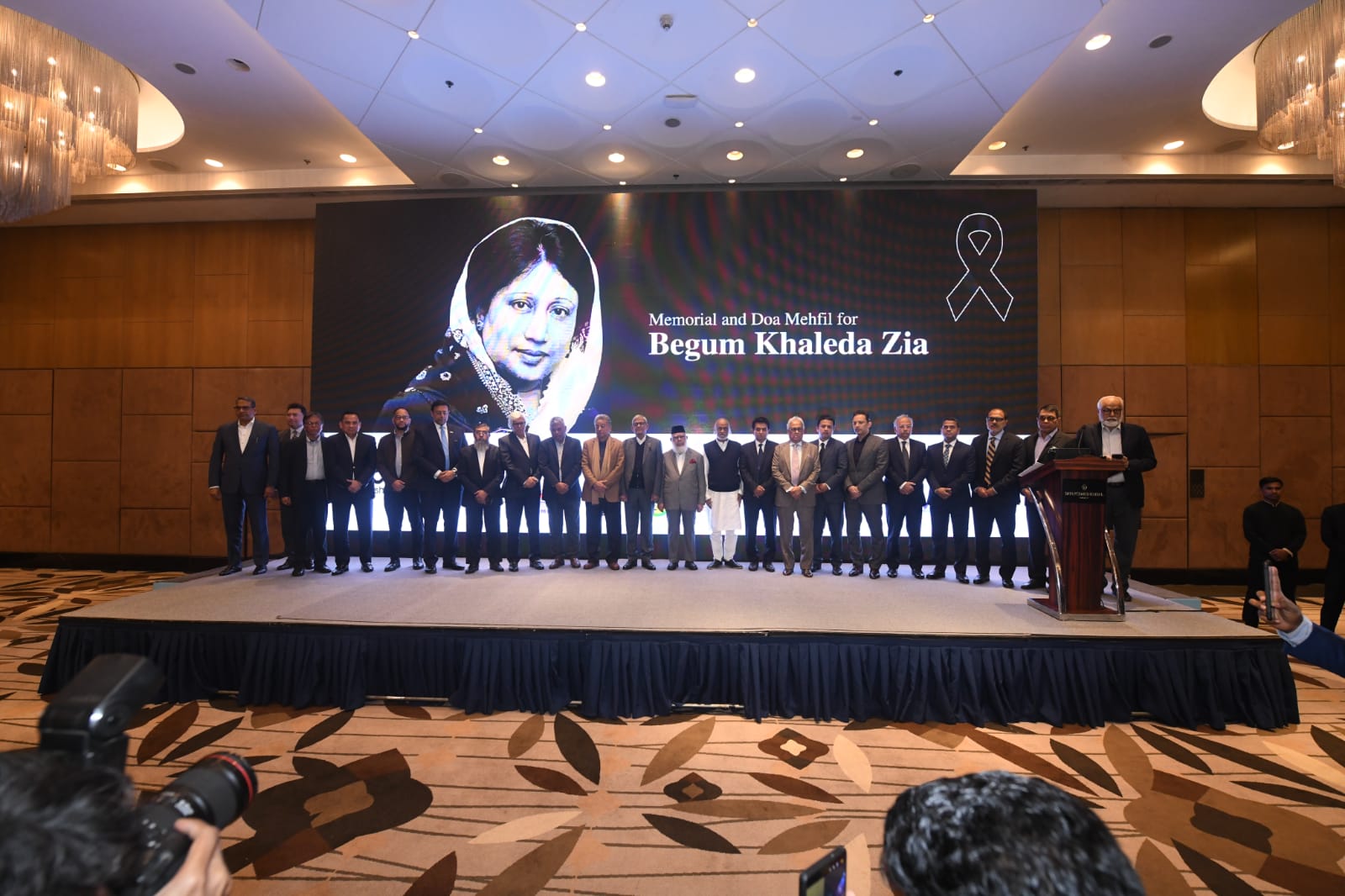
DHAKA, Jan 5, 2026 (BSS) – The business community today gathered to pay a solemn tribute to former Prime Minister Begum Khaleda Zia, recognizing her as a ‘pioneering leader’ who shaped the nation’s democratic and economic landscape.
They made the observation at a memorial and doa mehfil for Begum Khaleda Zia, Former Prime Minister and BNP Chairperson at a hotel in the city.
International Chamber of Commerce (ICC) – Bangladesh, in partnership with the Federation of Bangladesh Chambers of Commerce and Industry (FBCCI), Dhaka Chamber of Commerce and Industry (DCCI), Metropolitan Chamber of Commerce and Industry (MCCI), the Chittagong Chamber of Commerce & Industry (CCCI), Foreign Investors' Chamber of Commerce and Industry (FICCI), Bangladesh Chamber of Industries (BCI), Bangladesh Association of Banks (BAB), Bangladesh Insurance Association (BIA), Bangladesh Garment Manufacturers and Exporters Association (BGMEA), Bangladesh Knitwear Manufacturers & Exporters Association (BKMEA), Bangladesh Textile Mills Association (BTMA), Leathergoods and Footwear Manufacturers & Exporters Association of Bangladesh (LFMEAB), Bangladesh Association of Pharmaceutical Industries (BAPI), Bangladesh Association of Publicly Listed Companies (BAPLC), Bangladesh Semiconductor Industry Association (BSIA), Bangladesh Cement Manufacturers Association (BCMA) and Association of Bankers, Bangladesh (ABB) organised the memorial and doa mehfil.
BNP Secretary General Mirza Fakhrul Islam Alamgir, BNP Standing Committee member Amir Khasru Mahmud Chowdhury and BNP Standing Committee member Dr Abdul Moin Khan spoke on the occasion.
In his speech, Mirza Fakhrul Islam Alamgir described Begum Khaleda Zia as the nation's undisputed and uncompromising leader who dedicated her life to the restoration of democracy.
Recalling the moments following the student-led mass uprising on August 5, 2024, Fakhrul shared that despite her critical illness, Zia delivered a message of hope for the nation.
“Her directive was clear. The new Bangladesh must be built on unity and love, not revenge or malice,” he added.
He said that this message was instrumental in stabilizing the country during a period of potential lawlessness.
He called upon the people to transform their grief into strength to resist ongoing conspiracies and to build the Bangladesh envisioned in line with the spirits of War of Liberation in 1971 and movements of 1990 and 2024.
"We must stand up again," Fakhrul urged, noting that fulfilling her dreams for a democratic future is the only true way to show respect to her memory.
Amir Khasru Mahmud Chowdhury emphasized the pivotal role of Begum Khaleda Zia in shaping Bangladesh's modern economy and democratic framework.
He described the former Prime Minister as a ‘torchbearer' of democracy who carried forward the vision of Ziaur Rahman to restore the people's ownership of the country.
Chowdhury highlighted that the foundation of Bangladesh’s current economy rests on the private sector-led growth strategy initiated by Ziaur Rahman and vigorously continued by Khaleda Zia.
He noted that her foreign policy was rooted in multilateralism, a move designed to align the country with global free-market trends rather than being country-centric.
ICCB President Mahbubur Rahman delivered the welcome speech.
In his speech, Mahbubur Rahman said that by winning the historic 1991 election, Khaleda Zia became the first female Prime Minister of Bangladesh.
Her premierships, from 1991-1996 and 2001-2006, are noted for breaking barriers for women in leadership and strengthening democratic institutions, he added.
He highlighted her administration’s focus on poverty reduction and human development.
Under her leadership, he said, Bangladesh saw steady economic growth and a significant rise in foreign investment, including the landmark US$500 million KAFCO fertilizer project involving international partners from Japan, Denmark, and the Netherlands.
Beyond her policy achievements, he acknowledged the personal hardships Begum Khaleda Zia faced, including periods of imprisonment and long-term health struggles.
“Despite these challenges, she remained deeply connected to public service,” he added.
The ICCB President reaffirmed his own commitment to the nation's prosperity, echoing Zia's sentiment that she had “no home outside Bangladesh”.
Administrator of the FBCCI Abdur Rahim Khan honoured the legacy of late President Ziaur Rahman and Begum Khaleda Zia for their pivotal roles in Bangladesh's democracy and economic growth.
He stated that the late leader "unified all casts all parts in one point for the greater interest of the nation and democracy" to inspire a unified drive for national development.
Khan emphasized that the country must now unite to improve living standards as a lasting homage to their historical contributions.
In his speech, DCCI President Taskeen Ahmed said that when Khaleda Zia assumed office in 1991, the economy was stagnant and constrained by structural limitations.
“With remarkable foresight, she initiated an open-market approach, private sector–led development, and entrepreneurial policies to energize economic activity. Through landmark reforms-including the enactment of the VAT Act, the Bank and Financial Institutions Act, and the establishment of the Privatization Board and the Securities and Exchange Commission-she significantly strengthened revenue mobilization, the financial sector, and the capital market,” he added.
Among others, MCCI President Kamran T. Rahman, MCCI President BAB President Abdul Hai Sarker, BKMEA President Mohammad Hatem, BCI President Anwar-ul Alam Chowdhury (Parvez), BIA President Sayeed Ahmed, BGMEA President Inamul Haq Khan, BSIA President MA Jabbar and BCMEA President Mohammed Amirul Haque spoke on the occasion.