Tuesday
25 August, 2026
News Flash
News Flash
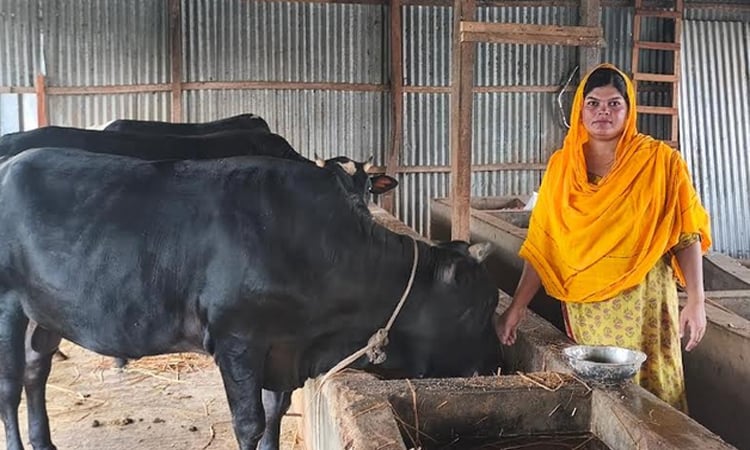
MADARIPUR, Aug 02, 2026 (BSS)- Determination, hard work and strong family support have helped Nusrat Jahan Sathi become a successful woman entrepreneur through dairy farming in Madaripur.
By raising and selling cattle, she has not only achieved financial independence but has also emerged as an inspiring figure for women in her community, encouraging others to pursue self-employment through commercial livestock farming.
Sathi, originally from Rajdi in Kalkini upazila, married Kazi Emarat Hossain of Syedarbali area in Madaripur town. After her marriage, she found that her father-in-law had been involved in cattle farming for many years. Inspired by the family tradition and encouraged by her husband, she established Amira Dairy Farm in front of her home in 2019.
She began her journey with just 10 cattle. However, due to a lack of experience, she lost several animals in the first year, suffering significant financial losses. Refusing to give up, she sought advice from experienced farmers on farm management, cattle nutrition, healthcare and hygiene.
With improved knowledge and dedication, she gradually expanded her farm and at one point raising the number of cattle more than 40.
She currently has nine cattle heads in her farm, including three dairy cows. Despite caring for her three children—the youngest being just two years old—she continues to manage the farm efficiently. She plans to expand the business again once her children are older.
In addition to cattle farming, Sathi also raises ducks, chickens and pigeons. Her farm currently includes around 80 ducks, 40 chickens and 20 pairs of pigeons, providing additional income and helping her build an integrated livestock farm.
Rising feed prices, however, remain a major challenge for livestock farmers as feeding a medium-size cow costs approximately Taka 300 to Taka 500 per day.
According to people involved in the livestock sector, cattle for fattening are generally purchased for Taka 70,000 to Taka 80,000 and sold after several months of proper feeding and care.
Dairy farming, on the other hand, requires purchasing young female calves and raising them over a longer period. With proper management, a cow purchased for around Taka 60,000 can later be sold for Taka 200,000 to Taka 300,000 generating substantial profits while allowing farmers to recover their investment relatively quickly.
Sathi shared early struggle of raising her dairy farm with BSS.
"I was devastated after losing several cattle in the first year. But I never lost my patience or determination. Today, I care for every animal as if it were my own child. I ensure timely feeding, a clean environment, regular treatment and vaccination. I want more women to become entrepreneurs and transform their lives. Greater access to government training and easy-term loans would encourage many more women to join this sector," she said.
Farm worker Soleman Sheikh said, cattle farming is labor-intensive but highly rewarding when managed properly.
"The animals need to be fed twice a day, bathed regularly and provided with medicine and veterinary care whenever necessary. Maintaining cleanliness significantly reduces the risk of disease," he said.
Mahmuda Akter Kona, former Deputy Director of the Department of Women's Affairs in Madaripur, said, Sathi's success demonstrates that women can make significant contributions to the livestock sector through confidence and perseverance. "Entrepreneurs like Sathis are creating positive social change and inspiring others," she added.
Nurunnahar Jui, president of the women's development organization Nakshi Kantha, described Sathi's achievements as an example for other women.
Madaripur District Livestock Officer Dr. Mohammad Achir Uddin said the department regularly provides technical guidance on disease prevention, vaccination, feed management and farm operations.
Entrepreneurs like Nusrat Jahan Sathi are a source of inspiration. We hope more women and men will be encouraged to engage in commercial livestock farming by following Sathi’s example, he hoped.