Saturday
05 September, 2026
News Flash
News Flash
Aynal Haque
RAJSHAHI, April 24, 2026 (BSS)- Severe heat waves and drought in the region have emerged as major problems for mango farmers despite flowering orchards had created immense hope among them at the beginning of the season.
According to the Department of Agriculture, this year the production target for Rajshahi, Chapainawabganj, Naogaon, and Natore districts has been set at about 12 lakh metric tons with an estimated market value of over Taka 11,000 crore.
However, due to adverse weather, mangoes fruitlets are dropping prematurely, raising concerns about meeting the target.
Most orchards saw good flowering, and increased cultivation of new varieties such as Amrapali, BARI Mango-3, and BARI-4, raised hopes for yielding more production than last year.
Surpassing last year’s record, there is a more export target this year in Malaysia and Japan. Under the Exportable Mango Production Project, orchard owners are adopting modern and safe cultivation practices.
A mild heat wave has been continuing from last week of March with temperatures reaching up to 39.5 degree Celsius. Due to lack of rainfall, small mango buds/fruitlets are drying up and falling off.
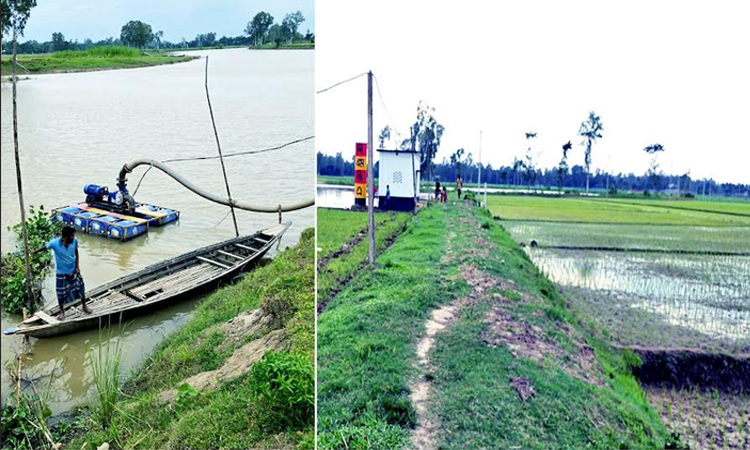
Although regular irrigation is needed during drought conditions, farmers cannot irrigate because groundwater levels have dropped.
Costs of fertilizer, pesticides, and irrigation have also increased, raising production expenses. Hopper insects and other diseases also aggravated the situation, creating possibility of putting impact on overall production.
Experts from Department of Agricultural Extension (DAE) and Fruit Research Center have advised light, regular irrigation in orchards, timely spraying of appropriate pesticides, and keeping the soil moisture to prevent mango drop.
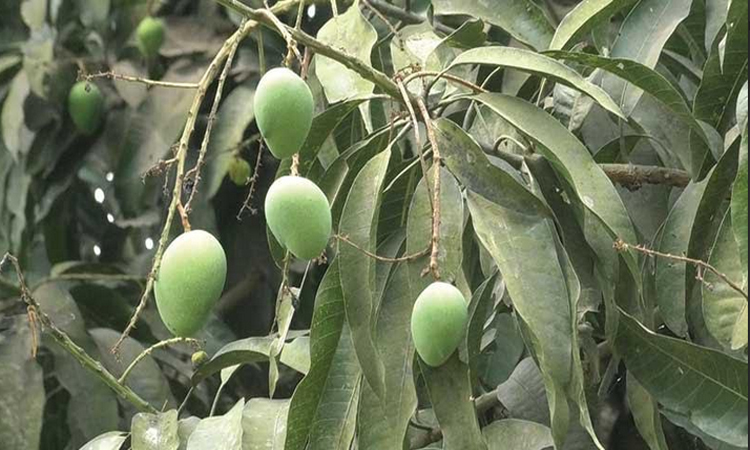
During a field visit on Thursday, it was observed that in many orchards, trees were nearly empty after fruitlets fell off in the prolonged heat. In some places, only a few fruitlets were visible in the branches while many trees become completely barren.
Farmers said mango flowering in the Rajshahi region began in the second week of February this year. With about 95 percent of trees flowering, they had hoped for a good yield. But the sudden heat wave dashed those hopes. Already, about 25 percent of the fruitlets in many orchards have dropped.
Suruj Ali, a mango grower from Puran Tahirpur area in Durgapur Upazila said, “This year all the trees had abundantly blossomed. Branches looked like they would break. But now, in the intense heat, most of the fruitlets have fallen. Many trees are completely empty now.”
Similarly, Estak Sardar, a farmer from Anulia village, said, “Last year I sold mangoes worth several lakh taka. But this year, with fewer fruitlets on the trees, the yield will be much lower.”
Golam Mostafa, a grower from Shyampur village, said about 90 percent of the trees in his orchard had blossomed. But the heat wave that began in the last week of March colossally damaged the blossoms. This has raised concerns about even recovering production costs.
Meanwhile, the Rajshahi Weather Office reported that a mild heat wave has been sweeping Rajshahi and other parts of the country since early April. Met office said several more heat waves are likely this month.
Agriculture officials say that because flowering occurred early this year, it was damaged by fog and heat waves. As a result, dropping has increased. If the drought continues, losses would high.
Durgapur Upazila Agriculture Officer Shahana Parvin Laboni said, “To prevent fruit drop, orchards must be irrigated regularly and pesticides should be sprayed as needed.”
However, farmers report they are struggling to irrigate due to a fuel crisis and falling groundwater levels in many areas. They fear this will have a major negative impact on mango production.