Friday
21 August, 2026
News Flash
News Flash
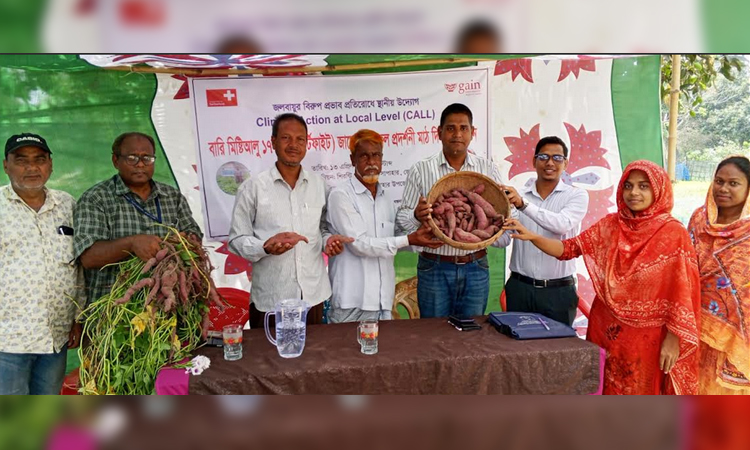
RAJSHAHI, April 14, 2026 (BSS) - Farmers in the drought-prone Barendra region of Naogaon are experiencing a notable shift in agricultural productivity and nutrition through the cultivation of the beta-carotene enriched and drought-tolerant sweet potato variety BARI Misti Alu-17.
Previously uncultivated land due to limited irrigation is now being brought under production, reducing dependence on water-intensive farming inputs while generating micronutrient-rich crops that are improving both food security and farmer incomes.
The initiative is being implemented by Caritas Bangladesh with technical support from the Global Alliance for Improved Nutrition under the Climate Action at Local Level (CALL) Programme, funded by the Embassy of Switzerland in Bangladesh.
The programme promotes climate-resilient and nutrition-sensitive agricultural practices among smallholder farmers.
A field day marking the harvesting of BARI Misti Alu-17 was held on Sunday at Kashitara village under Shironti Union in Sapahar upazila, drawing participation from farmers, agriculture officials, and local community representatives.
Farmer Sathi Akhter said the new variety has significantly reduced production costs as it requires no irrigation.
"The crop is disease-tolerant, produces long and nutritious tubers, and gives a high yield," she said, adding that she harvested around four tonnes per bigha.
Upazila Agriculture Officer Shapla Khatun under the Department of Agricultural Extension highlighted the nutritional benefits of the crop, noting that BARI Misti Alu-17 is rich in vitamin A (beta-carotene), zinc, and other essential micronutrients.
She added that the variety can yield around 5.0 to 5.5 tonnes per bigha under proper management, significantly higher than local varieties.
Experts also noted that sweet potato vines, locally known as Misti Alu lota, provide additional nutritional and livestock benefits. The tender leaves are rich in vitamin A, vitamin C, iron, calcium, and antioxidants, while also serving as high-quality green fodder in drought-prone areas.
The programme is currently being implemented across three upazilas of Naogaon-Porsha, Sapahar, and Niamatpur-where farmers are receiving training, technical guidance, and support for demonstration plots.
Alongside sweet potato cultivation, the project promotes a range of climate-smart agricultural practices, including year-round homestead vegetable production, biofortified rice, wheat and lentil cultivation, mulching-based vegetable farming, green manuring, alternate wetting and drying (AWD) irrigation, and urea deep placement technology.
Local representatives, including Shironti Union Chairman Representative Siddikur Rahaman, Sub-Assistant Agriculture Officer Babul Hossain, and around 60 to 70 farmers attended the field day.
Experts said wider adoption of climate-resilient and nutrient-rich crops like BARI Misti Alu-17 could play a key role in strengthening food security, improving nutrition, and enhancing resilience among smallholder farmers in climate-vulnerable regions.
The field day was chaired by Mohammad Abul Bashar Molla, Project Manager of the Caritas CALL Project.