Sunday
30 August, 2026
News Flash
News Flash
RAJSHAHI, March 17, 2026 (BSS) - Agricultural experts have called on grassroots farmers to expand the cultivation of biofortified wheat varieties to help reduce zinc deficiency among the people.
The appeal came at a field day where speakers highlighted the success of zinc-enriched wheat developed by Bangladesh Agricultural Research Institute, particularly the BARI Wheat-33 variety.
Farmers in the drought-prone Barind region are reporting promising results with the new variety, which is resistant to blast disease, tolerant to heat and capable of producing good yields with minimal irrigation.
Lands that previously remained fallow due to water scarcity are now being used to grow nutrient-rich wheat.
The action is being supported by the Climate Action at Local Level (CALL) implemented by Caritas Bangladesh in three upazilas of Naogaon district: Porsha, Sapahar and Niamatpur; managed by the Global Alliance for Improved Nutrition and funded by the Swiss Agency for Development and Cooperation.
The project provides farmers with training, seeds, fertilizers, demonstration plots, and technical support, alongside coordination with government agricultural agencies.
Key project activities include enhancing the effectiveness of climate-resilient agricultural practices, such as homestead vegetable cultivation, yam farming, cultivation of thick-stemmed Malabar spinach, zinc-enriched rice and wheat and vegetables.
It also focuses on increasing awareness about climate change impacts, forming and facilitating the Multi-Stakeholders' Platform (MSP) at the Union Parishad level, and strengthening close coordination with government departments of agriculture, fisheries and livestock.
Across 20 unions in the three upazilas, the project is actively engaging 160 farmer groups including youth.
Additionally, youth groups are helping farmers develop ICT skills and use agricultural mobile applications to manage crop diseases and pests.
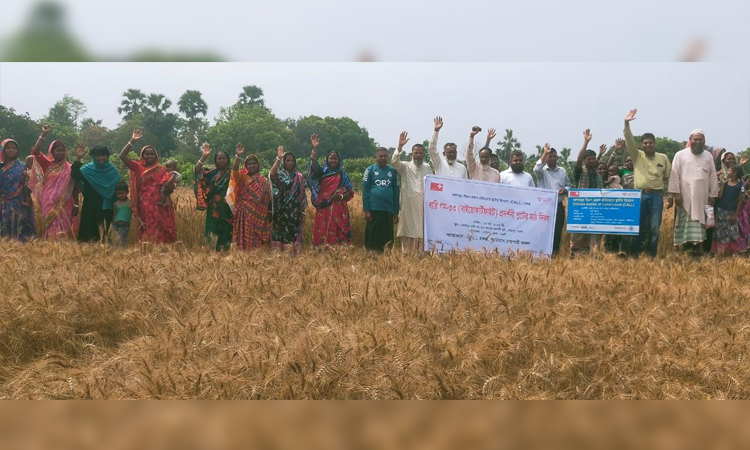
As part of these activities, a field day was held on Monday at the wheat field of farmer Md. Mozammel in Bejora village of Chhaur Union under Porsha upazila, Naogaon district.
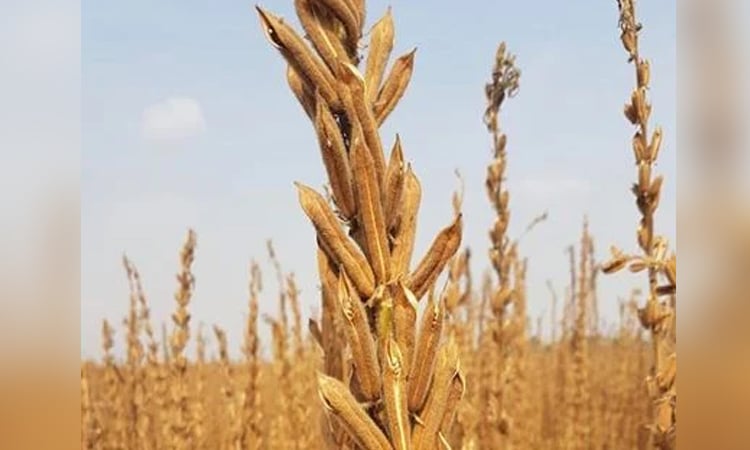
The event marked the harvesting of the zinc-enriched (biofortified) BARI Wheat-33 variety.
Farmer Md. Mozammel stated that the variety requires minimal irrigation, reducing production costs. It is resistant to diseases, has longer spikes, and has produced a good yield. He expects a yield of 18-20 maunds per bigha.
Upazila Agriculture Officer Mamunur Rashid also spoke at the event, noting that the variety is newly introduced, zinc-enriched, heat-tolerant, and resistant to blast and rust diseases.
Compared to conventional varieties, it yields significantly more-around 17 to 20 maunds per bigha-if sown at the right time and with proper seed treatment. After inspecting the demonstration plot, he expressed optimism for even higher yields.
Speakers at the event also included representatives from Chhaur Union and Sub-Assistant Agriculture Officer Samirul Islam.
Around 60-70 farmers, both men and women from Bejora village, attended the program.
The field day was chaired by Mohammad Abul Bashar Molla, Project Manager of the CALL Project.
He said the main goal of the project is to contribute to a resilient, diverse ecosystem and sustainable food system by strengthening public and private institutions in climate and disaster risk management and increasing farmers' capacity.
It has also been working to increase farmers' adaptive capacity through access to climate-smart technologies, sustainable agricultural practices, and community-driven adaptation strategies in climate risk management, which will reduce climate risks.