Tuesday
28 July, 2026
News Flash
News Flash
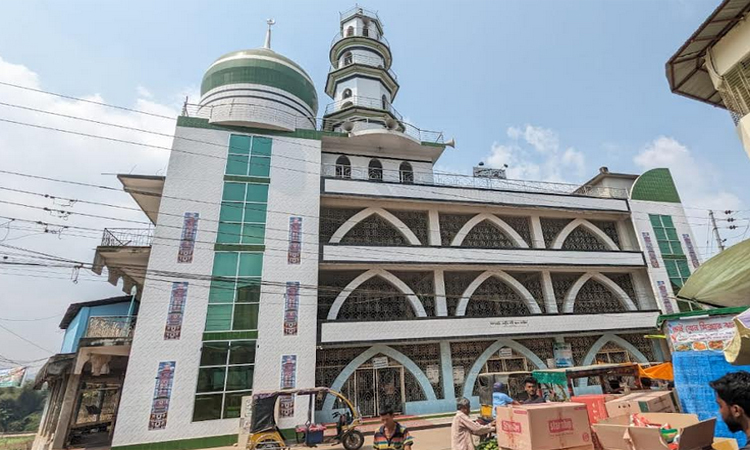
KHAGRACHARI, March 1, 2026 (BSS) - The historic Khagrachari Central Shahe Jame Mosque, widely regarded as a symbol of heritage and harmony, continues to stand tall as a witness to various eras in the hill district.
Located in Sadar upazila, the mosque-originally built in 1840 during the British rule-has evolved from a modest tin-shed structure into a spacious three-storey concrete building over the past 150 years. Today, it serves not only as a place of worship but also as a prominent architectural landmark attracting both devotees and tourists.
Historical accounts reveal that the mosque was established through the sole initiative of late Haji Badsha Miah Saudagar, eldest son of Lal Miah craftsman.
With the cooperation of the then Deputy Commissioner Ali Haider of Rangamati and contributions from prominent traders, including late Haji Maqbul Hossain Saudagar, the mosque was built on the banks of the Chengir River when Khagrachari was a small market village under Ramgarh Mahakuma.
Muslim traders from Rangunia and Raozan in Chattogram frequently traveled by boat through Rangamati and Mahalchhari to conduct business in the area.
Their collective support led to the construction of the original wooden and straw structure, which later transformed into a tin-shed building and eventually into the present three-storey mosque.
The mosque now spans nearly 10,000 square feet, measuring approximately 95 feet north-south and 100 feet east-west. Its square prayer hall is crowned with three domes, while a tall, illuminated minaret-visible even from the scenic Alutila Cave area-serves as a recognizable landmark of the town.
Designed with intricate craftsmanship, chandeliers, stone pillars, brickwork and decorative wall motifs, the mosque's architectural style reminds many visitors of Iranian mosque designs. Ablution facilities and sanitation services are located on the east-south side of the complex.
Currently, the mosque can accommodate around 5,000 worshippers at a time, compared to only 30 to 40 devotees during its early years. Morning religious lessons are conducted at the Maktab, and the mosque employs a khatib and eight staff members.
Local residents say the mosque has long symbolized communal harmony in the hill district, where people from different communities have historically coexisted peacefully. In earlier times, people of various faiths were known to light candles and offer prayers at the mosque, reflecting a spirit of brotherhood.
Mohammad Liaqat Sawdagar, a regular worshipper, described the mosque as both a spiritual sanctuary and a historic landmark. "One can recognize Khagrachari town from afar by seeing its tall minaret," he said.
Former mosque committee president Md. Jahedul Alam emphasized the importance of preserving the mosque's legacy for future generations. Mosque officials, including Khatib Abdun Nabi Haqqani and Pesh Imam Mohammad Salah Uddin, said that tourists from across the country visit the site, many believing it to be the oldest mosque in the district.
For the past three years, the mosque has been managed by the district administration. Regular worshipper Md. Zahurul Alam said that although communal iftar gatherings during Ramadan were once a cherished tradition, such public arrangements are no longer organized.
The mosque sustains itself through multiple income sources. It owns 28 shops and plots, generating approximately Taka 15 lakh annually. F
riday donations contribute an additional Taka 6-7 lakh per year, while two acres of agricultural land yield around Tk 35,000-40,000 annually. The mosque also maintains a pond where fish farming is conducted, alongside receiving government and private donations.
As Khagrachari continues to grow, the Central Shahe Jame Mosque remains not only a place of worship but also a historic monument-standing firm as a witness to time, tradition and unity in the hill district.