Saturday
22 August, 2026
News Flash
News Flash
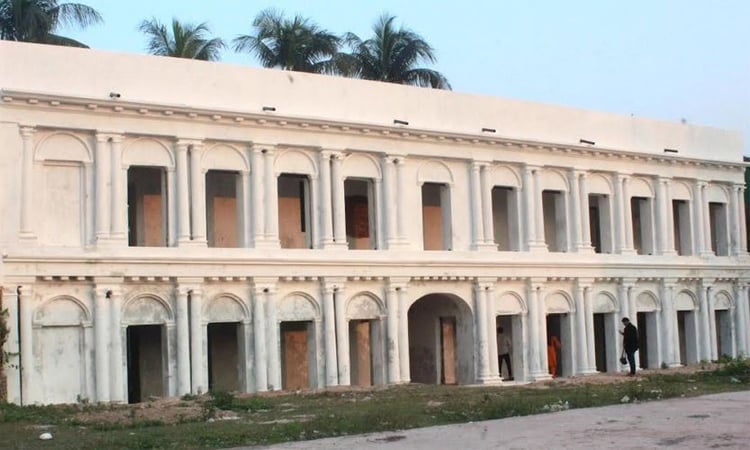
BARISHAL, Jan 11, 2026 (BSS) - The historic Lakutia Zamindar Bari in Babuganj upazila of the district has regained much of its original grandeur following long-awaited restoration work by the Department of Archaeology.
Once reduced to a crumbling ruin, the centuries-old palace is now standing strong again after the successful completion of the first phase of renovation work.
Visible from a far upon entering the Lakutia area, the zamindar house had for decades borne the marks of neglect—corroded walls layered with rain and dust, broken architectural designs, moss-covered verandas and a roof that had collapsed long ago.
Over time, the once-majestic structure had fallen into disrepair.
Under the supervision of the Department of Archaeology, renovation work began on May 4 last year. According to officials, the old roof was completely dismantled and replaced with new tiles sourced from Satkhira. Round brick pillars were constructed around the building to reinforce and stabilize the structure.
Arifur Rahman, Assistant Custodian of the Barishal Divisional Museum, said the first phase focused on restoring the foundation, brickwork and roof at a cost of approximately Taka 60 lakh. “The exterior has been painted white to protect the structure from rain. In the second phase, historical features such as doors, windows and flooring will be restored to reflect the original design,” he told BSS, adding that the next phase would begin soon.
On-site observations showed that the renovation has revived much of the building’s original appearance. Metal supports have been installed to preserve older wall sections, damaged wooden beams have been replaced with varnished wooden blocks, and the inner rooms have been thoroughly cleaned, giving the interior a renewed and attractive look.
Khulna–Barishal Regional Director of the Department of Archaeology, Lovely Yasmin, said the restoration work is being carried out based on old photographs, documents and descriptions provided by local residents. “Our aim is to restore the zamindar house as close to its original form as possible,” she said.
Historically, the Lakutia Zamindar family was founded by Rupchandra Rai, with the estate expanding significantly during the time of his grandson Rajchandra Rai, who built the zamindar house on nearly 50 acres of land. Members of the family later converted to Brahmanism. The family produced notable figures such as Indralal Rai, a renowned aviator, and Paresh Lal Rai, a celebrated boxer—both prominent in the history of the Indian subcontinent.
The zamindar family also shared close ties with the Tagore family. Dwijendranath Tagore’s sons, Arunendranath and Dipendranath, married Rajchandra Rai’s granddaughters, Sushila and Charubala.
Museum authorities said the two-storey building measures about 8.20 metres in height, 25.40 metres in length and 9.20 metres in width, and contains nine rooms. Three ponds surrounding the building, locally known as Babur Pukur, add to its historical setting.
Lincoln Bayen, Barisal divisional coordinator of the Bangladesh Environmental Lawyers Association (BELA), welcomed the renovation but urged authorities to remove a warehouse located beside the building. “If the warehouse is not removed, the archaeological value of the site will be diminished,” he said.
The restoration initiative gained momentum after Alpana Roy, an heir of the zamindar family currently living in Australia, wrote to the government in 2018 requesting preservation of the ancestral home.
Speaking to BSS, Alpana Roy said, “I grew up hearing stories of the Lakutia zamindarbari from my father, Pankaj Roy Chowdhury. It is not only part of our family history, but also an important chapter in Barishal’s heritage.” She also said the family’s historical connection to Rabindranath Tagore and contemporary literary figure Arundhati Roy.
Cultural personality Sushanta Ghosh, who has long advocated for the site’s preservation, expressed satisfaction with the progress.
“I saw this house slowly decay over the years. Through social initiatives by Charukala Barishal, we raised awareness. Now that restoration has begun, we hope it will be fully preserved for future generations,” he said.