Tuesday
18 August, 2026
News Flash
News Flash
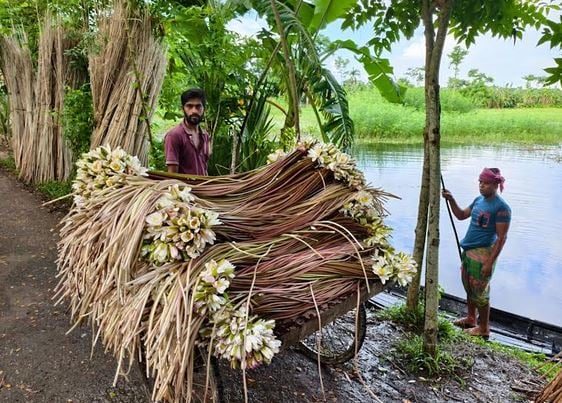
BARISHAL, Aug 18, 2026 (BSS) - Water lilies blooming across flooded fields, canals and wetlands have become an unexpected source of livelihood for hundreds of families in Agailjhara upazila of the district during the monsoon.
As agricultural land remains submerged during the rainy season and farm work declines, many farmers and rural residents are collecting water lily stalks from nearby wetlands and selling them without any investment. For some, the seasonal trade provides an income of up to Taka 2,000 to Taka 2,500 a day.
At dawn, collectors take their boats into the wetlands and spend hours gathering the stalks and before bringing them to local wholesalers. The wholesalers then transport the produce by vans to markets in different parts of the district and nearby upazilas, while some collectors sell the lilies directly in local markets.
The collection is particularly active in Chengutia-Choudameda wetland and other flooded agricultural areas. Residents of Rajihar, Goila, Bakal, Bagdha and Ratpur unions are also involved in the seasonal occupation.
Mohammad Kalam Howlader, a water lily collector from Chengutia-Choudameda wetland, told BSS that agricultural work becomes scarce during the monsoon as farmland remains under water.
“So, I go to the wetland by boat early in the morning. I can collect between 200 and 400 bundles of water lilies a day,” he said.
Local wholesalers buy the water lily stalks from collectors at around Taka 5 per bundle and resell them at nearly Taka 10. Wholesaler Banoj Mondal said he sells around 200 to 300 bundles a day by going from house to house.
“After meeting all expenses, I earn a good amount from the business,” he told BSS.
Local residents said a collector can gather around 200 to 250 bundles a day during the peak season. On a good day, earnings can reach Taka 2,000 to Taka 2,500. Those involved in wholesale trading can make daily sales of Taka 2,000 to Taka 3,000 or more.
Collector Rahman said he works in water lily collection for around four months every year.
“There is little work in the fields during this period. I collect water lilies and sell them to meet my family's expenses. It requires no investment, so it is a major source of support for us during the monsoon,” he said.
Water lily stems are traditionally used as a vegetable in rural areas, particularly in curries. Demand for the vegetable has also been increasing in urban areas, creating additional market opportunities.
The water lily season generally lasts from Ashar to Bhadra, roughly three to four months. The plant grows naturally in flooded paddy, jute and dhaincha fields as well as canals, wetlands, ponds and ditches. Since it grows naturally, farmers do not have to make any separate investment for its production.
Agailjhara Upazila Agriculture Officer Suniti Kumar Saha told BSS that water lily is not considered a conventional agricultural crop.
“It mainly grows naturally in agricultural land, ponds, ditches and other water bodies. Therefore, the scope for direct agricultural extension services regarding its production is limited,” he said.
He added that the agriculture department nevertheless tries to provide farmers with assistance, including advice on how to preserve water lilies for a longer period.
Md Shahidul Islam, additional deputy director (horticulture) of the Department of Agricultural Extension in Barishal, said better preservation and export opportunities could turn water lilies into a source of several crore taka in foreign currency every year.
He said people of different ages have become involved in the seasonal trade because collecting water lilies requires no capital.
According to him, 100 grams of water lily contains about 31 grams of carbohydrates, three grams of protein and 76 milligrams of calcium, making it a nutritious vegetable.
For people living around the wetlands of Agailjhara, the monsoon was once synonymous with unemployment as farmland remained submerged and agricultural work declined. The same water has now become a source of income for many households.
The national flower, water lily, is therefore more than a symbol of the beauty of the monsoon for the people of Agailjhara—it has become a quiet but important source of livelihood for many families during the rainy season.