Wednesday
26 August, 2026
News Flash
News Flash
By Md Aynal Haque
RAJSHAHI, Aug 3, 2026 (BSS)- Once, whenever it rained, panic would descend on the family of Motalib and Sanjuara Bibi. Water would drip into the house through holes in the tin roof. They tried to manage the leaks by placing pots in one spot, pans in another, and buckets elsewhere.
In the end, they had no choice but to spend the night on a wet bed. For safe drinking water, they had to go to the mosque or rely on their neighbors.
After a long decade of helplessness and poverty, a new chapter has begun for the family—a chapter of hope.
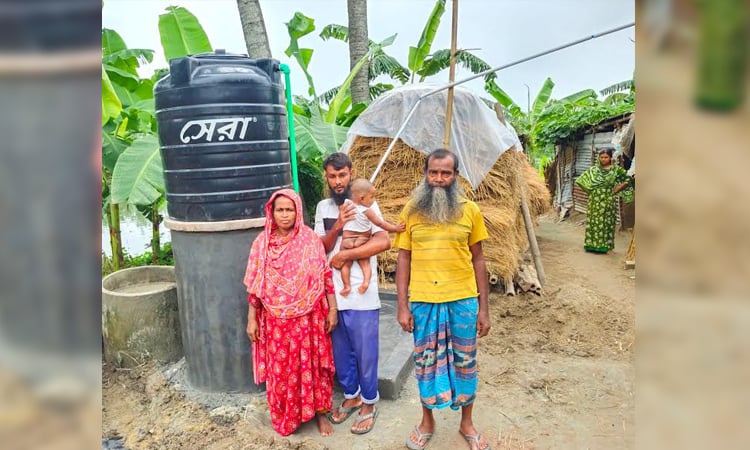
With humanitarian assistance from the upazila administration, the family has received new tin sheets, financial support, and a submersible water pump.
During a visit to Talgachhi Padmapukur village in Bargachhi Union of Paba Upazila, Rajshahi, this morning, it was seen that a new submersible water pump had been installed in front of their dilapidated house.
Not only Motalib's family but also people from the surrounding area are now collecting safe drinking water from the pump.
Fifty-four-year-old Motalib kept looking repeatedly at the new tin sheets placed beside the house. His tears seemed to say that these were not just sheets of tin, but the fulfillment of dreams he had carried for many years.
Motalib once earned his livelihood through heavy labor involving bamboo work. About 10 years ago, he suffered a serious waist injury while working. Later, doctors diagnosed him with a complicated spinal condition.
Since then, he has almost lost his ability to work. The entire responsibility of supporting the family fell on his wife, Sanjuara Bibi, and his younger son, Mithun Hossain.
Working as agricultural laborers on others' land, they somehow managed two meals a day. But they never had the means to repair the broken house or arrange safe water.
In a choked voice, Motalib said, “On rainy nights, I sat inside the house holding an umbrella. I kept pots and pans to stop the water. Many times I had to spend the night on a wet bed. I thought I would never be able to fix this house.”
On three decimals of land stands their small house with three rooms. The mud wall of one room collapsed long ago. Motalib and his wife live in that broken house. The younger son stays on the veranda, and in the next room lives their sick elder son Shafiqul Islam and his wife.
The elder son cannot do heavy work due to lung problems. The family's only regular earner is the younger son Mithun. To meet the family's shortage, Sanjuara Bibi also has to sell her labor every day in others' fields — in chili, brinjal, gourd, bitter gourd or other vegetable fields.
With tearful eyes, Sanjuara Bibi said, “We had no tube-well in our house. During the drought, we had to bring water from a distant mosque. Now not only us, but people of the whole neighborhood can take water from here. It feels like our suffering of so many days has eased a little.”
Local resident Al Amin Hossain said, “This initiative of the administration is truly praiseworthy.”
Muslim, a resident of Padmapukur village, said, “There was no water pump in this locality. Everyone faced a water crisis during drought. Now people of the whole area will benefit from this pump.”
Joint convener of Paba Upazila BNP, Sultan Ahmed, said, “This is not just assistance of a few bundles of tin or some money; it is a reflection of the state's humanitarian sense of responsibility towards a helpless family.”
Paba Upazila Nirbahi Officer (UNO) Md. Ibnul Abedin said Sanjuara Bibi had applied for assistance. Later, after visiting their house and seeing the actual condition, four bundles of tin, Taka 12,000 for house repair and a submersible water pump were given.
Ensuring a safe roof over one's head and pure water is a fundamental right. The upazila administration is working sincerely to deliver government assistance to the real beneficiaries.
He further said, “Our goal is to ensure that no helpless person in the upazila is deprived of government services. If affluent people of the society also stand by such families, then new dreams will light up in many more broken houses.”