News Flash

By Md Aynal Haque
RAJSHAHI, July 4, 2026 (BSS)- Rajshahi’s betel leaf has long held a distinct reputation in the country’s market for its taste, aroma, and quality.
Recognized as a GI (Geographical Indication) product, this betel leaf is not only part of the region’s agricultural heritage but also a vital source of the district’s economy and rural livelihoods.
Many farming families in various upazilas, especially Mohanpur, Bagmara, and Durgapur, depend on income from betel leaves.
Although the potential of the GI product has increased this season due to expanded cultivation and higher production, excess supply in the markets has created pressure on prices.
According to the Department of Agricultural Extension (DAE), betel leaf cultivation in Rajshahi has increased by 510 hectares this season. Production is also likely to be about 10,000 metric tons higher than last year.
With the rise in cultivation and production, supply has increased in various betel leaf markets across the district. While trading in the markets is brisk, farmers are somewhat concerned about prices.
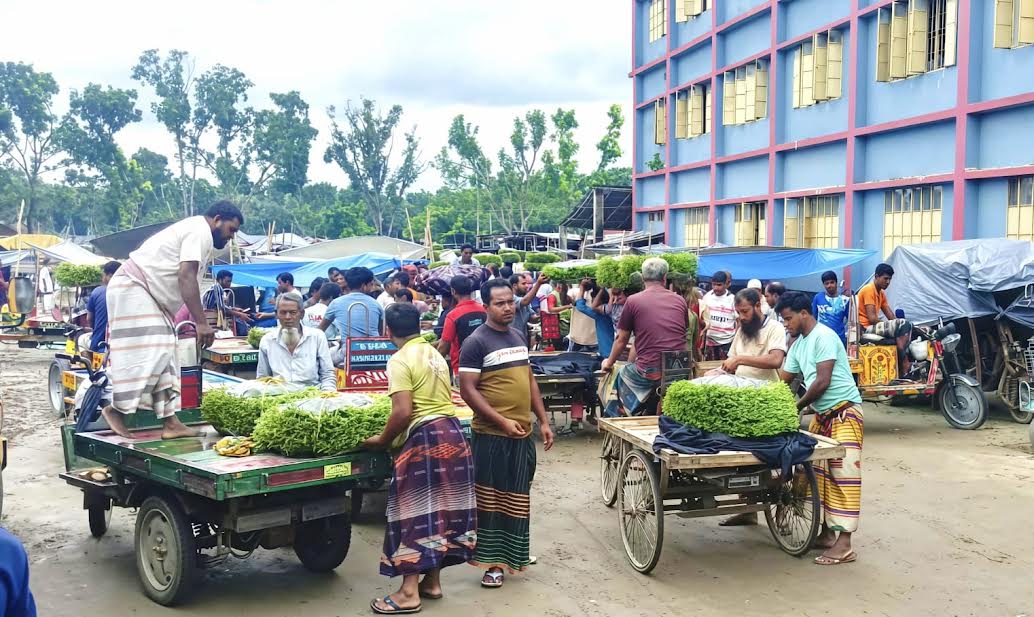
A field visit on Wednesday to the Mougachhi, Kesharhat, Pakuria, Kuthibari, and the largest Ekdiltola betel leaf markets in Mohanpur upazila of Rajshahi found farmers arriving at the markets with betel leaf from early morning.
Some carried it on their heads, others brought it by van or bicycle. The entire area was bustling with wholesalers, retailers, and farmers bargaining over prices.
Premium quality betel leaf is sold at Taka 100 taka per bira (a traditional unit for counting betel leaves, equal to 64 leaves), large-sized at Taka 35, medium-sized at Taka 20, and small-sized at Taka 6 per bira.
Regarding betel leaf market prices, Senior Agricultural Marketing Officer Sanoar Hossain said that 64 leaves make one bira, and 32 biras make one poya.
Accordingly, one poya contains 2,048 leaves. Currently, in the betel leaf markets, small-sized leaves sell for Taka 200 to 250 per poya, medium-sized for Taka 600 to 800, large-sized for Taka 1,000 to 1,200a, and premium quality for Taka 2,500 to 3,000 per poya.
Boder Uddin, a betel leaf farmer from Haridagachhi village in Mohanpur upazila, said that production was higher this year due to favorable weather.
He said, "I sold 10 biras of large betel leaves in the market for Taka 350." He added that despite higher production, he is somewhat worried about profits due to comparatively lower prices.
Golam Mostafa, another betel leaf farmer from Mohanpur upazila, said that the yield in the betel gardens was good this year.
However, due to high supply in the market, they are not getting the expected price. The cost of fertilizer, pesticides, labor, and garden maintenance has increased compared to before.
He said, "If the price were a little better, farmers could have made a profit." He believes that if the number of wholesale buyers increases and supply to other districts becomes easier, prices might rise.
Saidur Rahman, another betel leaf farmer from the same upazila, said that many families in Mohanpur depend on income from betel leaf. While higher production is good news for farmers, profits drop when prices fall.
He said, "A lot of betel leaves are coming to the market, but buyers are offering low prices." Because betel leaf spoils quickly, farmers are often forced to sell at lower prices.
He noted that if there were better systems for preservation and marketing, farmers could get fair prices.
According to the DAE, last year betel leaf was cultivated on 4,509 hectares of land in Rajshahi district, with production of 77,452 metric tons. This season, cultivation has taken place on 5,019 hectares.
Compared to last year, cultivation has increased by 510 hectares. The production target this year is set at 87,550 metric tons. That means there is potential for about 10,000 metric tons more betel leaf production than last year.
Agricultural officials say the increase in production is positive. However, excess supply in the market may put pressure on prices.
Therefore, emphasis needs to be placed on betel leaf preservation, transportation, wholesale market management, and increasing supply to other districts.
If branding, quality control, and market expansion of Rajshahi’s betel leaf as a GI product can be achieved, local farmers can benefit more.
Mohammad Nasir Uddin, Deputy Director of the DAE, said that both cultivation and production of betel leaf have increased in Rajshahi this season.
Farmers are being advised on quality betel leaf production, pest and disease management, and market-oriented farming.
The market situation is also being monitored to ensure that the produced betel leaf is sold at fair prices.
Kamrul Islam, Mohanpur Upazila Agriculture Officer, said that betel leaf is the main agricultural product in Mohanpur upazila.
This year, betel leaf has been cultivated on 1,900 hectares of land in the upazila. Every year, about Taka 600 crore worth of betel leaf is traded in various markets of Mohanpur upazila. Mougachhi, Jahanabad, and Dhurail unions of this upazila are betel leaf-dominated areas.
Local farmers and traders said that betel leaf from Mohanpur is supplied to various districts across the country in addition to Rajshahi.
Although production is high, farmers can get better prices with proper market management, transport facilities, and more wholesale buyers.
In their view, to realize the potential of Rajshahi’s GI product betel leaf, increasing production alone is not enough. Planned initiatives are also needed for preservation, marketing, and market expansion.