News Flash

By Borun Kumar Dash
DHAKA, June 17, 2026 (BSS) – Every morning before going to school, Riyan Ahmed, a resident of the capital's Azimpur Colony, eats chocolate-flavoured biscuits. His school tiffin usually contains chips or cake along with a soft drink, while in the evening his parents often bring home chanachur, noodles and other packaged snacks on their way back from work.
Like many urban families, packaged and ultra-processed foods have become a regular part of their daily diet due to their convenience, attractive packaging and affordability.
However, the family's lifestyle has recently begun to change. Riyan's father has developed high blood pressure, his mother has diabetes, and Riyan himself is gaining weight rapidly. Doctors have advised them to reduce their intake of foods high in salt, sugar and unhealthy fats.
Only then did they realise that the snacks they had long considered harmless were gradually contributing to serious health risks.
“We always thought packaged foods were safe and healthy,” Riyan's mother Julekha Parvin told BSS. “Apart from checking the expiry date, we hardly paid attention to anything else because the nutrition information on the back is written in tiny letters and difficult to understand. We never knew which products contained excessive sugar, salt or unhealthy fats.”
The story reflects the reality of countless Bangladeshi families who unknowingly consume ultra-processed foods and beverages that increase their vulnerability to non-communicable diseases (NCDs).
According to the World Health Organization (WHO), NCDs account for 570,263 deaths annually in Bangladesh, representing around 71 percent of total deaths in the country. Of these, 19 percent are premature deaths. Experts say a significant share of these diseases is linked to lifestyle and dietary habits, making food choices a major public health concern.
Over the past two decades, Bangladesh's food culture has undergone a significant transformation. Packaged and ultra-processed foods have expanded rapidly not only in cities but also in rural areas.
Many of these products contain excessive amounts of salt, sugar, saturated fat and trans fat.
A nationwide cross-sectional survey conducted in 2025 among 974 adults, adolescents and children found that nearly 97 percent of respondents consumed packaged foods at least once a week.
Research by the WHO further revealed that 63 percent of 105 processed and ultra-processed food products analysed across 14 food categories contained high levels of salt. In many cases, information regarding saturated fat, trans fat, sugar and sodium was incomplete, unclear or absent on product labels.
To address this challenge, WHO recommends Front-of-Pack Labelling (FOPL) as an effective and cost-efficient public health intervention. So far, 44 countries have introduced FOPL systems, including 10 that have made warning-label-based FOPL mandatory. Evidence from these countries shows that FOPL improves consumer awareness and encourages manufacturers to reformulate products to improve nutritional quality.
Public health experts say FOPL is directly linked to NCD prevention. Introducing clear and easy-to-understand warning labels on the front of food packages would help consumers make informed choices and reduce the burden of diet-related diseases.
They also stressed the importance of ensuring uninterrupted access to medicines for managing conditions such as hypertension.
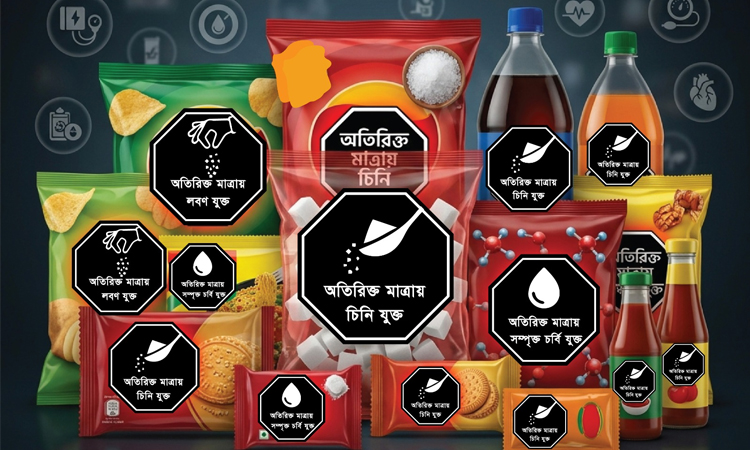
In Bangladesh, the Bangladesh Food Safety Authority (BFSA) has incorporated mandatory FOPL provisions into the draft Safe Food (Packaged Food Labelling) Regulations, 2026.
Under the proposal, packaged foods containing excessive sugar, sodium or saturated fat would be required to display black octagonal warning labels on the front of the package.
Experts believe that once implemented, the measure will enable consumers to identify unhealthy products more easily and make healthier dietary choices, thereby helping control food-related NCDs.
BFSA Member Professor Dr. Mohammad Shoeb told BSS that efforts are underway to introduce the Front-of-Pack Labelling system to raise consumer awareness about ultra-processed foods.
“Once implemented, the initiative will help reduce the risk of non-communicable diseases in the country,” he said.
WHO Programme Officer (Diet-Related Risk Factors) Samina Israt said FOPL is one of the organization's recommended cost-effective measures for addressing diet-related NCD risks.
“It can play an important role in promoting healthier eating habits among the population,” she added.
Highlighting global experiences and Bangladesh's current situation, public health expert Dr. M. Mushtaq Hossain told BSS that FOPL is much more than a labelling system.
“It is an important public health intervention. Its implementation can help protect future generations from the growing burden of non-communicable diseases,” he said.
He noted that excessive consumption of ultra-processed foods high in sugar, salt, saturated fat and trans fat is driving a rapid increase in diabetes, cardiovascular diseases and obesity.
xecutive Director of PROGGA ABM Zubair said FOPL is an effective tool for controlling NCDs.
“Clear warning labels on the front of food packages will empower consumers to choose healthier options, which will contribute to sustainable improvements in both public health and the economy in the long run,” he said.