Sunday
12 July, 2026
News Flash
News Flash
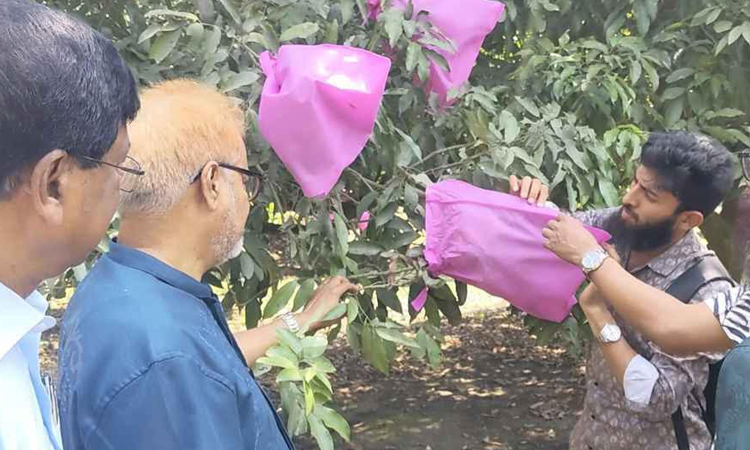
DINAJPUR, June 8, 2026 (BSS) - Research conducted by scientists at Hajee Mohammad Danesh Science and Technology University (HSTU) has demonstrated that the environmentally friendly bagging method can effectively protect litchi fruits from harmful insect attacks while increasing production and improving quality.
According to a press release issued on Sunday by HSTU's Public Relations Department, Professor Dr. Md. Abdul Alim of the Department of Entomology under the Faculty of Agriculture has achieved significant success over the past two years in developing and promoting this technique as an alternative to chemical pesticides.
The research has shown promising results in several litchi orchards in Dinajpur Sadar, Chirirbandar and Phulbari upazilas during the current harvesting season. Orchard owners reported improved yields and reduced fruit damage after adopting the bagging method under the guidance of HSTU researchers.
Sources said the technique involves covering clusters of developing litchi fruits with specially designed colored bags—such as orange, yellow, blue and white—shortly after fruit set. The bags act as a physical barrier, preventing attacks by the litchi fruit borer, one of the most destructive pests affecting litchi production.
Statistics indicate that more than 30 percent of annual litchi production is lost due to fruit borer infestations. To address this challenge, Dr. Alim and his team have been researching eco-friendly pest management practices, including bagging, biopesticides and insect growth regulators.
Explaining the process, Dr. Alim said that each bag typically covers 30 to 45 developing fruits immediately after fruit formation. The bags allow sufficient light and air circulation, ensuring normal fruit growth while preventing insect infestation.
“Bagging not only protects the fruit from harmful insects but also reduces damage caused by bats and other pests. Moreover, the use of biopesticides and insect growth regulators instead of harmful chemical pesticides ensures that the fruits remain free from toxic residues,” he said.
Dr. Alim said that conventional chemical pesticides pose risks to human health and the environment. The research team therefore focused on developing a safer and more sustainable pest management approach.
The study recorded positive results over the past two years. Researchers found that the method successfully controlled fruit-boring insects while maintaining the attractive color and quality of the litchi fruits.
“Last year, we successfully controlled litchi fruit borers using this method. Although fruit color can sometimes be affected by covering, our trials produced litchis with excellent color and quality. The yields were also satisfactory,” Dr. Alim said.
He expressed optimism that the technology would provide farmers with an effective, environment friendly solution for managing fruit-boring insects and reducing dependence on chemical pesticides.
Interest among orchard owners has increased significantly this season, with many growers expressing their willingness to adopt the technique on a larger scale next year. Researchers plan to work closely with the Department of Agricultural Extension to expand awareness and encourage widespread adoption of the method.
Dr. Alim believes that large-scale implementation of bagging technology could help produce safe, pesticide-free litchis for consumers across the country while promoting environmentally sustainable fruit production practices.
“With the support of the Agriculture Department and active participation from farmers, we hope to make poison-free, safe litchi available to consumers nationwide,” he added.