Monday
24 August, 2026
News Flash
News Flash
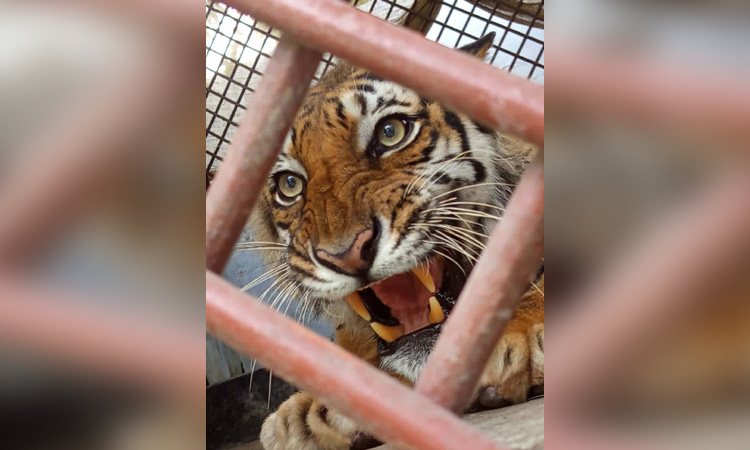
KHULNA, June 4, 2026 (BSS)- A tigress rescued from a poacher’s snare in the Sundarbans and treated for five months at the Wildlife Management and Nature Conservation Department’s rehabilitation centre in Khulna has fully recovered, but experts remain divided over its release into the forest.
The differing opinions have slowed the process of releasing the animal back into the Sundarbans, concerned sources said.
A section of wildlife experts believes that, given the tigress’s advanced age, its movements should be monitored after release through the use of a satellite collar or microchip.
However, procuring a satellite collar from the United States could take several months and would require substantial funding.
Meanwhile, the Forest Department is spending more than Taka 2 lakh per month on the tigress’s food and medication.
Divisional Forest Officer (DFO) of the Khulna Wildlife Rescue and Rehabilitation Centre Nirmal Kumar Paul said the tigress is being fed 4-5 kilograms of fresh meat daily. The injury to its left foreleg has completely healed following regular treatment and medication.
“New skin has formed over the wound, and the tigress is now able to move swiftly. She is physically fit for release into the forest,” he said.
Paul said another meeting is scheduled this month, during which a final decision on the tigress’s release is expected.
Earlier, on May 21, a virtual meeting involving senior Forest Department officials and wildlife experts was held to discuss the matter.
The meeting was chaired by Deputy Chief Conservator of Forests (Education and Training) Zahidul Kabir and attended by Conservator of Forests for the Khulna region Imran Ahmed, wildlife experts from Jahangirnagar University and University of Dhaka, as well as officials from the eastern and western divisions of the Sundarbans.
During the meeting, some experts recommended fitting the tigress with a satellite collar or microchip to facilitate post-release monitoring. As a result, the meeting concluded without a final decision.
Asked about the proposal, DFO Nirmal Kumar Paul said importing the technology could take another two to three months and would require a budget currently unavailable to the Forest Department.
“If no decision is made to install the tracking device, the tigress could be released by the end of this month or during the first week of July,” he added.
The tigress was trapped in a poacher’s snare in the Sharkir Khal area of the Sundarbans in Mongla Upazila on January 3 this year.
On the following day a specialised Forest Department team rescued the animal and transferred it to the rehabilitation centre in Khulna.
A five-member medical board was formed to oversee its treatment. After nearly five months of intensive care, the tigress is now fully recovered.
Veterinarian Hatem Sajjat Zulkarnaine, who was closely involved with the treatment, said the animal had been rescued under extremely challenging circumstances.
“At the time of rescue, the tigress was weak, emaciated and lethargic. The snare had caused severe damage to the skin, muscles and veins over a three-inch section of its front left leg,” he said.
He added that the wound had become infected due to prolonged struggle against the snare, but regular dressing and antibiotic treatment allowed it to heal by March.
Conservator of Forests for the Wildlife and Nature Conservation Region, Sannauallah Patwary, said tigers generally live up to 15 years in the wild, while the rescued tigress is estimated to be between 10 and 11 years old.
“After prolonged treatment, the tigress has regained its agility and strength. It now weighs around 80 kgs,” he said.
However, he expressed concern that the tigress may have lost some hunting ability after spending a long period in captivity and may struggle to compete with other animals in the wild due to its age. For that reason, he suggested that the tigress could instead be housed in a safari park.
Wildlife researcher and zoology professor M A Aziz disagreed, arguing that the tigress has the right to live and die in its natural habitat.
“Even if the tigress survives for only one day in the wild, it would be meaningful. Keeping it in a safari park would deprive it of a natural life and death,” he said.
However, Aziz supported the idea of fitting the animal with a satellite collar for monitoring purposes. Conservator of Forests Imran Ahmed said camera-trap surveys conducted in 2024 identified the tigress three times across an area spanning about 40 kilometres.
“Based on those records, we are considering releasing it in the most remote area, far from human settlements,” he said.
Ahmed added that the differences of opinion regarding the tigress’s release have delayed the final decision, but a conclusion is likely to be reached within June.