Monday
15 June, 2026
News Flash
News Flash
By Moshtak Ahmed
DHAKA, May 23, 2026 (BSS) - Bangladesh is uniquely blessed with a vast network of waterways that crisscross the land. The country’s agriculture and economy is heavily dependent on the waterbodies.
However, due to long-term encroachment, siltation, unplanned urbanisation and mismanagement, countless canals and water bodies across the country have lost their natural flow. This has impacted river navigability, agriculture, fisheries and waterlogging situation.
The disappearance of canals has intensified waterlogging across both urban and rural areas. Even moderate rainfall now inundate streets in Dhaka and other cities, while low-lying regions suffer frequent and prolonged flooding.
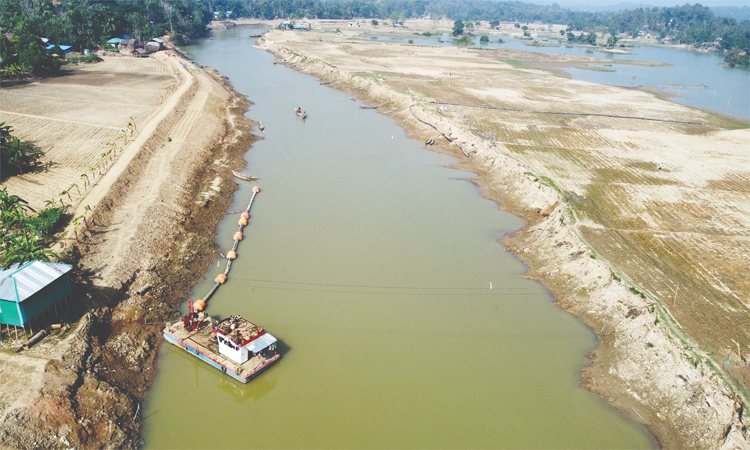
Against this backdrop, the nationwide canal excavation and re-excavation programme launched by Prime Minister Tarique Rahman on March 16, offers a glimmer of hope.
The benefits of restoring rivers and canals are immense, both economically and ecologically. Reviving these natural waterways would improve drainage, reduce waterlogging, enhance agricultural productivity and restore ecological balance.
According to government data, there is a plan to excavate and re-excavate a total of 20,000 kilometres of canals across the country over the next five years.
Water Resources Minister Md. Shahid Uddin Chowdhury Annie recently informed that this massive programme has been undertaken as part of implementing the government's electoral pledges.
Several organisations, including the Ministry of Water Resources, the Local Government Division, the Ministry of Agriculture, and the Ministry of Disaster Management and Relief, are jointly implementing this programme.
The implementing agencies include the Bangladesh Water Development Board (BWDB), the Local Government Engineering Department (LGED), the Bangladesh Agricultural Development Corporation (BADC), district administrations and upazila administrations.
According to government figures, a target has been set to complete the excavation or re-excavation of 1,204 kilometres of canals by June this year.
During the same period, there are plans to repair and re-excavate an additional approximately 1,500 kilometres of canals under the KABIKHA, KABITA and TR programmes of the Ministry of Disaster Management and Relief.
Sources concerned say that the national-level river-canal-water body excavation programme officially began in March this year. Prime Minister Tarique Rahman inaugurated the programme at Kahaloo upazila in Dinajpur.
According to water experts, when canals connected to rivers become silted up, the natural water flow of the rivers is disrupted.
This leads to silt accumulation in rivers, reducing navigability. Also, as water cannot drain quickly during the rainy season, severe waterlogging occurs.
When water movement is normalised through canal re-excavation, the river's flow is also revitalised. This gradually removes accumulated silt from the river and restores navigability.
Experts say that "a river's life" essentially refers to its flow capacity, biodiversity, navigability and water retention capacity.
When the canals and water bodies connected to a river remain active, water exchange in the river increases, fish breeding improves, irrigation facilities for agriculture enhance and waterlogging decreases. Thus, the river becomes alive again.
Officials of the Bangladesh Water Development Board say that many ancient canals connected to the country's numerous rivers have become silted up due to encroachment and filling, causing the rivers to dry up.
This natural connection is being restored through canal re-excavation.
The Ministry of Water Resources has stated that under the programme, besides excavating canals, work is also being done on canal bank protection, tree plantation, eviction of illegal encroachment and ensuring water flow. District administrations have been given special instructions in this regard.
Recently, the Ministry of Land issued a circular allowing private initiatives to also participate in the excavation and re-excavation of government canals. The circular stated that many canals have lost navigability due to long-term encroachment and siltation.
Therefore, initiatives are being taken to restore canals by involving local people and private entrepreneurs.
Government sources said that emphasis is also being placed on raising public awareness about protecting rivers and canals on the occasion of National River Day. Various district administrations, the Water Development Board and the Local Government Division are conducting river cleaning drives, discussion meetings and tree plantation programmes.
From an economic perspective, canal re-excavation is also seen as important. Agricultural experts say that when canals are active, irrigation systems become easier, pressure on groundwater decreases and fish production increases.
The positive impact of canal re-excavation is already visible, especially in the northern and coastal regions.
Urban planners believe that canal re-excavation is also playing a major role in mitigating waterlogging. In the capital Dhaka and other cities, encroachment and siltation of canals cause waterlogging even with light rain. They believe that if the canals are restored, the city's drainage system will become more effective.
Environmentalists say that excavation alone is not enough; strict monitoring is required to keep canals free from re-encroachment and re-filling. Often, even after excavation, canals get encroached upon again within a few years.
Meanwhile, although no separate single budget has been announced for the government's integrated canal re-excavation programme, funds are being allocated periodically under various ministries and projects. Officials concerned said that these tasks are being carried out from the development budgets of the Ministry of Water Resources, LGED, BADC and the Ministry of Disaster Management and Relief.
Chairman (Senior Secretary) of the National River Protection Commission, Moksemul Hakim Chowdhury, told BSS, "There is no scope to view rivers separately. A river is connected to numerous canals, beels (marshes) and water bodies."
He said, "If these canals become silted or encroached upon, the natural water flow of the river is disrupted, silt accumulates reducing navigability, and gradually the river becomes almost dead. So, canal re-excavation is actually an effective initiative to bring rivers back to life."
He further said, "The excavation and re-excavation programme that the government is currently implementing is not only for alleviating waterlogging; it is also directly related to preserving the river's ecological balance."
He said, "When canals become active, water flow in the river increases, fish habitats are restored, irrigation facilities for agriculture improve, and biodiversity also returns."