Sunday
06 September, 2026
News Flash
News Flash
By Moshtaq Ahmed
DHAKA, May 11, 2026 (BSS) - There was a time when obtaining land records, completing mutation and paying land development taxes (khajna) were time-consuming, complex and costly processes for ordinary citizens.
People had to visit union and upazila land offices or even deputy commissioner’s offices for days to receive services. Bureaucratic delays, lack of transparency, and the dominance of brokers further increased public suffering. However, with the advancement of digital technology, the situation is changing. Most land services are now available through mobile phones.
As a result, corruption is decreasing, transparency is increasing, and citizens are experiencing greater convenience.
Regarding this, Additional Secretary (Development) of the Ministry of Land, Emdadul Haque Chowdhury, told BSS that due to automation, people no longer need to visit land offices directly for services. They can now receive services from home or online. As a result, corruption has decreased and access to services has become easier.
He suggested that citizens must also become more aware; otherwise, it will remain difficult to eliminate middlemen completely.
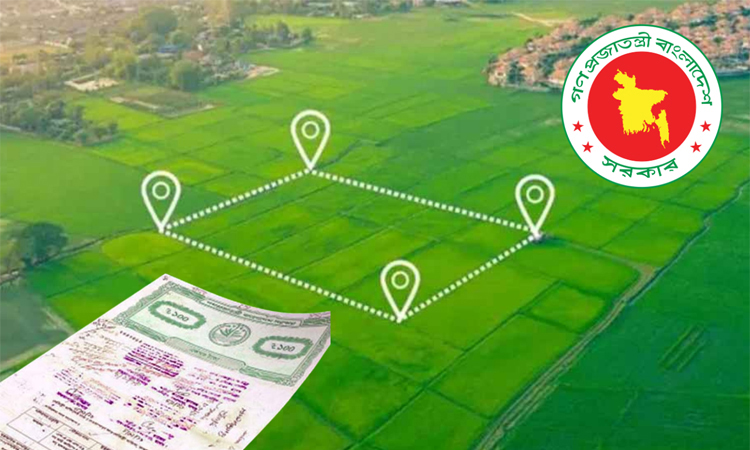
As part of the government’s “Smart Bangladesh” initiative, the Ministry of Land and the Directorate of Land Records and Surveys (DLRS) have gradually brought land management under a digital framework over the past several years.
As a result, online mutation applications, e-mutation settlements, land development tax payments, collection of land records and mouza maps, complaint submissions, and verification of land-related information can now all be done easily through mobile phones.
Officials concerned say that the introduction of digital land services has not only reduced time and costs but also ensured transparency at every stage of service delivery.
Consequently, opportunities for corruption have declined and public suffering has been significantly reduced.
Paying taxes from home: Previously, paying land development tax required visiting land offices in person and standing in long queues.
In many cases, people had to travel multiple times, resulting in both time and financial loss.
Now, taxes can be paid from home through mobile banking and online payment gateways.
According to the Ministry of Land, the number of online tax payers has been increasing every year since the introduction of e-porcha and e-khajna services.
Currently, around four to five million citizens pay land development taxes online annually. A significant number of expatriate Bangladeshis are also paying taxes from abroad. As a result, the need to physically visit land offices has greatly decreased.
Zainal Abedin, a resident of Lakshmipur Sadar Upazila, told BSS that paying taxes used to consume an entire day, but now the process takes only a few minutes on a mobile phone, and receipts are received instantly.
Online mutation reducing dependence on brokers: After purchasing land, ownership records must be updated through mutation procedures. Previously, this was one of the most complicated stages. Many people relied on brokers and had to spend several times more than the official fees.
Now, with online mutation applications, the situation has changed significantly.
Applicants can submit applications online themselves, upload necessary documents, and monitor the progress through mobile phones.
Since SMS notifications are available at every step, applicants receive updates instantly. According to government data, more than 10 million e-mutation applications have already been resolved nationwide.
Currently, over 500,000 applications are under process at different stages. Officials concerned said special instructions have been given to field administrations to dispose of pending applications quickly.
Regarding this, Additional Secretary of the Ministry of Land Nasrin Jahan, told BSS that online mutation applications have significantly reduced the problems faced by service seekers.
She added that assistant commissioners (land) at every upazila have been instructed to ensure quick disposal of applications.
If mutation applications are not resolved within the stipulated time, officials are being held accountable, she said.
Land records and mouza maps now within reach: Verification of land records and mouza maps is crucial to prevent land-related fraud.
Previously, many people were deceived due to fake documents while collecting such information. Now, ownership details, plot numbers, ‘khatian’ numbers, and land measurements can all be verified online.
Businessman Shimul Chakraborty from Chattogram said that verifying land documents during purchases used to be very troublesome.
Now, information can easily be cross-checked online to confirm authenticity, he said.
Decline in broker influence: In the past, broker syndicates centered around land offices exploited ordinary people and extracted extra money.
Due to lack of information and complicated procedures, many citizens were forced to depend on them.
Now, online-based services have significantly reduced that dependence.
Since official fees and timelines are publicly available online, opportunities for demanding extra payments or causing unnecessary delays have decreased.
In addition, digital tracking systems now make it possible to monitor how long an official has kept an application pending, thereby increasing accountability.
Teacher Shahadat Hossain from Kachua Upazila of Chandpur said that mutation once seemed extremely difficult, but this time he completed the process easily through an online application without needing any broker.
Digital database and future plans: The Ministry of Land is working to incorporate all land records, ‘khatians’, and ‘mouza’ maps into an integrated digital database. Old records from various districts are already being scanned and preserved in digital archives.
In the future, there are plans to introduce GIS (Geographic Information System)-based map services that will allow citizens to view land information visually.
This is expected to reduce land boundary disputes and litigation.
There are also plans to use Artificial Intelligence (AI) to detect forged documents, prevent attempts to sell the same land multiple times, and accelerate application verification processes.
Officials concerned stated that if information from the Ministry of Land, district administration, sub-registrar offices, and revenue departments can be integrated into one platform, land ownership records could be updated automatically after land transactions.
Regarding this, Joint Secretary of the Ministry of Land Tofazzal Hossain told BSS that databases of land services received by citizens are being preserved due to automation.
He added that there are future plans to launch GIS-based map services for land information. This would reduce land boundary disputes as well as land-related court cases.