Tuesday
11 August, 2026
News Flash
News Flash
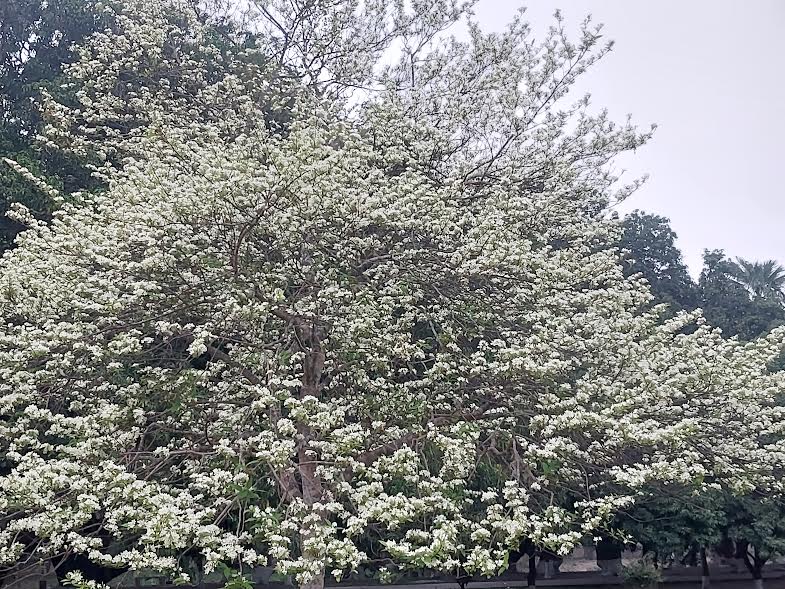
NATORE, May 8, 2026 (BSS) - Uttara Ganabhaban is now in the full bloom season of Hemonti flowers. Seven Hemonti trees have transformed the premises of Uttara Ganabhaban into a unique landscape filled with color, fragrance and charm. The buzzing of bees around the blossoms has created an enchanting atmosphere all around.
Beyond the breathtaking royal architecture and the museum of extraordinary collections brought from various countries, the rare assortment of trees inside the Ganabhaban grounds stands out remarkably.
Most of these are flowering trees. Among them are Parijat, Magnolia, Nagalingam, Eggplant flower tree, Surabhika and Hemonti.
The presence of these flowering trees proves that Uttara Ganabhaban is not only a royal palace but also a vast floral kingdom.
Among them, the Parijat tree changes the color of its leaves in a circular pattern and turns into clusters of red blossoms during spring. Though the Eggplant flower tree bears a few flowers almost throughout the year, winter and monsoon are its peak blooming seasons.
Nagalingam and Magnolia bloom in spring, with their beauty extending into the rainy season. Surabhika, said to be the king’s favorite flower, mainly blossoms during winter.
Meanwhile, during spring, the Hemonti trees shed their leaves and appear pale. Although flowers begin to emerge in the latter half of spring, Hemonti reaches its most stunning form in summer.
The entire tree becomes covered in flowers, with hardly any leaves visible. Amid the intense summer heat, the white blossoms seem like a soothing touch of peace and beauty.
The fragrance of these summer flowers will continue spreading for at least two months.
This is considered the peak season of Hemonti. In autumn, the trees attempt to bloom beautifully once again, though they do not display the same abundance of flowers and fragrance as in summer.
After passing through the lion gate of the Ganabhaban and walking straight ahead, a Hemonti tree stands before the entrance to the Italian Garden.
There is another tree inside the Italian Garden, one near the deer enclosure, one beside the museum, two in front of the royal palace, and one at the Queen’s Palace area. Among the seven slow-growing Hemonti trees, the one in front of the royal palace is the richest in blossoms.
Hemonti has now become the center of fascination and tranquility for visitors. Thousands of visitors are enjoying its beauty every day.
Visitor Fazle Rabbi Mopasa from Jashore said with admiration, “I had never seen Hemonti before. Its beauty is extraordinary,” he added.
Al Razi, a teacher of the Department of Mass Communication and Journalism at the University of Chittagong, remarked, “Ganabhaban is beautiful, but the beauty of Hemonti is incomparable.”
Former Additional Secretary and former official of the Natore Horticulture Center S. M. Kamruzzaman said, the rows of coconut trees surrounding the lake at Ganabhaban and the smallest ornamental Hemonti tree in front of the royal palace were planted around 1988.
He added, “In Japan, I have seen people enjoying peaceful happiness during the cherry blossom season. Visitors are similarly being enchanted by the beauty of Hemonti in the Ganabhaban grounds. It has become a scenic destination for nature lovers. We too can organize a Hemonti festival in this colorful paradise of flowers.”