Monday
07 September, 2026
News Flash
News Flash
DHAKA, Aug 15, 2026 (BSS) – Mobile phone operators are pressing for a more rational approach to spectrum pricing, arguing that high costs are squeezing investment in networks and limiting improvements in service quality as the country seeks to expand its digital economy.
Chief executives and senior industry officials said spectrum should be assessed not only for the revenue it generates for the government but also for its impact on network capacity, consumer prices, investment and the wider economy.
They said the industry’s economics have changed significantly as mobile connectivity has become an essential input for financial services, e-commerce, education, manufacturing and other sectors.
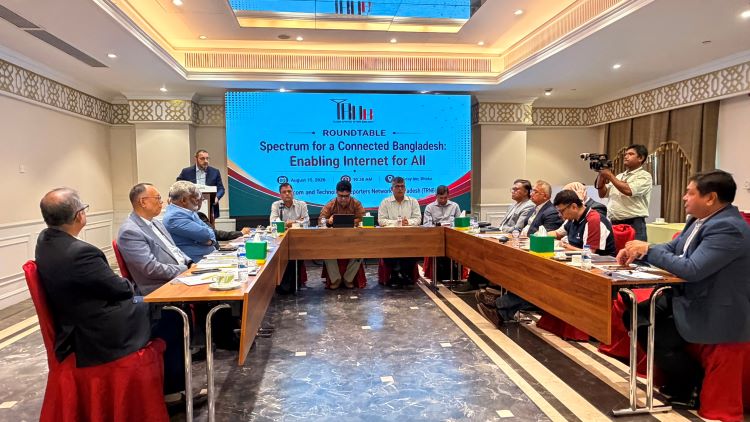
They made the comments at a roundtable titled “Spectrum for a connected Bangladesh: Enabling Internet for ALL”, organised by the Telecom and Technology Reporters’ Network (TRNB) at a city hotel.
TRNB President SM Masuduzzaman Robin chaired the event, while its General Secretary Faruque Hosain delivered the welcome address.
Prime Minister’s Adviser on Posts, Telecommunications and Information Technology Rehan Asif Asad attended as chief guest and Bangladesh Telecommunication Regulatory Commission (BTRC) Chairman Major Gen Md Emdad Ul Bari (retd) as special guest.
Independent Telecom Strategy, Spectrum and Regulatory Adviser Md Munir Hasan presented keynote on the subject.
Grameenphone Chief Executive officer (CEO) Yasir Azman said spectrum, taxes and revenue sharing should not be considered in isolation when assessing the industry’s economics.
“We are taking one lens at a time, once spectrum, once tax, once revenue sharing separately,” he said, calling for a broader assessment of the sector.
Azman said the telecom industry had evolved from a “vertical” business into one that cuts across mobile financial services, OTT, e-commerce and education, while connectivity is becoming increasingly important for manufacturing and other industries.
He said the industry’s economics had fundamentally changed, noting that margins had fallen over the past five years as operators have sought to cover their businesses through data services. The focus, he said, should ultimately be on what consumers receive after spectrum is acquired, including network rollout, smartphones at appropriate prices and affordable data.
Association of Mobile Telecom Operators of Bangladesh (AMTOB) President and Robi CEO Ziad Shatara said operators made less money in 2024 and 2025, with profitability declining in 2025, and urged stakeholders to examine why the industry's financial performance has weakened.
He said historical spectrum pricing was no longer an appropriate benchmark because the services delivered today require much greater capacity and speed than earlier voice-focused networks.
Operators are now expected to provide much higher speeds, including gigabit-level connectivity, he said, adding that the spectrum requirement for such services is fundamentally different from that of earlier networks.
Shatara also argued that spectrum pricing should be viewed against the cost structure of competing markets. Bangladesh needs a broader economic transformation involving telecom, energy, infrastructure, manufacturing and human resources rather than relying on higher spectrum prices to address fiscal pressures, he said.
Banglalink CEO Johan Buse said lower spectrum prices would benefit service quality, the country and investment.
“More affordable spectrum would benefit quality, would benefit country, and would definitely attract more investments,” he said.
Robi Chief Corporate and Regulatory Officer Shahed Alam put the industry's cost concern in numerical terms, saying global operators spend around 7 percent of their revenue on spectrum, compared with about 15 to 18 percent for operators in Bangladesh.
He said the difference was affecting network quality, prices and the country's overall digitalisation.
Alam said Bangladesh should study international experience before setting spectrum prices, pointing to Vietnam and other countries.
He also stressed the need for a competitive market so that smaller operators can gain traction and invest in network rollout.
Alam said spectrum pricing should be rationalised to a level that allows operators to complete network rollout, provide services to consumers and retain sufficient profitability to finance future investment.
Foreign Investors' Chamber of Commerce and Industry (FICCI) Executive Director TIM Nurul Kabir said the telecom sector had made a significant contribution to the economy through investment and connectivity.
He said mobile operators had invested around US$ 450 million since the industry's inception and that the networks they established had helped strengthen connectivity across the economy.
Kabir said Bangladesh should conduct research comparing its spectrum pricing with other countries before making further decisions.
He also suggested involving experts and foreign chambers in such a study so that the broader economic impact could be assessed.
Chief Corporate and Regulatory Affairs Officer Taimur Rahman said Bangladesh should focus on making 4G available more broadly before expanding 5G, while 5G could be deployed selectively according to need.
He said spectrum was essential for coverage and capacity, but operators were facing difficulty recovering network costs because spectrum costs accounted for around 18 percent of revenue.
Rahman cited Pakistan's reduction in spectrum prices by more than 50 percent and called for a rational, long-term approach in Bangladesh.
Grameenphone Chief Corporate Affairs Officer Tanveer Mohammad said acquiring spectrum was only the beginning, as operators also needed sufficient capacity to invest in networks and ensure the spectrum was properly utilised.
He said Grameenphone had already rolled out more than 2,000 sites using its 700 MHz spectrum and was continuing deployment, while 2600 MHz spectrum had been used for 4G expansion and some 5G test cases.
Tanveer welcomed recent steps on tax and policy reforms and said spectrum should not be used solely as a tool for fiscal extraction.
He said the appropriate spectrum price should be determined by considering international benchmarks, operator capacity, customer needs and the country's interests.
The industry officials said the ultimate objective should be to create conditions in which operators can continue investing in networks while consumers gain better connectivity and the wider economy benefits from greater digital access.