Monday
07 September, 2026
News Flash
News Flash
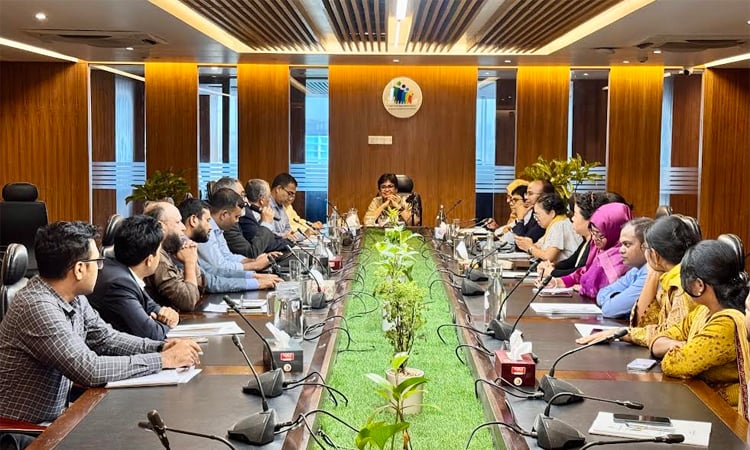
DHAKA, Aug 9, 2026 (BSS) - The National Skills Development Authority (NSDA) has for the first time in the country completed task analysis and occupational mapping of the 'Chinese Language' occupation involving high-level local and foreign experts, aiming to make skills development activities more up-to-date and employment-oriented in line with the demands of domestic and international labour markets.
The initiative was taken considering Bangladesh's growing trade, economic and diplomatic relations with China and the demand for skilled manpower with Chinese language proficiency in various industrial sectors, according to a press release received here today.
The initiative aims to structure Chinese language not merely as a linguistic skill, but as a distinct occupation involving employment and professional skills.
The workshop discussed the possible types of work, responsibilities, required knowledge, skills and competencies of the 'Chinese Language' occupation, as well as the demands of the relevant labour market.
A four-day development workshop is planned for August 16-19, followed by a validation workshop on August 25, with the aim of formulating the competency standard.
Through this, the final process of developing the training curriculum will be completed, and subsequently, opportunities will be created to introduce Chinese language courses at NSDA-registered training institutions.
NSDA Executive Chairman and Secretary to the Government of the People's Republic of Bangladesh Dr. Nazneen Kawshar Chowdhury chaired the closing ceremony of the workshop.
NSDA members, directors and relevant consultants attended the closing session.
In her remarks, Dr. Nazneen said skilled human resources must be developed in new and promising occupations considering the changing demands of the labour market.
New employment opportunities can be created for young people in domestic and international labour markets by acquiring proficiency in the Chinese language.
She said task analysis and occupational mapping can specifically identify the skills, knowledge and competencies required to work in an occupation.
As a result, the training and skills assessment system can be made more standardised, labour-market-oriented and based on industry demand, she said.
She further said that the demand for skilled manpower proficient in the Chinese language exists not only in the international labour market but also in the country.
Therefore, alongside developing skilled human resources for this occupation, it is important to create opportunities for proper recognition and certification of the skills, she said.
The workshop also discussed the possibility of signing memorandums of understanding with several Chinese universities for joint certification.
At the same time, an initiative has been taken to develop a skills framework for the Chinese Language occupation in alignment with Levels 2 and 3 of the Bangladesh National Qualifications Framework (BNQF), which will be equivalent to Chinese Language Test-HSK Levels 1 and 2.
Representatives and experts from various universities and institutions involved in Chinese language, education, research and training participated in the workshop.
General Secretary of 'We Speak Language Club' Lieutenant Colonel (Retd) Md Shahadat Hossain; Yidai Yilu Chinese Institute in Dhaka Principal Dr. Mohammad Sady and Director of Shanto-Mariam University of Creative Technology Md Mahiuddin Taher were present, among others, on the occasion.
Dr Rafiqul Islam, teacher of Chinese Language and Culture at BRAC University; Professor and Director of the Centre for China Studies at the University of Dhaka Dr Md Rakibul Haque were aslo present.