Monday
07 September, 2026
News Flash
News Flash
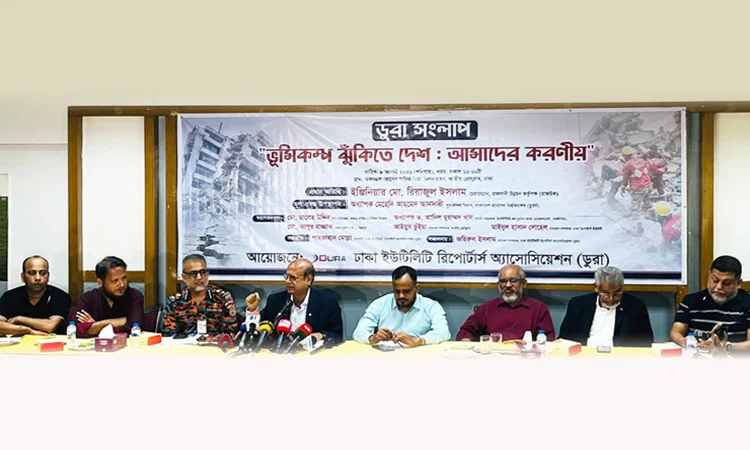
DHAKA, Aug 8, 2026 (BSS) - Chairman of the Rajdhani Unnayan Kartripakkha
(RAJUK) Engineer Md Riazul Islam today said RAJUK is taking phased measures
to identify faulty and vulnerable buildings in the capital and reduce
earthquake risks.
"Building height alone is not responsible for collapses during earthquakes.
Faulty designs, soil conditions and construction irregularities are also
major factors," he told a discussion on "The Country at Earthquake Risk: What
We Should Do", organised by the Dhaka Utility Reporters Association (DURA) at
the National Press Club here this morning.
He stressed the need to ensure approved designs, proper soil tests and
compliance with engineering standards in building construction.
Riazul said it was not possible to assess all buildings in Dhaka at once due
to their huge number.
"We have planned to conduct Rapid Visual Assessment, Preliminary Engineering
Assessment and Detailed Engineering Assessment in phases," he mentioned.
The RAJUK head said an initiative had been taken to establish a research
institution to strengthen RAJUK's capacity to deal with earthquakes. The
institution will conduct risk assessments, raise public awareness and
undertake research.
Riazul said earthquake risk reduction was not the sole responsibility of
RAJUK, stressing coordinated efforts by city corporations, disaster
management authorities, Fire Service and other relevant agencies.
He warned that an approved six-storey building would not be allowed to be
illegally extended to 10-storey or constructed in violation of its approved
design.
The RAJUK Chairman also stressed the responsibilities of architects and
engineers, saying that they should remain involved in construction
supervision and implementation.
Necessary action would be taken against professionals involved in
irregularities, he added.
He urged building owners to construct buildings according to approved designs
and obtain occupancy certificates.
BUET Professor of Civil Engineering Dr Mehedi Hasan Ansari presented the
keynote paper at the event.
Speakers underscored the need for identifying vulnerable buildings, enforcing
the Bangladesh National Building Code, conducting regular drills and
training, and raising public awareness.
Fire Service and Civil Defence Deputy Director Saleh Uddin said 41 fire
stations around Dhaka had been earmarked for earthquake response and special
response teams were ready.
He stressed coordinated preparedness involving all stakeholders.
Institute for Planning and Development (IPD) Executive Director Professor Dr
Adil Mohammad Khan said earthquake risks also depend on the location and soil
conditions of buildings.
Unplanned housing projects in weak and wetland areas increase such risks, he said, urging strict enforcement of laws against construction on weak soil.
Dhaka Reporters Unity (DRU) General Secretary Mainul Hasan Sohel said illegal
construction of additional floors on approved buildings was highly risky and
such buildings should be identified and inspected quickly.
DURA President Shahjahan Mollah called for a stronger media role in raising
public awareness about earthquake risks and preparedness.
DURA General Secretary Zahirul Islam moderated the programme. Among others,
DURA Publicity and Publication Secretary Miraj Mahbub Ifti, senior journalist
Ripon Talukder and journalists from different media outlets were present.