Monday
07 September, 2026
News Flash
News Flash
DHAKA, Aug 5, 2026 (BSS) - Experts have called for stronger public-private collaboration to fully integrate nutrition services into Bangladesh's primary healthcare system to address the country's evolving nutrition challenges and accelerate progress towards Universal Health Coverage (UHC).
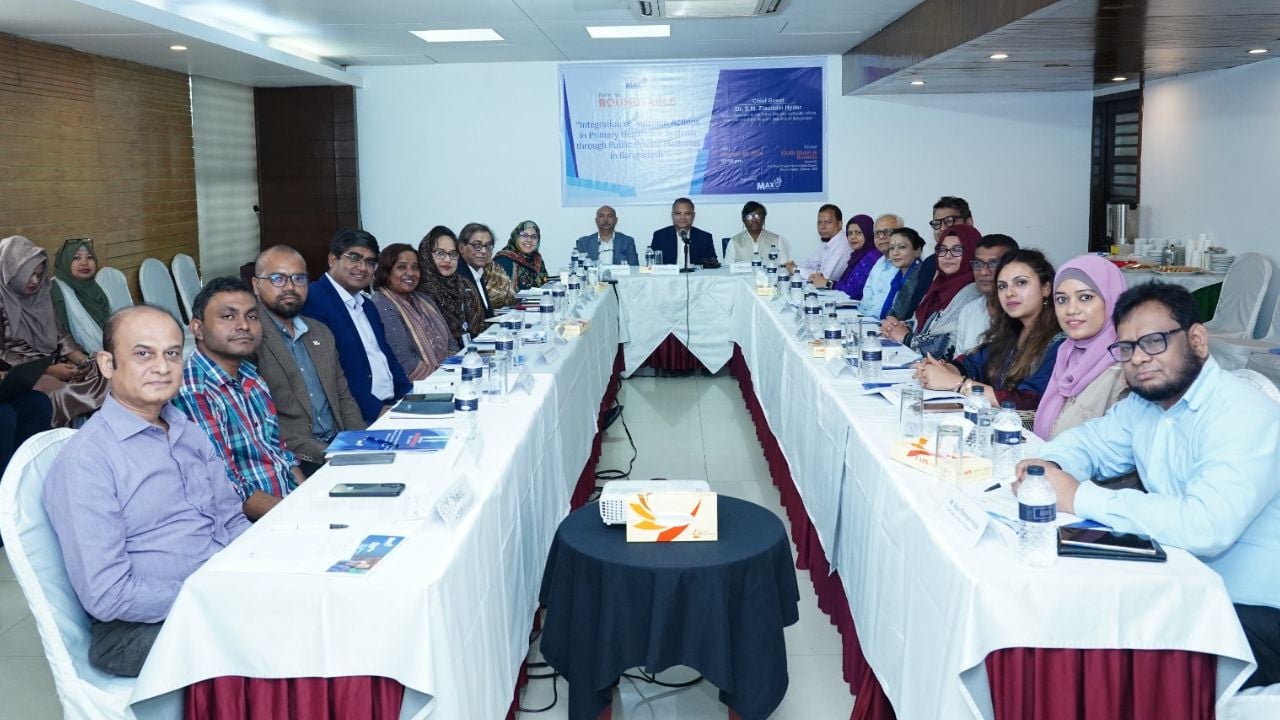
The call came at a national roundtable titled "Integration of Nutrition Actions in Primary Healthcare Systems through Public-Private Platforms in Bangladesh," organised by Max Foundation Bangladesh in the capital on Monday, a press release received here today.
Senior government officials, representatives of development partners, UN agencies, research organisations, academia, civil society and the private sector attended the event to discuss practical approaches to mainstreaming nutrition within routine primary healthcare services.
Prime Minister's Special Assistant on Health Affairs Dr S.M. Ziauddin Hyder attended the programme as the chief guest, while Director General of the Directorate General of Health Services (DGHS) Prof Dr Pravath Chandra Biswas was present as the special guest.
The keynote paper was presented by public health nutrition specialist Saiqa Siraj, while the session was chaired by Dr ATM Tariqul Islam, Country Director of Max Foundation Bangladesh and Regional Director of Max Foundation South Asia.
Dr Hyder said past nutrition policy initiatives in Bangladesh had lacked strong government ownership and remained largely donor-driven, resulting in slow progress in achieving sustainable change.
"We have achieved gains in tackling malnutrition and stunting, though progress has been slow. We need a stronger, government-led and coordinated approach," he said.
Highlighting the government's vision for a healthier Bangladesh, he stressed the importance of a life-cycle approach under which people would receive community-based preventive care from birth through adulthood via an expanded primary healthcare system.
He said each union sub-centre would be staffed by nine community health workers.
Dr Hyder also underscored the need for an inter-sectoral approach to nutrition, health and food safety.
To strengthen coordination, he said, the government is considering establishing a National Food and Nutrition Authority Commission to oversee policies, implementation and collaboration.
Prof Dr Pravath Chandra Biswas linked persistent micronutrient deficiencies to the country's disease burden, noting that non-communicable diseases now account for 70 per cent of deaths in Bangladesh.
He said chronic conditions such as hypertension and kidney disease are closely associated with micronutrient deficiencies, explaining that inadequate nutrition during pregnancy can reduce nephron function in children and contribute to chronic diseases later in life.
Director of the Institute of Public Health Nutrition (IPHN) Dr Mohammed Eunus Ali said nutrition continues to remain on the periphery of health services instead of being placed at their core.
Deputy Director of IPHN Dr Rawshan Zahan Akhter Alo stressed the importance of focusing on the first 1,000 days of life, comprising 270 days of pregnancy and the following two years.
Executive Director of icddr,b Dr Tahmeed Ahmed highlighted global advances in understanding nutrition and child health, saying extensive clinical studies conducted by icddr,b had identified poor water, sanitation and hygiene as key contributors to stunting.
Public health nutrition specialist Dr Iqbal Kabir raised questions about how to operationalise public-private partnerships for nutrition, regulate public-private platforms and define the role of the private sector.
Professor Kaosar Afsana of the BRAC James P Grant School of Public Health emphasised the need for systems thinking and stronger linkages, noting that nutrition responsibilities are currently spread across multiple ministries, while sectors such as agriculture, fisheries and livestock remain outside the broader policy discussion despite their importance.
In her keynote presentation, Saiqa Siraj said nutrition services remain fragmented despite an extensive policy framework, with an estimated 60 to 70 per cent of rural healthcare being provided by informal and private providers operating outside public sector protocols.
In his closing remarks, Dr ATM Tariqul Islam stressed the importance of bringing together the public sector, private sector and civil society to strengthen nutrition services and primary healthcare.
Among others, WHO National Professional Officer (Food & Security) Faria Shabnam, GAIN Country Director Dr Rudaba Khondker, UNICEF Nutrition Specialist Tahmina Ferdous, BRAC James P Grant School of Public Health Deputy Director of Education and Research Dr Santhia Ireen, Max Foundation Head of Programme Design and Quality Kazal MM Ahidul Islam, Bopinc Country Director Shihab Uzzaman, Grameen HealthTech Limited (Shukhee) Chief Technology Officer and Chief Business Officer Mohammad Solaiman Rasel, iDE (International Development Enterprises) Associate Director of Programs Mohammad Soeb Iftekhar, and SMC's MMS Project Team Leader A S M Shahidul Alam also spoke.