Tuesday
08 September, 2026
News Flash
News Flash
DHAKA, May 01, 2026 (BSS) - Tepakhali is a village near the Sundarbans. The Shakbaria River flows past the village. There is a deep forest on the other side of the river. Geographically, the village is in Koyra upazila of Khulna district. Therefore, the Sundarbans have a spiritual relationship with the residents here.
Some work in the Sundarbans to collect seasonal honey. Some earn by fishing or crab hunting.
However, this time, while walking along the embankment of the Shakbaria River, this reporter saw something different. Small trees were planted in rows on the char that rises from the river. It is different in the sense that usually no other trees or shrubs grow in the brackish water char except the trees of the Sundarbans. However, the sight of such planned planting of saplings in the Sundarbans has aroused quite a response locally.
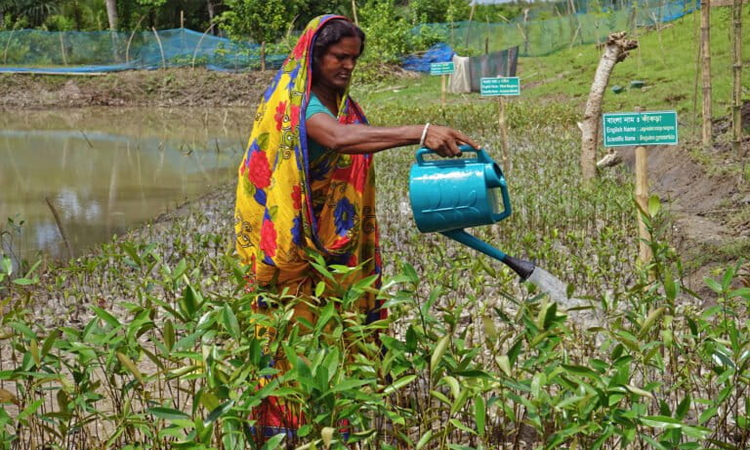
A recent trip to the Sundarbans shows a part of the char surrounded by bamboo and netting. Inside, there are rows of seedlings of various Sundarban trees in polybags. It is a small nursery. While taking pictures before the seedlings drowned in the water, a woman was seen taking care of the seedlings inside the netting. Her name is Basanti Munda (50).
Standing next to her nursery, she was telling this reporter about the new reality. “I myself and a few women planted these trees,” said Basanti.
She said that in this char, four types of Sundarban trees – Keora, Khalisha, Kankada and Bina – are grown. There was a plan to grow Golpata seedlings, but it was not possible due to lack of seeds, she added.
“However, we will try to collect the Golpata fruits in a few days,” added Monica Munda, another woman who works with Basanti.
Apart from Basanti, several other women are involved in this new initiative. They are all neighbors. They are Monika, Rita and Kamala Mal, Samala and others.
Initially, many doubted whether the seedlings would grow like this? However, Basanti believed that it would grow.
She said, “I have seen seedlings growing from the seeds that fell in the river bank next to my house. I have been trying with that confidence, and it has also yielded results.”
In response to a question about the process of making seedlings, Basanti said, first, a net is placed around the area with bamboo so that goats or other animals cannot enter.Then, small areas are divided and 20 to 25 polybags are arranged in each line and the char soil is filled in them. Then, the fruits of the Sundarbans that float in the river are collected and placed in the polybags. New seedlings have emerged from there, she added.
However, a local non-governmental organization (NGO) brought this initiative of Basanti to her attention.
Basanti said, “One day I went to catch crabs in the Sundarbans. At that time, I suddenly met some NGO workers. They proposed me that some women of the village should work together to grow Sundarban tree seedlings in the riverbank. Then the organization would provide the necessary materials and when the seedlings grow, they would buy each seedling by Taka 10.”
She said, “I liked it. Initially I talked to some of the women in the neighborhood. They showed interest in working with me. And later, we started it.”
Basanti is a self-reliant woman who works in a nursery. Her husband, Dipankar Munda, has gone to a brick kiln outside the area for work.
She lives in a small house next to the river bank with her three-year-old daughter, Tanushree.
In addition to looking after the nursery in the river bank, she sometimes catches crabs in the Sundarbans and sometimes does daily labor.
About her income, she said, “Men get Taka 400 for a day's work. We get Taka 300 for the same work. On days when we don't get work, we go to the Sundarbans to catch crabs. Earlier, I was afraid of tigers, now I'm afraid of robbers. If there were no robbers in the forest, I could have lived in peace.”
It is learned that the local non-governmental organization CNRS is supporting the women in this nursery initiative.
Organization's Koyra Upazila Officer Md. Nuruzzaman said that a large number of seedlings are needed for a project to afforest the river banks. But commercial nurseries do not produce these mangrove tree seedlings. Therefore, an initiative has been taken to produce seedlings from the floating fruits of the Sundarbans by involving local women, he added.
He said, “The fruits floating from the Sundarbans are dried by the local people and used as fuel. Sometimes the seedlings are eaten by cattle. Therefore, it is important to preserve mangrove forests along the river banks and embankments.”
Nuruzzaman said that afforestation initiatives have been taken on about 74 hectares of land along the banks of the Kapotaksha and Shakbaria rivers in Koyra upazila. This is creating employment opportunities for local women.
Monica Munda said, “Earlier, I used to catch crabs all day long. Now, I catch crabs and also do the work of planting seedlings. As a result, my income has increased from before.”
Meanwhile, in the coastal localities adjacent to the Sundarbans, fruits of various trees flow from the forest every day with the river water. Thousands of family members from five unions of Koyra upazila, which is located near the Sundarbans in Khulna, collect these fruits. They dry these fruits in the sun to meet their fuel needs. As a result, the expansion of forest land was hindered and there was a risk of erosion in the coastal areas.
However, the establishment of nurseries has reduced that fear to a great extent.
Videsh Ranjan Mridha, a lecturer at Kapotakshma College in Koyra upazila, told this reporter that when the fruits of various trees in the Sundarbans float in the river and reach the locality, the common people in the area unknowingly collect them and use them as fuel. By preserving the fruits and establishing nurseries, a green belt will be created in the chars.This will make it possible to maintain the balance of the environment, prevent river erosion and preserve biodiversity, he added.