Tuesday
08 September, 2026
News Flash
News Flash
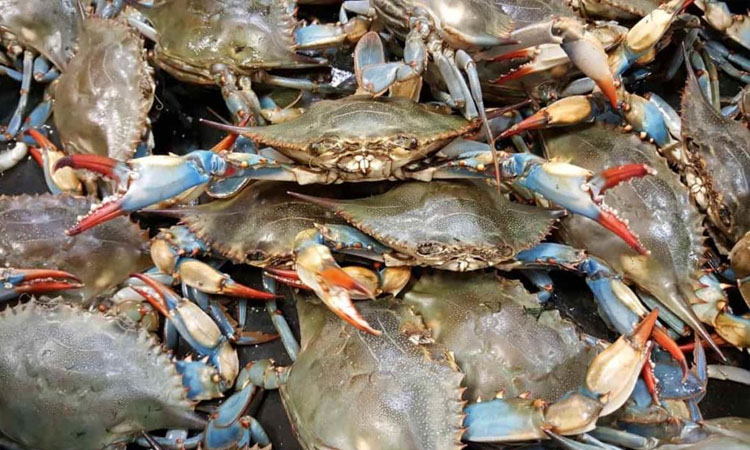
DHAKA, April 28, 2026 (BSS) - Crab farming in black boxes has now become a source of income especially for women in Shyamnagar, a coastal upazila of Satkhira, and a woman is able to earn Taka 10-12 thousand per month by working as ‘checker’ in a crab cultivation farm.
Burigoalini Union in Shyamnagar is one of the major crab farming areas where women are found working in water bodies full of black boxes in which soft shell crabs are cultivated.
In some areas of this upazila, water bodies spread out on both sides of the road. When crossing these water bodies, people see rows of thousands of black boxes with holes floating. Crabs are cultivated in those boxes and local people call the place where crabs are cultivated 'Crab Point'.
When the reporter visited some villages including Harinagar and Durgabati in Burigoalini, he saw crab points spread over a large area. Men and women are working there together.
On the other side of the reservoir is a ‘Tongghar’. A bridge with a bamboo, wood and tin roof has been built in the middle of the reservoir for movement.
In one company, five people are working. Three of them are women. Two men are supervisors, and the women are 'checkers'. Talking to this reporter, they said that the ‘checkers' job is to open the boxes every three hours to check whether the water and environment in the box are suitable for the crabs.
They cut ‘Tilapia’ fish into pieces and keep into the box every four days as food for the crabs. In this process, soft shell crabs are cultivated.
And this cultivation has provided employment to a large number of women in the area.
Crab farmers and experts said that 60 percent of the people working at crab points are women. They mainly work as 'checkers'.
According to the Export Promotion Bureau (EPB), crab is the most exported item after shrimp. Crab worth Taka 867.88 crore was exported in the 2024-25 fiscal year. About 98 percent of the crabs are exported to 17 countries including China.
Sheikh Nazrul Islam, Assistant Project Coordinator of the Green Climate Fund (GCF) Resilient Homestead and Livelihood Support to the Vulnerable Coastal People of Bangladesh (RHL) of the Palli Karma-Sahayak Foundation (PKSF), said that the most crab farming is now taking place in Satkhira. There are crab farms only in Shyamnagar Upazila. About 10,000 people work in those farms. Women run the small farms, he added.
He said, “Women are more skilled and productive in crab farming. They spend more of their earnings on their children's education and health. In some families, I have seen that husband and wife are working together.”
Worker Shyama Dey said that she works to bring prosperity to the family. She gets Taka 40 per hour and her monthly income is Taka 10-12 thousand.
“I have been working as a checker here for a year to meet the family's needs. I have an eight-year-old boy, who studies in a local school,” she added.
Mentioning that work-hour is divided into two shifts here, Supervisor Abdul Mia said, “Women work during the day as the crabs have to be monitored every three hours. Male workers perform duty at night.”
He said that soft shell crab farming started in Satkhira in 2013. Three years ago, the owner has built this crab point on a six-bigha water body, he said, adding that crabs are being farmed in 20,000 boxes and twenty employees, including 10 women, are working here day and night.
According to the Satkhira District Fisheries Office, there are 1,671 crab farmers in the district. Crab production in the district is increasing every year. In the 2023-24 fiscal year, the district produced 645 metric tons and 750 metric tons of soft-shell crab in the 2024-25 fiscal year.
Satkhira District Fisheries Officer GS Selim said that a large number of women are being employed in crab farming.
He said men and women collect crab fries from canals and rivers adjacent to the Sundarbans. One crab lays 2 million eggs. But the production of fries from crab eggs in the country is still at the trial stage. There is only one private hatchery in Satkhira, he added.
He said that investment and dedicated people are needed to cultivate fries (pona). “If we can increase the production of fries by more than one percent, the economic situation of this region will radically change,” he added.