Monday
24 August, 2026
News Flash
News Flash
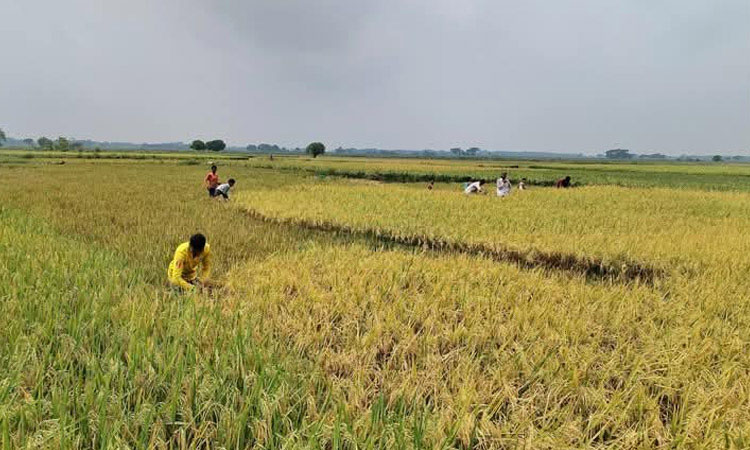
DHAKA, April 28, 2026 (BSS) - Farmers have been asked to harvest Boro paddy quickly from the country's north-eastern haor areas as flash floods are forecasted there.
"In consultation with the district administration, upazila administration, and the Water Development Board, farmers have been advised to harvest 80 percent-ripe paddy quickly to prevent crop loss," Additional Director of Department of Agricultural Extension (Sylhet Regional Office) Dr Mosharraf Hossain told BSS.
He said due to the forecast of heavy rains and flash floods, efforts are on to harvest Boro paddy quickly in the Sylhet region.
Boro has been cultivated on 2,77,000 hectares of land in the Sylhet haor areas and till Monday, Boro paddy has been harvested from 155,000 hectares, Dr Mosharraf said.
Sunamganj Deputy Commissioner Muhammad Minhazur Rahman said the administration is giving utmost importance to the issue of Boro harvesting in haors.
In some haors, he said, 50 to 60 percent of the paddy has already been harvested so far. "We are conducting a massive campaign so that the Boro harvesting in haors can be completed quickly," he added.
Citing the weather forecast of Bangladesh Meteorological Department, Executive Engineer of Bangladesh Water Development Board (BWDB) at its Sunamganj office, Md Mamun Howlader said there will be heavy to very heavy rain in Sunamganj and Cherrapunji of India for three consecutive days starting today (Tuesday).
This will further increase the water level in the haor region, he said.
Due to heavy rainfall in Sylhet region and upstream Cherrapunji of Meghalaya, flash floods may occur in the country's north-eastern haor region from today, inundating a vast area of Boro paddy fields.
"We have already issued an alert that flash floods can take place in Sylhet region from April 28 as heavy to very heavy precipitation is likely to occur there," Partho Protim Barua, Sub-Divisional Engineer at BWDB's Flood Forecasting and Warning Center (FFWC), told BSS.
He said heavy rainfall is likely to occur in the Sylhet region for three consecutive days from April 28 and it may continue, resulting in flash floods there.
Partho said once floodwater enters the haor areas, there is no scope to recede as the intensity of rainfall will go up in the coming days.
He said the FFWC has already sent the message of flash flood forecast to the DAE, local administration and agencies concerned so that they can inform the farmers.
After getting flood forecast, farmers are able to harvest their Boro paddy before the flash flood hits, he added.
Meanwhile, the BWDB engineer said the DAE and local administration have issued the flood alert there and asked farmers to reap their Boro paddy as soon as possible.
He said if the farmers can be able to harvest their Boro paddy from the haors, their economic loss could be minimised.
According to flash flood forecast issued by the FFWC on April 23, due to heavy to very heavy rainfall, water may flow above the danger level in some points of major rivers in the haor basin for three days beginning on April 28, creating flash flood situation there. Heavy precipitation will continue for the next three days (May 1 to 3).
The north-eastern haor region of Bangladesh is a vast, bowl-shaped tectonic depression covering roughly two million hectares across Sunamganj, Sylhet, Habiganj, Moulvibazar, Netrakona, Kishoreganj, and Brahmanbaria districts. These wetlands, which become a 'sea' during monsoons, are vital for Boro paddy cultivation and fisheries.
Flash floods in the haor region -primarily Sylhet, Sunamganj, and surrounding areas - occur rapidly, often in April-May, triggered by heavy, early-monsoon rainfall in the upstream Assam and Meghalaya hills of India. These sudden, intense floods devastate the region's primary agriculture (Boro rice) and livelihoods, causing massive economic losses.