Monday
24 August, 2026
News Flash
News Flash
By Moazzam Hossain Rokon
DHAKA, April 19, 2026 (BSS) - In a groundbreaking move aimed at reducing post-harvest losses and modernizing agricultural practices, a researcher has developed an innovative, eco-friendly technology to protect stored paddy from damaging pests.
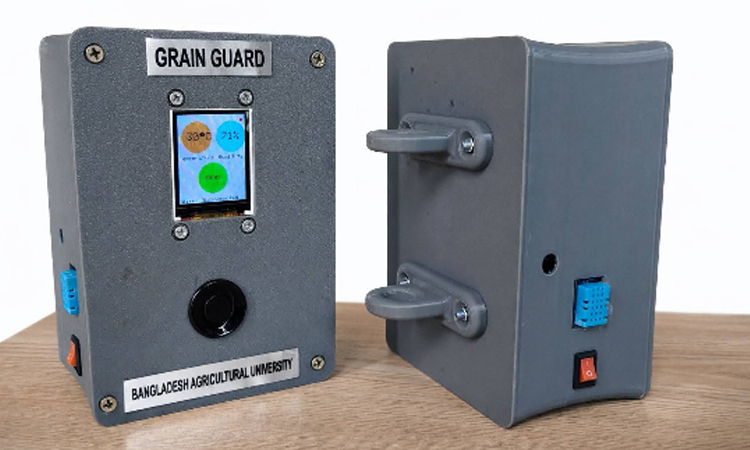
Professor Dr. Md. Abdul Awal of the Department of Farm Power and Machinery at Bangladesh Agricultural University (BAU) has introduced a smart ultrasonic device called “Grain Guard.”
The technology is designed to safeguard stored paddy without the use of harmful chemicals—an issue that has long challenged farmers across the country.
The device works by emitting high-frequency sound waves that are disruptive to rice weevils, one of the most destructive storage pests. These sound waves interfere with the insects’ nervous systems, affecting their movement, feeding habits, and reproduction. Over time, the pests weaken and abandon the grain, ensuring effective protection without compromising food safety or environmental health.
“This technology provides a safe and sustainable solution for grain storage,” said Dr. Awal. “It eliminates the need for chemical pesticides while maintaining long-term effectiveness,” he added.
The development of Grain Guard began in 2020 under a research initiative focused on reducing post-harvest losses in stored paddy.
The project later received support from the World Bank through the Bangladesh Agricultural University Research and Innovation Center (BAURIC).
A team of researchers, including co-investigator Professor Dr. Ehsanul Kabir, carried out the design, testing, and field validation of the device.
Now fully developed, the device is awaiting commercial rollout. Several companies have already expressed interest in bringing it to market.
According to Dr. Awal, the product is expected to be highly affordable, with a projected retail price below Taka 2,000—making it accessible to farmers across different income levels.
However, concerns remain over the potential spread of counterfeit versions once the device enters the market.
To address this, the inventor has secured patent registration through the Ministry of Industries and completed intellectual property filings.
He has also urged farmers and distributors to remain vigilant against imitation products.
Experts believe that widespread adoption of this technology could significantly reduce grain losses in Bangladesh, where 7pc to 12pc of stored rice is typically lost due to pests and fungal growth. The country’s warm and humid climate further exacerbates the problem.
Even a modest 5 percent reduction in overall rice loss could save the economy an estimated Taka 750 crore annually. Additionally, improving seed germination rates by 10percent could conserve around 350,000 metric tons of seeds, valued at approximately Taka 1500 crore.
If successfully commercialized and adopted nationwide, “Grain Guard” could mark a major step forward in ensuring food security and advancing sustainable agriculture in Bangladesh.