Tuesday
08 September, 2026
News Flash
News Flash
DHAKA, April 19, 2026 (BSS) – Every afternoon, 13-year-old Anannya steps onto a dusty open field in Dhaka’s Dhalpur with a determination that once seemed impossible.
Her fists rise into the air as she practises self-defence moves with dozens of other girls under the blazing sun—learning not only how to protect herself, but also how to safeguard her future.
“Now I am more confident. I know how to protect myself,” Anannya says, her voice carrying a strength that reflects the transformation sports have brought to her life.
For thousands of adolescent girls like Anannya across Bangladesh, sports are becoming more than just games. They are turning into a powerful tool against one of the country’s most persistent social challenges—child marriage.
According to a recent UNICEF policy brief titled Game Changers: How Sports Empower Girls to End Child Marriage in Bangladesh, structured sports programmes are helping girls build confidence, leadership, resilience and life skills, while shifting deeply rooted community attitudes about gender and early marriage.
Despite gradual progress, child marriage remains widespread in Bangladesh. UNICEF says 52 per cent of girls in the country are married before the age of 18, while 8 per cent are married before turning 15.
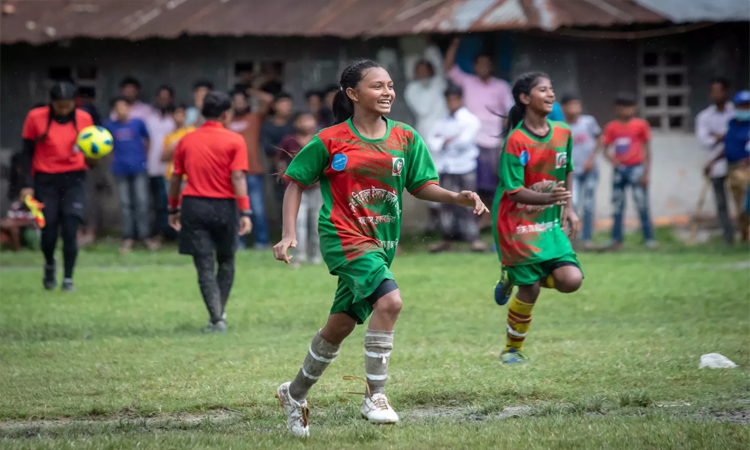
To combat the trend, UNICEF and the Ministry of Youth and Sports launched the Sports for Development (S4D) programme in 2022, using football, cricket, volleyball, kabaddi, swimming and self-defence training as tools to empower vulnerable children—especially girls.
The programme has already reached over 3.8 million people and helped prevent more than 12,000 child marriages in 2024 alone, according to UNICEF.
Experts say the success lies not simply in getting girls onto playing fields, but in what happens there.
Through structured sports sessions, girls develop self-esteem, teamwork, leadership and decision-making abilities—skills that help them resist pressure for early marriage and stay focused on education.
“Sports create safe spaces where girls can find their voice,” the UNICEF report notes, adding that girls involved in sports programmes report stronger negotiation skills and greater confidence in challenging harmful practices.
The initiative also works beyond the field. Parents, caregivers and community leaders are engaged through awareness sessions and dialogue programmes designed to challenge long-held beliefs that girls should marry young.
For many families, these conversations are changing mindsets.
Anannya’s mother, who once hesitated to let her daughter join self-defence classes, now proudly watches from the sidelines.
“My perspective has changed,” she says in the UNICEF report. “I think, thanks to this training, Anannya can protect herself.”
UNICEF says the programme is particularly impactful in rural and climate-vulnerable communities, where poverty and insecurity often drive families towards early marriage as a coping mechanism.
As Bangladesh continues its fight against child marriage, the growing success of sports-based interventions offers a hopeful lesson: sometimes change begins not in courtrooms or conference halls, but on an open field where girls learn to run, compete—and believe in themselves.