Thursday
27 August, 2026
News Flash
News Flash
DHAKA, Jan 20, 2026 (BSS)–Bangladesh Jamaat-e-Islami today proposed interest-free scholarships for graduates and students, plans to establish the world’s largest women’s university, and the setting up of 64 specialized hospitals across all districts as part of its policy agenda announced at the Policy Summit 2026 in Dhaka.
The party announced a wide-ranging policy framework aimed at building a “New Bangladesh,” focusing on anti-corruption, economic reforms, education, healthcare, youth development, ICT expansion and remittance growth.
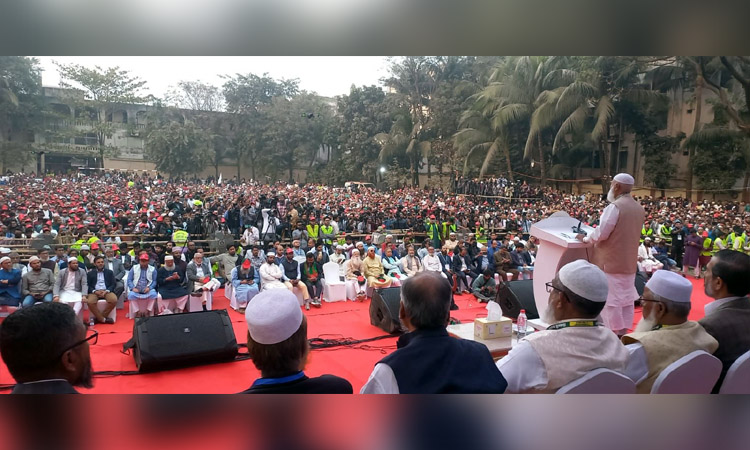
The policies were unveiled at the party’s day-long “Policy Summit 2026” at the Hotel InterContinental in the capital, where a series of panel discussions outlined its vision and proposed policy directions.
Under its economic agenda, Jamaat announced a zero-tolerance policy against corruption and set long-term targets to gradually reduce tax to 19 percent and VAT to 10 percent. It proposed introducing a Smart Social Security Card, integrating NID, TIN, health and social services into a single platform.
The party pledged not to increase gas, electricity and water tariffs for industries over the next three years and to rerun closed factories through public-private partnerships, with 10 percent ownership allocated to workers.
Business-friendly policies, simplified licensing systems and interest-free loans for small and marginal farmers were also highlighted.
In the education sector, Jamaat proposed interest-free financial support for graduates and students. These include monthly interest-free loans of up to TK 10,000 for 500,000 graduates for a maximum of two years until employment, and similar support for 100,000 students based on merit and need.
It also pledged interest-free education loans for 100 students annually to study at top global universities such as Harvard, MIT, Oxford and Cambridge.
The party further announced plans to establish the world’s largest women’s university by merging Eden College, Begum Badrunnesa Government College and Home Economics College, alongside upgrading major National University-affiliated colleges into full-fledged universities. All recruitments, it said, would be strictly merit-based.
In healthcare, Jamaat committed to free medical services for senior citizens above 60 and children under five, establishing 64 specialized hospitals in all districts, and implementing the “First Thousand Days Program” to ensure maternal and child health and nutrition from pregnancy to early childhood.
Focusing on youth empowerment, the party proposed forming a new ministry for skilled manpower and job placement, providing market-oriented skills training to 10 million youths in five years, and setting up Youth Tech Labs in each upazila.
It also pledged to create 5 million job accesses through district-level youth job banks, develop 500,000 entrepreneurs—prioritizing women and marginalized groups—and produce 1.5 million freelancers.
Under its ICT roadmap, Jamaat announced “Vision 2040”, targeting the creation and placement of two million ICT jobs by 2030, establishing a national payment gateway for freelancers and digital exports, achieving $50 billion in ICT export earnings, and transitioning from a labour-based to a knowledge-based economy.
On remittances, the party aimed to double or triple remittance earnings within 5–7 years through skilled manpower development and to promote “intellectual remittance” by engaging expatriate professionals, researchers and academics.
The summit was attended by ambassadors, high commissioners and diplomats from different countries and international organizations, including the United States, United Kingdom, China, India, Japan, EU, UN and UNDP, alongside political leaders, economists, academics, senior journalists and civil society representatives.
Senior Jamaat leaders, including Nayeb-e-Ameer Dr Syed Abdullah Mohammad Taher, Secretary General Mia Golam Parwar and members of the central executive council, were also present.