Monday
07 September, 2026
News Flash
News Flash
By Al Sadi Bhuiyan
SATKHIRA, Jan 14, 2026 (BSS) – In the climate-ravaged upazila of Shyamnagar, women have emerged as the most vulnerable victims of environmental change.
Escalating salinity, collapsing livelihoods and recurrent natural disasters have steadily eroded the region’s economic base, driving men to migrate to urban centers in search of work.
Left behind, women are now forced to carry the full responsibility of sustaining their families—managing households, securing safe drinking water, caring for children and the elderly, and earning a livelihood—often under conditions of relentless physical, social and economic hardship.
Girls in Shyamnagar begin to realize their vulnerability to nature as soon as they turns adolescence. The women here stand as living testimony to how climate change can negatively shape an entire human life.
Do those responsible for climate change ever take account of the struggles, sacrifices, and unspeakable suffering these women endure at every turn of life? The answer, overwhelmingly, is no.
Seventeen-year-old Bulbuli (pseudonym) lives in a government cluster village in the Kolbari area of coastal Shyamnagar. Her life is marked by relentless hardship. She is burdened by poverty, family breakdown, and long-standing health problems.
Currently a ninth-grade student at a local polytechnic school and college, Bulbuli walks or travels by van for nearly an hour each day to attend classes. Her mother, the family’s sole breadwinner, sustains the household through daily wage labour and cooking jobs.
Bulbuli said her father has not lived with the family for many years. Although there is occasional phone contact, he provides neither financial nor emotional support. As a result, she has grown up watching her mother struggle alone.
Her health condition is equally alarming. Bulbuli began menstruating at the age of 12 and has since suffered from excessive bleeding, severe abdominal pain, and chronic pain in her waist and legs. Her menstrual cycle lasts seven to eight days, often with abnormally heavy bleeding.
She has also endured long-term problems such as burning sensations during urination, itching, and skin allergies. Despite seeking treatment from local and homeopathic practitioners, her condition has not improved.
A gynaecologist following ultrasonography and tests identified early-stage uterine complications and advised regular medication. However, due to financial constraints, Bulbuli has been unable to complete the prescribed course of treatment.
She reports that during menstruation she is often forced to bathe in polluted pond water, which exacerbates infections and discomfort. The lack of safe water and sanitation facilities has further complicated her condition.
Because of menstrual pain and physical weakness, Bulbuli frequently misses school. When these problems coincide with examination periods, her studies suffer severely. Yet she remains determined not to abandon her education.
Her sole dream is to ease her mother’s suffering and to grow into a dignified, self-reliant human being.
Jamila, 32, of Gabura village narrated a similarly arduous life struggle. Climate change, she says, has made her existence unbearable.
“There was once no shortage of food in our family,” Jamila recalls. “When I was young, we had meat, milk, and ghee at home. Now everything has to be bought. On top of that, I have to bear the medical expenses for myself and my husband,” she said.
Jamila explains, “Everything in this household depends on me. My husband used to work, but now he is ill. If I don’t earn, there will be no food on the table. I run a small shop, do sewing, and sell scraps of cloth and shoes. My son has grown up and earns a little, but managing the household finances rests entirely on me. I used to think men ran households; now I realize times have changed—if I don’t stand up, the family collapses.”
Due to salinity, Jamila developed uterine tumours. Unable to endure the pain, she underwent a hysterectomy. “I suffered from severe bleeding for seven or eight years,” she said.
“Eventually, the doctor said there was no option but surgery. It cost TK 40,000 and required seven bags of blood. I received no help from my husband. I paid for the operation with my son’s earnings and my own business income. The day before surgery, I was nearly at death’s door” said Jamila.
She said her own income is insufficient even to support herself.
About her husband, she said, “He is a sick man and cannot work properly. He lives in Shyamnagar and does some small trading. I earn alone—how can I support him as well? So we live separately. We are not divorced, but there has been no relationship for years. Running a household does not allow for sitting idly with emotions.”
“There is nothing left here like before. There is no arable land or ponds. We need to purchase everything. In my father’s time, there was no scarcity in this area. Now salinity and lack of work make survival difficult. Even when the body is unwell, we cannot stop working—because if stop workings, we cannot manage food,” said Jamila.
The story of Keya, 37, from Moyna village is much the same. She underwent two caesarean deliveries for the births of her children and has had four surgeries in total, including appendix and uterine operations.
Burdened by loan repayments, her financial condition is dire. Although her husband is present, his lack of steady income has placed all family responsibilities on Keya.
“My husband is a day labourer,” Keya said. “He does not earn much each month. It is extremely difficult to run a household on this income. My medical expenses, my children’s costs, loan instalments—everything together makes survival a constant struggle. I am a sick woman, yet the entire burden of managing the household revolves in my head. If I don’t think about it, nothing moves,” she said.
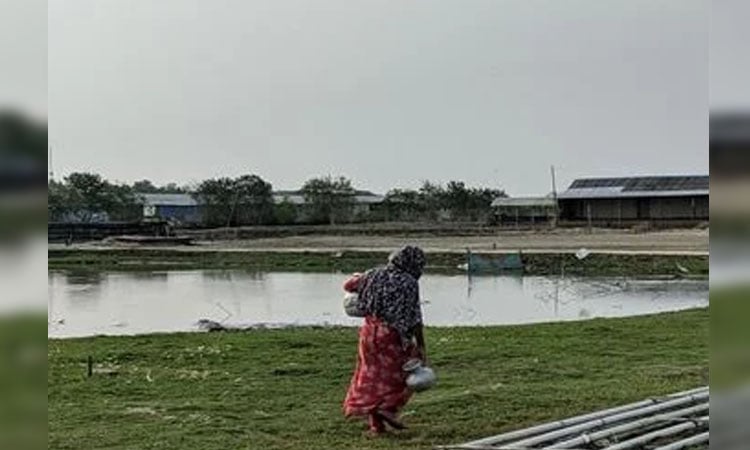
She added, “For drinking water, I have to walk a kilometre and carry pitchers on my shoulders. This water is reserved only for drinking. For cooking, bathing, and sanitation, we use saline water. This hardship of water collection falls primarily on women.”
Even when unwell, Keya said, the thought of work never leaves her mind. “There is no certainty of work here. When river water rises and salinity increases, work decreases. A household cannot survive solely on my husband’s income. Now I must decide what comes first and what comes later. I never had to think like this before, but circumstances have made it inevitable—if I don’t think, the household simply will not run.”
Shyamnagar Upazila Women Affairs Officer Sharid Bin Shafique said climate change has profoundly altered the social fabric of the area.
“Climate change has adversely affected society, families, health, and income here. Frequent migration has made the family structure of this region different from others. Divorce and abandonment rates are higher than elsewhere. As men migrate for work, women are forced to manage almost everything,” he said.
He noted that during winter, when there is little work, men migrate to other areas. “At this time, women suffer extreme hardship in collecting water because ponds and water bodies dry up. Compared to other times of the year, women’s suffering is greatest during this period,” he said.
He also mentioned that more than 30 NGOs are operating programmes in the area and that regular government allocations are maintained across various sectors.
Professor Hasan A Shafie of the Department of Anthropology at Dhaka University, who has conducted long-term research in Shyamnagar, said: “From my extensive research in Satkhira’s Shyamnagar, I have observed not merely women’s individual resilience, but a profound transformation of family and social structures driven by climate pressure.”
Salinity, livelihood crises, and frequent disasters compel a large proportion of men to migrate for work, effectively shifting economic and social responsibilities onto women, he said.
“In many families in Gabura, women have become the central pillars—earning income, raising children, collecting water, and caring for sick relatives. Yet they remain the most neglected in terms of land rights, healthcare, and social protection. This has created a form of ‘invisible leadership,’ where women sustain families and communities while bearing the heaviest physical, mental, and economic burdens,” he said.
He emphasized that this reality makes it clear that climate change here is not merely an environmental crisis, but a deeply gendered crisis of health and justice.
“If government adaptation plans, social protection measures, and health policies do not centrally address the real vulnerabilities of Shyamnagar’s women, climate adaptation will fail—and existing inequalities will only deepen,” he said.