Sunday
28 June, 2026
By Md Mamun Islam
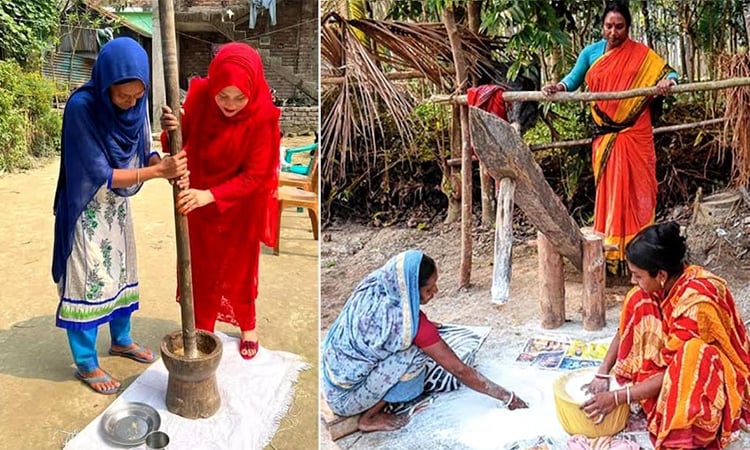
RANGPUR, Dec 13, 2025 (BSS) - Despite the advent of modern machinery that can easily grind cereals into flour, Urun-Gain and Dheki-traditional wooden grinding devices-remain an integral part of rural Bangladesh.
Urun is made by carving the middle of a tree trunk, while a hard wooden rod called 'Gain' is used to grind rice into flour, keeping the nutritional value of the rice intact.
There is an iron bar or cap on the head of the Gain, which helps break rice grains easily and efficiently.
A Dheki is a traditional foot-powered wooden device primarily used for peeling rice husks, separating grains from paddy, and grinding various food items.
It essentially functions as a manual rice mill that preserves the nutritional value of rice and produces healthy brown rice.
Due to the advancement of modern grinding machinery, the use of traditional Urun-Gain and Dheki has declined. However, their usage has revived as people use them on various occasions, particularly during the Nabanna Festival-the harvest celebration of new rice.
Both devices are still equally popular among village women in the northern region of the country for grinding rice, making flour, and processing spices such as ginger and turmeric.
Former Head of the Department of Bengali at Rangpur Government Begum Rokeya College, Professor Mohammad Shah Alam, said the cultural elements of the Nabanna festival-celebrated during the Bengali months of Agrahayan and Poush-are closely associated with rural Bengali instruments like Urun-Gain and Dheki, which are used to knead rice flour to prepare various traditional delicacies.
Professor at the Department of Bengali at Begum Rokeya University, Dr Tuhin Wadud, said homes in rural Bengal can still be seen using traditional Urun-Gain and Dheki to make rice flour for dishes such as pitha, puli and payesh during Nabanna.
The sweet, rhythmic 'dhoop-dhaap' sound of Urun-Gain and Dheki wakes villagers early in the morning, reminding them of the preparations for the Nabanna festival. Housewives and women become busy making pitha, puli and payesh.
Sadly, some cultural elements associated with Nabanna, such as folk music, dance, poetry and folk art performances, are gradually fading, although the delicious dishes that carry the tradition remain firmly alive in rural Bengal.
However, without Urun-Gain and Dheki, it is not possible to make the proper rice flour required for preparing pitha, puli and payesh, he added.
Additional Director (In-charge) of the Department of Agricultural Extension for the Rangpur region, Krishibid Md Shirajul Islam, said that traditional Bengali food-including rice, fish, meat, pulao and various other dishes-is served during Nabanna. These food items are accompanied by special attractions such as sweets made from rice flour, pitha and different types of payesh prepared with date molasses.
"The main ingredient in making these dishes is Atap rice flour, which is made by grinding rice in Urun-Gain or Dheki-integral parts of the traditional Nabanna festival," he said.
Chairman of the North Bengal Institute of Development Studies, Dr Syed Samsuzzaman, said the Nabanna festival keeps economic activities alive in villages, as people buy new clothes during Nabanna just as they do during religious festivals.
Around the Nabanna festival, fairs are held in various places, including riverbanks and historical sites. From Urun-Gain and Dheki to household goods and agricultural equipment, all kinds of items are available at these fairs.
During the full Aman paddy harvest season, the agro-based rural economy remains vibrant. New food items emerge in every village, and families enjoy pitha and payesh together. As a result, during Nabanna, the prices of wooden tools such as Urun-Gain and Dheki increase.