Wednesday
24 June, 2026
News Flash
News Flash
MYMENSINGH, Feb 9, 2026 (BSS) - Research conducted by Bangladesh Agricultural University (BAU) has identified short-duration mustard cultivation as a promising option to reduce climate risks and improve farm income in the haor region of northeastern Bangladesh.
The haor, a unique wetland ecosystem characterized by bowl-shaped lowlands, remains submerged during the monsoon and is highly vulnerable to early floods, hailstorms, drought, and cold stress. Agriculture in the region largely depends on Boro rice, which farmers often describe as a "crop of fate" due to frequent crop losses caused by sudden flooding before harvest.
BAU researchers suggest that introducing short-duration mustard during the fallow period between the recession of floodwaters and Boro transplanting could offer farmers an additional harvest. This approach would increase land use efficiency, reduce financial risk, and promote a more sustainable cropping system.
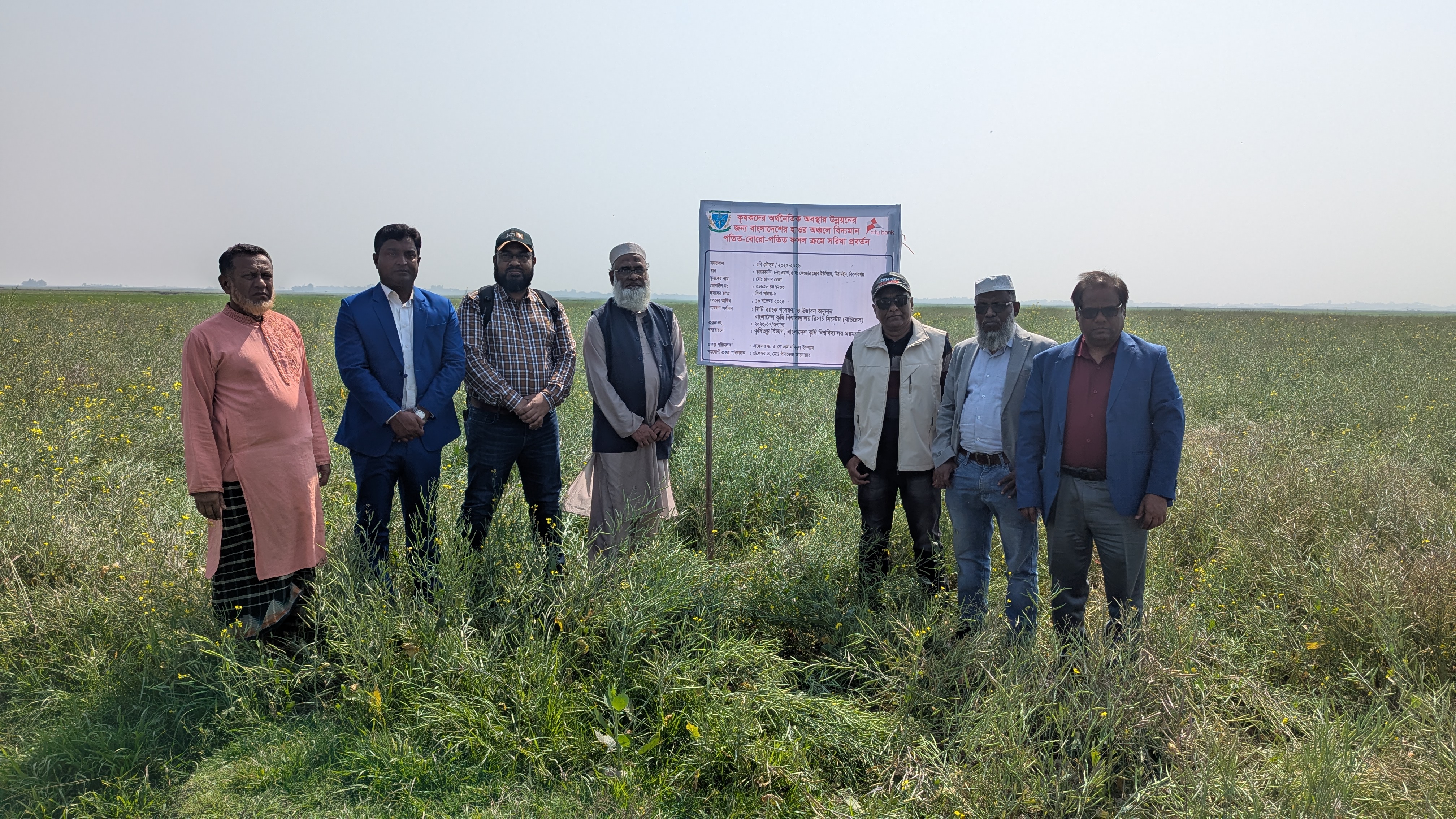
The findings were presented on Monday during a field day at Kurarkandi village under Keoarjor Union of Mithamoin upazila in Kishoreganj district. The event was led by the project's principal investigator, Professor Dr. AKM Mominul Islam of theDepartment of Agronomy while Prof Dr. Md. Parvez Anwar was present as a co-investigator.
The meeting was chaired by Prof Dr. Ahmad Khairul Hasan, head of the Department of Agronomy, and attended by BAU Research System (BAURES) Director Prof Dr. Md. Hammadur Rahman, Senior Scientific Officer Dr. Paresh Kumar Saha, local agriculture officials and farmers.
The research project titled "Introducing Mustard into the Fallow-Boro-Fallow Cropping Pattern in the Haor Region of Bangladesh for Improving Farmers' Economic Conditions", has been underway since 2023 in Mithamoin upazila. It is implemented under BAURES supervision with financial support from City Bank.
Researchers said that cold stress can cause spikelet sterility if Boro rice is transplanted early, while late transplanting increases exposure to flash floods. As a result, identifying safer alternative cropping systems has become essential.
Currently, nearly 40 percent of cultivated land in the haor follows a Fallow-Boro-Fallow pattern. Introducing mustard before Boro planting could ensure at least one harvest even if the rice crop is damaged.
During the first year of the study (2023-24), six short-duration mustard varieties developed by BAU, BARI, and BINA were tested across three sowing dates. BINA Sarisha-9 produced the highest yield when sown on November 20, followed closely by BARI Sarisha-17. The subsequent rice crop (BRRI dhan100) yielded an average of 6.2 tonnes per hectare.
In the second year (2024-25), BINA Sarisha-9 and BARI Sarisha-17 were evaluated under different seed and fertilizer rates. The highest yield was achieved with BINA Sarisha-9 using the recommended seed rate and full fertilizer application. The following hybrid Boro rice yielded an average of 6.4 tonnes per hectare, resulting in a total rice-equivalent yield of 10.1 tonnes per hectare.The third year of research (2025-26) is currently ongoing.
However, challenges remain, including unpredictable water recession, land suitability, and unexpected rainfall during sowing periods. Researchers recommend developing faster-maturing mustard varieties, promoting community-based farming, ensuring quality seed supply, and expanding farmer training programmes.
Local farmer Hasan Raja said mustard cultivation on elevated haor land has proven profitable. "After losses from maize, I switched to mustard and expect better returns. Others are now showing interest," he added.
Another farmer, Nazrul Islam, said growing mustard has benefited his household. "I use the oil for family consumption and feel healthier. Producing our own oil is a big advantage," he added.
Additional Upazila Agriculture Officer Mahabub Alam said the department is providing free seeds and fertilizers to encourage mustard cultivation, noting its health benefits, soil improvement qualities, and contribution to the national economy.
BAURES Director Prof Dr. Md. Hammadur Rahman said the haor region has changed significantly over the past 15 years. "Earlier, only rice was grown. Now maize and mustard are being introduced. Efficient land use brings better returns," he said, expressing hope that the research would help expand mustard cultivation beyond the haor region.