Sunday
23 August, 2026
News Flash
News Flash
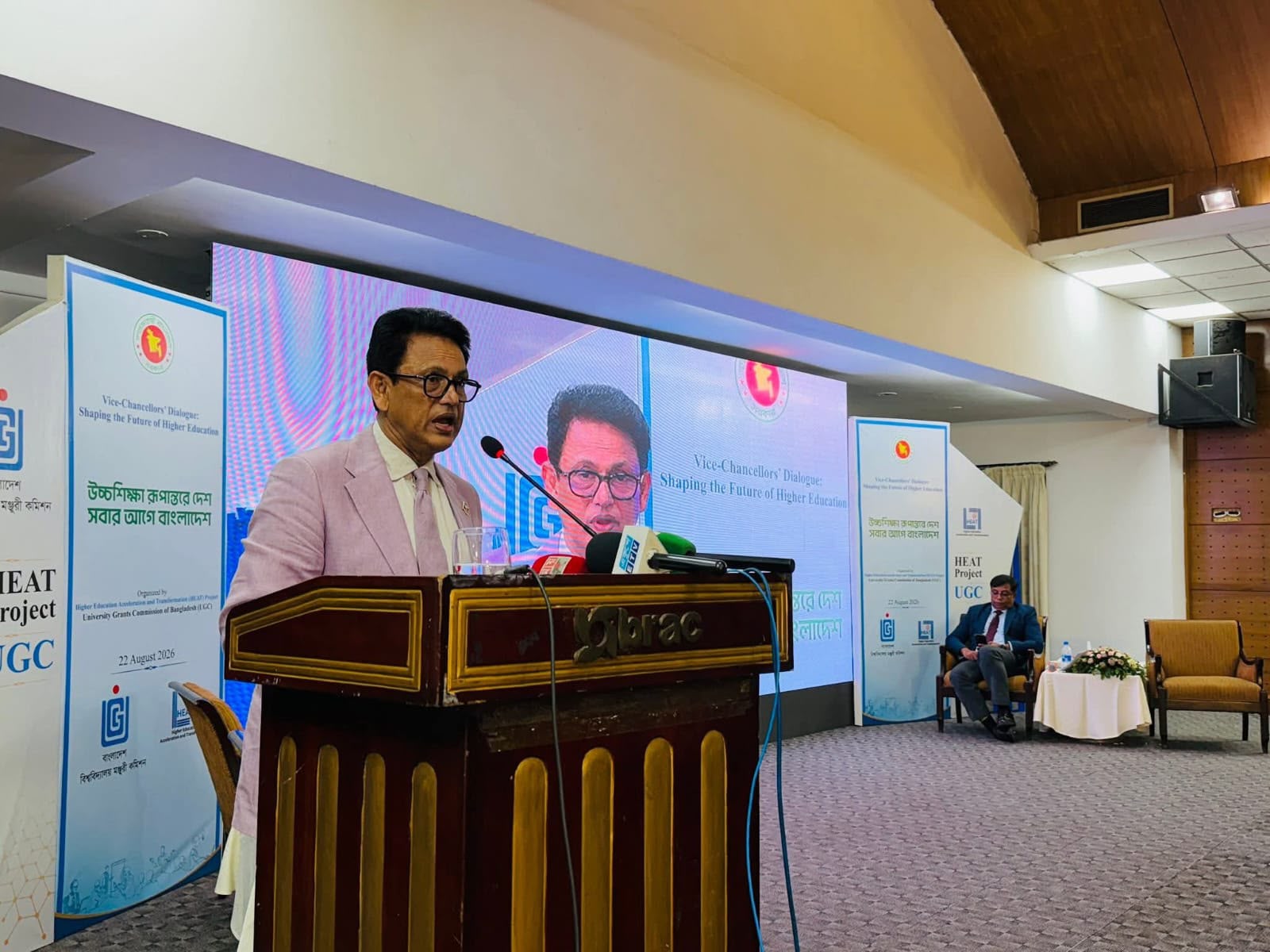
SAVAR, Aug 22, 2026 (BSS) - Education Minister Dr A N M Ehsanul Haque Milon today called for comprehensive reforms in the education system, including curriculum revision, quality research, internationalisation and stronger academic infrastructure, to make higher education responsive to changing global realities and job market needs.
"Fundamental changes are needed in our education system to keep pace with changes in technology, employment and society," he said.
The minister was speaking as the chief guest at the concluding session of the two-day 'Vice-Chancellors' Dialogue: Shaping the Future of Higher Education' at BRAC CDM in Savar, organised by the University Grants Commission (UGC) under the Higher Education Acceleration and Transformation (HEAT) Project.
Around 65 vice-chancellors of public and private universities, policymakers, academics and experts took part in the national policy dialogue.
Milon said Bangladesh should not focus merely on increasing the number of universities without ensuring the resources required to run them effectively.
"Establishing universities one after another will not ensure quality education. We must ensure adequate teachers, infrastructure, research facilities and logistical support," he said.
He also stressed that the academic programmes of new universities should be designed based on national priorities, regional needs and future employment prospects.
Emphasising research as a key pillar of higher education, the minister called for stronger accountability in research funding.
"Providing funds for research is not enough. We have to ensure how the money is being used and what the actual outcomes of the research are," he said.
He urged universities to create greater opportunities for teachers to participate in international conferences, seminars and research programmes, saying exposure to international academic and practical experiences could contribute to improving the quality of higher education.
"Doing a PhD through research and learning practically through work are two different worlds," he said.
The minister also called for strengthening the 'reverse brain drain' initiative to bring Bangladeshi academics and researchers working abroad back to the country and utilise their expertise in domestic universities and research institutions.
He said private universities should also be encouraged to conduct advanced research and offer PhD programmes according to their institutional capacity.
"PhD programmes cannot be limited to public universities. Private universities should also be involved," he said.
Milon further emphasised expanding cross-border education through partnerships between Bangladeshi universities and renowned foreign institutions.
He said opportunities should also be explored for foreign universities and educational institutions to operate in Bangladesh, enabling local students to receive international-standard education and research opportunities without going abroad.
On public examinations, the minister said the government was planning to complete the 2027 SSC examinations before the beginning of Ramadan to reduce students' academic delays.
He said the government also planned to expedite higher education admission procedures after the SSC examinations so that students could save valuable time.
The minister also announced plans for introducing a mechanism to assess examiners' competence to ensure greater consistency and fairness in evaluating examination scripts.
He said differences in examiners' marking standards could create disparities in students' results, making quality assessment of examiners necessary.
Regarding the UGC, Milon said the commission needed to expand and strengthen its role in ensuring quality higher education, research, curriculum development, teacher training and monitoring of universities.
He noted that the UGC, which started its journey in 1973 Act with four universities, now faces much broader responsibilities due to the expansion of the country's higher education sector.
Describing the dialogue as an opportunity for coordination and collective planning, he said, "This is not a picnic. It is like a workshop for you. If there is cohesion and coordination, we will understand where we are heading."
The minister said the government was working to identify and address problems in higher education and would take necessary measures after reviewing the recommendations and concerns raised by vice-chancellors.
At the concluding session, UGC Chairman Professor Dr Mamun Ahmed presented 'Transforming Higher Education in Bangladesh: A National Agenda for Sustainable Excellence (2026-2030)'.
He also announced plans to establish a 'Higher Education Academy' to provide institutionalised training for university teachers and develop academic leadership.
UGC Chairman Professor Dr Mamun Ahmed chaired the session, while UGC Member Professor Dr Abdullah Al Mamun moderated it. Former Dhaka University Pro-Vice Chancellor Z N Tahmida Begum was present.