Sunday
23 August, 2026
News Flash
News Flash
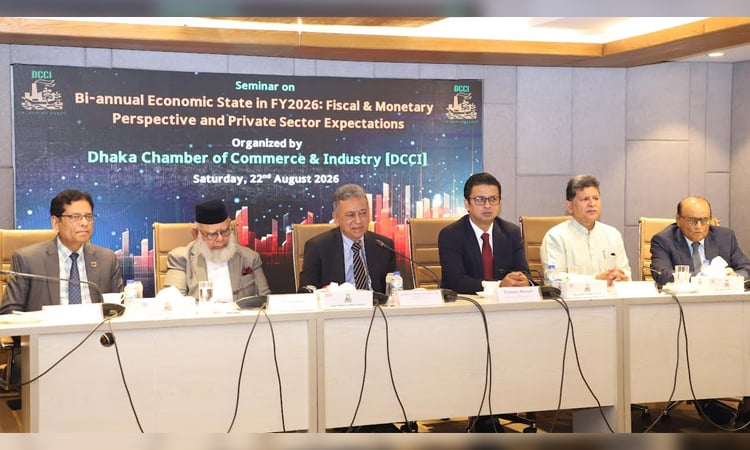
DHAKA, Aug 22, 2026 (BSS) - Economists, business leaders and policy experts
today called for coordinated fiscal and monetary reforms, stronger private-
sector confidence and a predictable business environment to revive investment
and economic growth in the country.
They made the call at a seminar titled "Biannual Economic State in FY2026:
Fiscal and Monetary Perspective and Private Sector Expectations", organised
by the Dhaka Chamber of Commerce and Industry (DCCI) at its auditorium in the
capital.
Finance Minister Amir Khosru Mahmud Chowdhury attended the seminar as the
chief guest while Executive Chairman of Power and Participation Research
Centre (PPRC) and Chairman of BRAC Dr Hossain Zillur Rahman, International
Chamber of Commerce (ICC) Bangladesh President Mahbubur Rahman, Policy
Research Institute of Bangladesh (PRI) Chairman Dr Zaidi Sattar and Centre
for Policy Dialogue (CPD) Distinguished Fellow Professor Mustafizur Rahman
were present as special guests.
Dr Hossain Zillur Rahman said the country's economy was at a critical
juncture and that taking the right decisions at this stage could help it
regain the desired momentum while failure to do so could push the economy
further behind.
He stressed the need to address structural problems in the financial sector
to reduce non-performing loans and ensure adequate credit for SMEs. He
proposed establishing an "Economic Reform Acceleration Unit" to monitor
implementation of the government's economic reform initiatives.
ICC Bangladesh President Mahbubur Rahman said inflation had not yet declined
to the desired level.
He stressed the importance of strengthening private-sector confidence,
capacity and competitiveness and ensuring a stable, predictable and
investment-friendly policy environment for sustainable and inclusive economic
growth.
Dr Zaidi Sattar said there was a significant gap between policy formulation
and implementation in Bangladesh, resulting in the country failing to derive
the desired benefits from policies.
He noted that while Bangladesh maintained relatively liberal policies for
export product and market diversification, its import policies remained
restrictive. High tariff rates, he said, contributed to higher domestic
inflation and increased prices of goods.
He also called for appropriate strategies to be formulated and implemented
within the available timeframe for Bangladesh's LDC graduation.
Professor Mustafizur Rahman said a "revolution" in tax collection was
essential for implementing the Annual Development Programme, while there was
little possibility of achieving the revenue collection target set in the
national budget.
He said although the budget contained several positive initiatives, these
were not adequately reflected in monetary policy, contributing to rising
inflation. He called for urgent monetary policy reforms and greater caution
in obtaining foreign loans and repaying existing debt.
BIDS Director General Dr A K Enamul Haque said prolonged high inflation was a
major concern for a remittance-dependent economy and that ensuring economic
stability would be challenging amid global uncertainty.
He stressed the need to increase liquidity in the banking sector and ensure
an overall business-friendly environment.
Transcom Limited Group CEO Simeen Rahman said business-friendly policies in
the national budget had yet to restore the desired momentum in the private
sector.
She said SMEs were among the worst affected and called for improving the
efficiency of ports, customs and logistics services.
Mutual Trust Bank Managing Director and CEO Syed Mahbubur Rahman stressed the
need for better coordination between monetary policy and the national budget,
digitalisation of tax administration and development of skilled human
resources.
In his keynote presentation, DCCI President Taskeen Ahmed said global
economic growth for 2026 has been projected at 3.1 percent, mainly due to
trade barriers, the Middle East crisis, supply-chain disruptions, rising
energy prices and a doubling of transportation costs.
He said these global challenges were contributing to a downward trend in
investment, business and trade activities.
Against this backdrop, he highlighted several reform measures incorporated
into the current fiscal year's budget, including completing company
registration within 48 hours through digitisation, extending bonded warehouse
facilities for the leather, footwear and home-textile sectors by three years,
providing duty-free benefits to 10 new sectors, expanding automation in tax
administration and expediting customs procedures.
He also stressed the need to accelerate the signing of preferential and free
trade agreements with promising export destinations as Bangladesh prepares
for LDC graduation.
He said Bangladesh needs to reduce its long-term dependence on the banking
system for financing by strengthening the capital market. He also called for
uninterrupted access to essential services in industrial zones to reduce
export lead times.
Taskeen proposed increasing cash flow through digital scoring instead of
conventional collateral-based lending and establishing special funds to help
businesses purchase affordable machinery and equipment.
In view of the energy crisis, he also proposed low-interest financing
facilities for small and marginal farmers to invest in solar-powered
irrigation systems. He suggested reviewing power purchase agreements to
reduce unnecessary subsidy burdens while ensuring stable and affordable
electricity prices for consumers in the long run.
During the open discussion, participants also called for recognising the real
estate sector as an industry, developing a national logistics authority,
expanding the tax net through greater use of AI, establishing cluster-based
special economic zones for SMEs and making adequate preparations for the
post-LDC graduation period.
DCCI Senior Vice President Razeev H Chowdhury, Vice President Md Salem
Sulaiman, members of its board of directors and representatives from the
public and private sectors were present in the seminar.